

In 1956, the Methodist Church made a decision that changed the visual landscape of American worship.
They voted to grant women full ordination rights as ministers.
That decision raised an immediate practical question that had never needed answering before: what would a female Methodist minister wear when she stood at the pulpit?
The black preaching robe had served male Protestant ministers since the sixteenth-century Reformation, when reformers adopted the black academic gown as a deliberate rejection of ornate Catholic vestments and a statement that the minister’s primary role was to preach the Word. But those robes had been designed for men, cut for men, and sold exclusively to men.
Black clergy robes for women did not exist as a commercial product category in 1956. They had to be invented, adapted, and eventually purpose-built, and the story of how that happened is the story of women’s ordination written in fabric.
What Was the State of Clergy Attire Before Women Were Widely Ordained?
Before the mid-twentieth century expansion of women’s ordination across mainline Protestant denominations, the question of black clergy robes for women simply did not arise in most church contexts.
The black pulpit robe, derived from the academic regalia worn at European universities, had been the standard preaching attire in Reformed and Protestant traditions since the 1500s. John Calvin and his contemporaries wore it to signal that the minister’s authority came from scholarship and Scripture rather than from the hierarchical vestment traditions of Rome.
This tradition passed through centuries of Protestant worship and eventually crossed the Atlantic, becoming the standard preaching attire across Baptist, Presbyterian, Methodist, Lutheran, and non-denominational Protestant churches throughout the United States.
Every assumption built into the design of those robes reflected a male wearer. The shoulder width, the chest measurement, the overall proportion, and the specific construction of the collar area all assumed a male body. Women in ministry who existed before formal ordination became widely available had no appropriate attire category to draw from.
What Did Early Female Ministers Wear?
Women who served in ministerial capacities before their denominations formally recognized women’s ordination typically adapted whatever was available. Some wore men’s robes in smaller sizes, producing garments that bunched at the shoulders and failed to fit properly across the chest. Others wore conservative professional dress that communicated ministerial seriousness without a robe at all.
Neither solution produced the kind of clear, recognizable ministerial visual identity that the black pulpit robe had always created for male ministers. The problem of modern female clergy attire was real, and it predated the commercial solutions that would eventually address it.
When Did Black Clergy Robes for Women Enter Ministry as a Recognized Category?
The 1950s and 1960s mark the turning point. As the Methodist Church voted in 1956 to ordain women, and as Presbyterian and Lutheran bodies followed with similar decisions through the following decade, newly credentialed female ministers needed appropriate pulpit attire that matched the dignity and visual weight of the black robes their male colleagues wore.
The initial solutions were practical compromises. Some female ministers adopted the traditional black pulpit robe in the closest available men’s size, accepting imperfect fit as the price of wearing the recognizable traditional garment. Others commissioned tailors to adapt the standard pattern for a female form, creating early versions of what would eventually become purpose-built female preaching robes for women.
The Fourth Lateran Council’s 1215 requirement that all Christian clergy wear distinctive, identifiable clothing had established the principle that ministerial dress matters. That principle now extended to women who held ordained ministerial offices, and the clothing needed to keep up.
How Did the 1970s Change the Market?
By the 1970s, women were graduating from seminary in significantly greater numbers across mainline Protestant denominations. That surge of female seminary graduates created both a commercial demand and a practical urgency for properly designed clergy robes for women.
Suppliers who had previously offered only men’s clerical garments began developing women’s lines. Early offerings were often modest adaptations of existing men’s patterns. Over time, genuinely women-specific designs emerged: ladies preaching robes cut with proper shoulder width for female frames, chest accommodation through bust darts, and hemlines calibrated for women’s height ranges rather than requiring universal alterations.
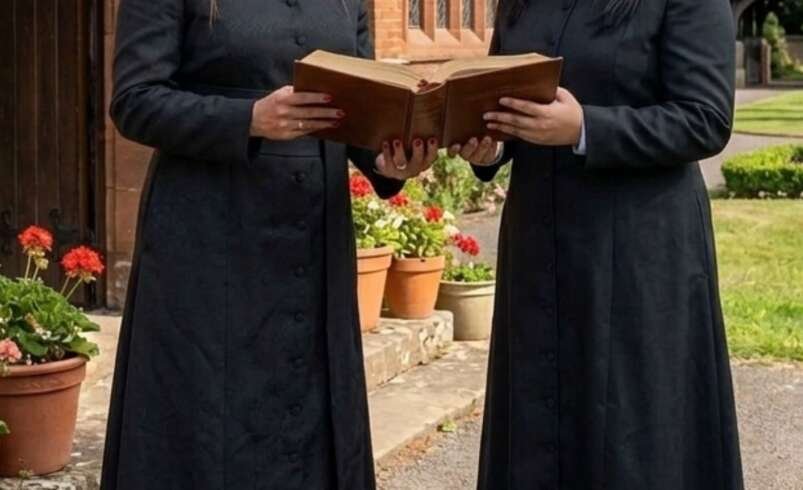
The black robe specifically dominated this development because black had been the preaching robe standard for Protestant ministers since the Reformation. Female ministers entering the pulpit wanted the same visual weight and traditional authority that the black robe communicated for their male counterparts. Women’s pastor robes in black allowed a newly ordained female minister to stand at the pulpit in a garment that said, visually and immediately: this person is a minister, in the same tradition and with the same authority as every minister who has stood at this pulpit before her.
Why Did Black Become the Dominant Color for Women’s Clergy Robes?
Black’s dominance in clergy robes for women did not happen by accident. It reflected a very specific set of reasons that made black the most practical and theologically appropriate choice for female ministers entering ordained ministry in the second half of the twentieth century.
Black communicates formality, gravity, and the weight of the ordained office across virtually every denomination and cultural context. It is the color with the widest acceptance across the most traditions. A female minister in a black robe signals ministerial authority in a way that is immediately legible to any Protestant congregation regardless of their specific tradition.
Female clergy robes in black also allowed newly ordained women to enter established ministerial visual traditions rather than appearing to create something new. The black robe was not a women’s invention. It was the Reformed tradition’s preaching robe, adopted by both men and women as they entered ordination together.
What Did Black Symbolize for Female Ministers Specifically?
For many of the women who first wore black clergy robes for women in the 1950s through 1970s, the color carried personal significance beyond its liturgical and traditional meaning.
Black was the color that said: this is serious. I have not dressed for attention. I am not here to make a fashion statement. I am here to preach, to lead, and to serve, in the same tradition and with the same seriousness that this office has always demanded.
The modern priest outfit equivalent for Protestant women entering ordained ministry was the black pulpit robe, and wearing it was an act of claiming belonging in a tradition that had not previously made space for them visually.
How Has the Design of Women’s Black Clergy Robes Evolved?
From the early adaptations of men’s patterns in the 1950s to the purpose-built, women-specific designs available today, clergy robes for ladies in black have undergone significant design evolution over seven decades.
Early women’s clergy robes were primarily adapted from men’s patterns, with modifications made to address the most obvious fit problems. The results were functional but rarely elegant. Women’s ministry attire was an afterthought in an industry that had always served male clergy.
By the 1980s and 1990s, dedicated women’s clergy clothing lines had developed among several specialist suppliers. These lines featured women-specific pattern development rather than male pattern adaptation. Bust darts, adjusted sleeve proportions, and properly set shoulder seams began appearing in commercially available female clergy robes.
What Does Modern Design Look Like?
Modern female clergy attire in black robes today reflects decades of refinement. Contemporary designs feature princess-line cuts that create a dignified silhouette for the female form, inverted back pleats that allow ease of movement without adding bulk, and collar areas specifically designed to display a clerical collar or tab correctly.
Fabrics have improved significantly as well. Modern poly-cotton blends resist wrinkles through long service, hold their color under bright sanctuary lighting, and launder easily through the frequent washing that regular wearing requires. These are practical improvements that serve working ministers in ways that earlier fabric choices did not.
Where Can Women Find Quality Black Clergy Robes Today?
The market for black clergy robes for women has expanded substantially since the early days of adapted men’s patterns. Specialist clergy clothing suppliers now offer dedicated women’s lines that cover a genuine range of sizes, including plus sizes and petite options that were simply unavailable in earlier decades.
Ladies preaching robes in black from quality suppliers come with detailed sizing guidance, ministry-specific design features like concealed pockets and microphone cord management, and fabric options suited to different climate and service demands.
Women pastor robes in black remain the most widely purchased category of female clergy attire across most Protestant denominations, reflecting both the continued relevance of the black preaching robe tradition and the growing number of women who need properly fitting ministerial garments to serve in it.
FAQ
Why don’t pastors wear robes anymore? Many modern evangelical and non-denominational pastors have moved toward casual attire to communicate approachability, though robes remain standard across liturgical, mainline Protestant, and many traditional church traditions.
What religion wears black robes?
Black robes are worn by Protestant ministers across Reformed, Presbyterian, Baptist, Methodist, Lutheran, and many other traditions, deriving from the academic gown adopted by Reformation-era preachers.
What does a black robe symbolize?
Black symbolizes formality, the gravity of the ordained office, and the Reformed preaching tradition’s emphasis on the minister’s role as proclaimer of the Word rather than liturgical celebrant.
When did churches start allowing women pastors?
The Methodist Church voted to grant women full ordination in 1956, followed by Presbyterian and Lutheran bodies in the 1960s and 1970s, with the Episcopal Church ordaining its first female priests in 1976.
Final Thoughts
Black clergy robes for women entered ministry attire as a direct consequence of women’s ordination, and their development as purpose-built garments tracks the history of women’s full participation in ordained ministry across Protestant denominations.
From the 1956 Methodist vote through the seminary surge of the 1970s and into the genuinely women-specific designs of the present day, female preaching robes in black have been the most consistent visual expression of women’s equal standing in the preaching office.
The black robe does the same work for a female minister today that it has done for Protestant male ministers since the sixteenth century. It says: this person is ordained. This person is here to preach. This is serious, sacred work being done with full authority and full commitment.
Whether you are searching for clergy robes for ladies for your first installation service, exploring modern female clergy attire options for a growing wardrobe, or simply understanding why black clergy robes for women look the way they do, the answer lies in a history of women claiming their place in a tradition that was always big enough to include them.