

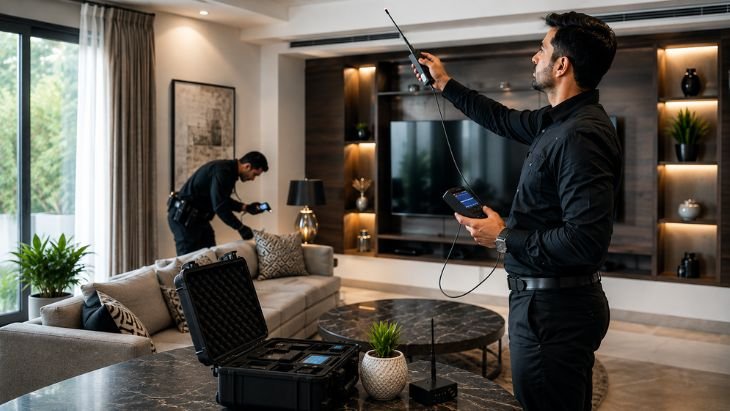

Mumbai’s fast-paced business environment often involves confidential meetings, financial discussions, client data, and sensitive corporate strategy. At the same time, modern workplaces rely on connected devices, wireless networks, smart meeting tools, and shared office infrastructure—factors that can increase privacy concerns if not managed carefully. Surveillance risks are not always obvious; unusual information leaks may have multiple causes, and technical threats can be difficult to confirm without expertise. TSCM (Technical Surveillance Countermeasures) offers a professional way to assess potential electronic surveillance risks—without assuming surveillance is present.
2. What Is TSCM Bug Sweeping?
TSCM is a structured security inspection focused on identifying and assessing potential technical surveillance risks in a given environment. People often use “bug sweeping” to mean looking for hidden devices, but a TSCM assessment is broader: it considers physical, electronic, and operational indicators that could suggest unauthorised monitoring or suspicious technical activity. TSCM inspections may be conducted in offices, boardrooms, conference rooms, residences, and vehicles—anywhere sensitive conversations or assets may be exposed. The goal is to produce factual findings and practical risk-reduction guidance, rather than speculation or fear-driven conclusions.
3. Common Surveillance Risks Businesses May Consider
Depending on the context, a business may want to evaluate risks such as unauthorised audio or video monitoring, hidden cameras, or suspicious recording devices placed in sensitive areas. Some organisations also review concerns around GPS tracking of company vehicles, unauthorised wireless transmission near meeting spaces, or compromised/unfamiliar electronic equipment introduced into controlled areas. Another red flag can be objects or devices added to boardrooms, cabins, or reception areas without clear authorisation or asset records. These risks are not “everywhere” by default; the likelihood depends on the sensitivity of information, the threat profile, access control practices, and the physical and technical environment.
4. How a TSCM Inspection Helps Identify Potential Risks
A professional TSCM inspection typically starts with an initial discussion to understand the client’s concerns, the sensitivity of discussions held on-site, and the layout and technology used in the space. The inspection may then include a physical examination of relevant areas (meeting rooms, executive cabins, reception zones, and adjacent spaces) to look for anomalies, undocumented modifications, or suspicious placements. A technical assessment can follow to check for indicators of potential electronic surveillance activity, including wireless/RF-related signals and other environmental anomalies—without treating every signal as evidence of a device. Where appropriate, unfamiliar or questionable equipment may be examined and documented. Findings are recorded clearly, and follow-up recommendations are provided to strengthen privacy and reduce exposure.
5. Why Mumbai Businesses May Consider TSCM Assessments
Organisations in Mumbai may consider TSCM assessments when board meetings involve sensitive decisions, when mergers, acquisitions, or investment discussions are underway, or when confidential client negotiations require higher privacy assurance. Executive offices and high-value commercial discussions can also justify periodic checks, particularly if there are concerns about information leaks or unusual changes in privacy conditions (new staff, office renovations, shared premises, or vendor access). Importantly, a risk assessment should be proportionate: the higher the value and sensitivity of the information, the more justified a structured privacy review becomes—without disrupting normal operations.
6. Choosing a Professional TSCM Provider
When selecting a TSCM provider, businesses should look for relevant technical and investigative experience, strong confidentiality practices, and a clearly defined inspection scope. The provider should use professional equipment and consistent methodology, and deliver proper documentation of observations and findings. It’s also important to avoid exaggerated guarantees or sensational claims—no ethical provider should promise to “detect everything” in every situation. Finally, the team should respect applicable laws, workplace policies, and privacy requirements, ensuring the inspection is conducted responsibly and with minimal operational disruption.
7. Spy Detective Agency’s Approach to TSCM in Mumbai
Spy Detective Agency is a private investigation agency in Mumbai providing TSCM and bug sweeping support in Mumbai for offices, meeting rooms, residences, and vehicles. Under Director Rohit Malik, with 18+ years of investigative experience, the focus remains on confidentiality, discreet handling, professional inspection methods, and structured reporting that supports informed decisions. Engagements are planned with a defined scope and practical outcomes, centred on identifying potential risks rather than making assumptions. Learn more about the service here: TSCM Bug Sweeping Services in Mumbai.
8. Conclusion — Identify Risks Before They Become Problems
TSCM is a proactive privacy and security measure that helps organisations understand their exposure to potential technical surveillance risks. Businesses don’t need to assume surveillance exists to take privacy seriously; a professional assessment can identify concerns, reduce uncertainty, and guide improvements in physical and technical controls. In a city where high-stakes decisions move quickly, protecting confidential information starts with knowing where vulnerabilities may exist—and addressing them before they become costly problems.