

Feeling fit is about much more than lifting heavy weights or completing a demanding workout. Real fitness shows up in everyday life. It is carrying groceries without struggling, climbing stairs without getting completely winded, getting up from a chair comfortably, reaching for something on a high shelf, or having enough energy to enjoy your weekend.
For people exploring resources such as Delta Fitness Authority or researching health-focused publishing platforms through write for us health, the most useful fitness guidance should focus on practical, sustainable habits rather than quick transformations.
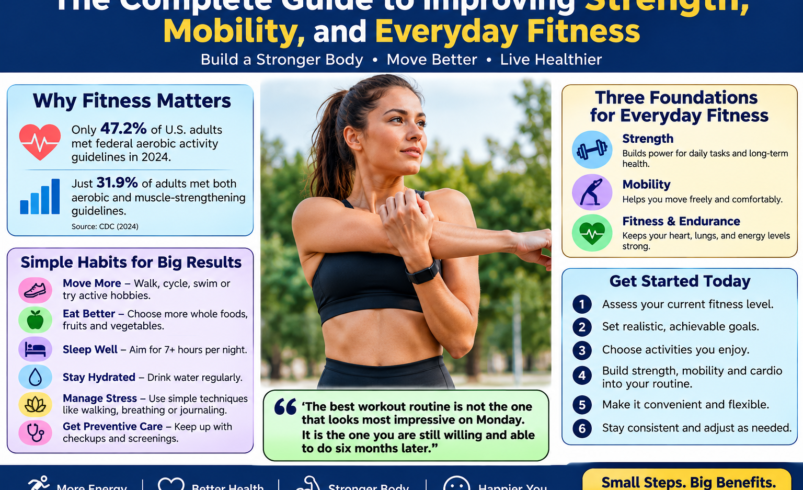
This is especially relevant in the United States. According to the CDC, only 47.2% of U.S. adults met the federal aerobic physical activity guidelines in 2024. The same data showed that just 31.9% met both aerobic and muscle-strengthening recommendations.
Those figures highlight an important point: fitness is not simply about becoming an athlete. It is about giving your body enough strength, movement, and endurance to handle everyday demands.
Fortunately, you do not need an extreme program to improve. A combination of progressive strength training, regular movement, mobility work, cardiovascular activity, recovery, and consistency can create a strong foundation.
Understanding the Three Foundations of Everyday Fitness
Before creating a routine, it helps to understand what you are actually trying to improve.
Strength
Strength is your ability to produce force. It helps with everyday tasks such as carrying bags, lifting objects, climbing stairs, and getting up from the floor.
Mobility
Mobility refers to your ability to move your joints through useful ranges of motion with control. Good mobility can make everyday movements feel easier and can help you perform exercises with better technique.
Fitness and Endurance
Cardiovascular fitness helps your body handle sustained physical activity. Walking, cycling, swimming, jogging, dancing, and similar activities can contribute to endurance.
These areas overlap.
A stronger person may find daily activities easier. Better mobility can make movement more comfortable. Improved cardiovascular fitness can make physical tasks less tiring.
Therefore, the best approach is not to focus on one quality while ignoring the others.
Start With Your Current Fitness Level
One of the biggest mistakes beginners make is copying someone else’s workout.
A professional athlete’s program is not automatically appropriate for a beginner. Likewise, a workout designed for someone who has trained for years may be excessive for someone returning after a long break.
Start by asking:
- How active am I right now?
- Can I comfortably walk for 20–30 minutes?
- Can I perform basic bodyweight movements?
- Do I have previous training experience?
- Do I have any injuries or movement limitations?
- How many days can I realistically train?
Your answers should determine where you begin.
If you currently do little physical activity, begin with manageable sessions and build gradually.
The federal Physical Activity Guidelines specifically encourage inactive adults to start with smaller amounts of activity and gradually increase frequency, intensity, and duration.
Do not train according to the fitness level you wish you had. Train according to the fitness level you have today, then build from there.
Build Strength With Fundamental Movements
You do not need dozens of exercises.
Instead, learn a few basic movement patterns and gradually improve them.
A well-rounded strength routine can include:
- Squat or sit-to-stand movements
- Hip hinges
- Push movements
- Pull movements
- Carrying movements
- Core exercises
For example, beginners might use:
Squat: Bodyweight squats or chair squats
Push: Wall push-ups or incline push-ups
Pull: Resistance-band rows
Hinge: Lightweight Romanian deadlifts or hip-hinge practice
Carry: Farmer carries with manageable weights
Core: Planks or controlled dead-bug variations
The exact exercises should match your ability and equipment.
Start with good technique rather than chasing heavy weights.
Follow Progressive Overload Carefully
Your body needs a reason to adapt.
Once an exercise becomes comfortable, you can gradually make it more challenging.
Progress may involve:
- Adding a small amount of resistance
- Increasing repetitions
- Adding a set
- Improving movement control
- Increasing the range of motion
- Reducing rest slightly
- Performing a more challenging variation
You do not need to increase everything simultaneously.
For example, if you can comfortably perform three sets of 10 bodyweight squats, you might first increase repetitions to 12. Later, you could introduce resistance.
This gradual approach is more sustainable than constantly pushing to exhaustion.
Train Your Major Muscle Groups
A balanced strength program should involve the major muscle groups rather than focusing only on visible muscles.
Your routine can include movements targeting:
- Legs
- Glutes
- Back
- Chest
- Shoulders
- Arms
- Core
Federal guidelines recommend adults perform muscle-strengthening activity involving all major muscle groups on at least two days each week.
You can accomplish this through free weights, resistance machines, bands, or bodyweight exercises.
Improve Mobility Through Regular Movement
Mobility does not need to become a separate one-hour workout.
You can integrate it into your day.
For example:
- Perform controlled shoulder movements after sitting at a desk.
- Practice gentle hip mobility before lower-body training.
- Move your ankles through comfortable ranges of motion.
- Perform controlled bodyweight squats.
- Include dynamic movements during your warm-up.
The key is consistency.
Five to ten minutes of appropriate movement performed regularly can be easier to maintain than an ambitious mobility routine completed once every two weeks.
Understand the Difference Between Mobility and Flexibility
The terms are often used interchangeably, but they are not identical.
Flexibility generally refers to the ability of muscles and other tissues to lengthen or allow movement.
Mobility involves your ability to actively control movement through a range of motion.
You can therefore be flexible without having excellent movement control.
A sustainable fitness program should develop both where appropriate.
Rather than forcing a joint into an uncomfortable position, focus on controlled movement and gradually improving your usable range.
If a movement causes sharp or persistent pain, stop and seek appropriate professional guidance.
Add Cardiovascular Training
Strength is important, but cardiovascular fitness deserves equal attention.
The CDC recommends that adults get at least 150 minutes of moderate-intensity physical activity each week, or 75 minutes of vigorous activity, along with muscle-strengthening activity on at least two days.
You can accumulate aerobic activity through:
- Brisk walking
- Cycling
- Swimming
- Jogging
- Dancing
- Hiking
- Recreational sports
- Cardio machines
You do not have to run if you dislike running.
The best cardio activity is one that fits your preferences, abilities, and lifestyle.
Use Walking as Your Fitness Foundation
Walking is often underestimated because it does not look complicated.
That is precisely why it can be useful.
Walking is accessible to many people, requires little equipment, and can be incorporated into daily routines.
You could:
- Walk after meals.
- Take a longer route home.
- Walk during phone calls.
- Park farther away when practical.
- Take short walking breaks.
- Explore local parks or neighborhoods.
For someone who currently spends most of the day sitting, increasing everyday walking can be a realistic first step toward becoming more active.
Create a Simple Weekly Training Schedule
You do not need to train seven days a week.
A beginner-friendly structure might look like this:
Monday — Full-Body Strength
30–45 minutes of basic resistance exercises.
Tuesday — Light Cardio
A brisk 20–30 minute walk or another enjoyable activity.
Wednesday — Recovery
Rest or gentle movement.
Thursday — Full-Body Strength
Repeat the main movement patterns with appropriate progression.
Friday — Cardio
Walking, cycling, swimming, or another activity.
Saturday — Active Recreation
Hiking, sports, dancing, or a longer walk.
Sunday — Rest
Allow your body to recover.
This is only an example. Your schedule should reflect your fitness level, goals, availability, and health needs.
Warm Up Before Challenging Exercise
A warm-up prepares you mentally and physically for a workout.
It does not need to be complicated.
A simple warm-up could include:
- Five minutes of easy walking or cycling.
- Gentle joint movements.
- Dynamic movements related to your workout.
- One or two lighter sets before heavier resistance work.
The goal is to gradually transition from rest to exercise.
Avoid turning your warm-up into another exhausting workout.
Do Not Neglect Recovery
Progress happens when training and recovery work together.
If you constantly push your body without enough recovery, your performance can suffer.
Recovery can include:
- Rest days
- Adequate sleep
- Balanced nutrition
- Hydration
- Managing training volume
- Light activity
- Taking breaks when necessary
Sleep deserves particular attention. CDC data found that 30.5% of U.S. adults reported sleeping less than seven hours on average in 2024. (cdc.gov)
If your sleep is consistently poor, simply adding more workouts may not solve the problem.
Your overall lifestyle matters.
Eat to Support Your Activity
You do not need a complicated “fitness diet.”
Instead, focus on a varied eating pattern that provides the nutrients your body needs.
Depending on your individual needs, meals can include:
- Vegetables
- Fruits
- Whole grains
- Beans and legumes
- Protein-rich foods
- Nuts and seeds
- Dairy or appropriate alternatives
- Healthy sources of fats
If your goal involves significant weight change, sports performance, or a specific nutritional requirement, consider working with a qualified healthcare professional or registered dietitian.
Avoid extreme dietary rules based solely on social media trends.
Learn to Recognize Good and Bad Fitness Advice
The internet is filled with fitness information.
Some of it is excellent.
Some of it is complete nonsense.
Be cautious when someone promises:
- Instant results
- Guaranteed fat loss
- A “secret” exercise
- Results without consistent effort
- A one-size-fits-all program
- Supplements that supposedly replace training or nutrition
Instead, look for information that explains limitations and references credible evidence.
The same E-E-A-T principles used when evaluating health content can help here.
Ask who created the content, what experience or qualifications they have, whether claims are supported by reliable evidence, and whether the advice is transparent about uncertainty.
Health-focused publishing resources such as Write For Us Health emphasize health, fitness, nutrition, and related subjects while highlighting the importance of quality and fact-checked content.
That is a useful standard for both writers and readers.
Measure Progress in Practical Ways
Your fitness progress should not depend entirely on your weight or appearance.
Track things that demonstrate improved capability.
For example:
- Can you lift more safely?
- Can you perform more repetitions?
- Can you walk farther?
- Can you climb stairs more comfortably?
- Can you move through a greater range of motion?
- Are everyday tasks easier?
- Are you more consistent with exercise?
These improvements matter.
A person who can comfortably carry groceries, climb several flights of stairs, and play with their children has achieved meaningful fitness—even if they do not look like a fitness model.
Avoid the All-or-Nothing Mentality
You will miss workouts.
You will have busy weeks.
You may travel.
You may get tired.
That is normal.
The mistake is believing that one missed workout means the entire routine has failed.
Instead, return at the next opportunity.
If you planned a 45-minute workout but only have 20 minutes, do 20 minutes.
If you cannot get to the gym, take a walk.
If your normal training feels too difficult one week, reduce the intensity.
Consistency does not mean doing everything perfectly. It means returning to your routine after life inevitably interrupts it.
A flexible routine is much more likely to survive real life.
Know When to Get Professional Guidance
General fitness advice cannot account for every individual.
If you have an injury, chronic health condition, significant pain, are pregnant or postpartum, or have other concerns that may affect exercise, consult an appropriate healthcare professional.
A qualified fitness professional can also help with technique, programming, and progression when needed.
Stop exercising and seek appropriate medical attention if you experience concerning symptoms such as severe chest pain, fainting, severe shortness of breath, or other unusual symptoms during physical activity.
Do not confuse discomfort from challenging exercise with pain that may indicate injury.
Make Fitness Part of Everyday Life
The strongest fitness routine is not necessarily the one performed inside a gym.
Fitness can become part of your lifestyle.
Walk when practical.
Carry your own groceries.
Take the stairs.
Play with your children.
Go hiking on weekends.
Cycle to nearby destinations when appropriate.
Join recreational sports.
Take movement breaks during long work sessions.
These activities may seem small individually, but together they create a more active lifestyle.
A Practical Four-Week Starting Plan
If you are starting from a relatively inactive lifestyle, keep the first month simple.
Week 1
Focus on consistency.
- Two short strength sessions
- Three easy walks
- Daily movement breaks
Week 2
Increase slightly.
- Two strength sessions
- Three moderate walks
- One longer recreational activity
Week 3
Add controlled progression.
- Increase resistance or repetitions slightly
- Continue regular walking
- Maintain recovery days
Week 4
Review your progress.
Ask:
- What activities did I enjoy?
- What was difficult to maintain?
- Which exercises felt comfortable?
- Where can I improve?
- What schedule fits my lifestyle?
Then adjust the next month accordingly.
Final Thoughts
Improving strength, mobility, and everyday fitness does not require an extreme lifestyle.
It requires a sensible starting point, consistent movement, progressive resistance training, cardiovascular activity, mobility work, good recovery, and patience.
The CDC’s 2024 data show that only 31.9% of U.S. adults met both aerobic and muscle-strengthening guidelines. That means there is plenty of room for improvement—and you do not need to become an elite athlete to benefit.
Start where you are.
Learn the basic movements.
Train your major muscle groups.
Walk regularly.
Work on mobility.
Recover properly.
Then gradually make your routine more challenging.
Most importantly, make it fit your life.
Fitness should help you live better, not take over your life.
FAQs
- How often should I strength train?
For general health, U.S. federal guidelines recommend muscle-strengthening activities involving all major muscle groups on at least two days per week. Beginners can often start with two full-body sessions and gradually adjust their routine.
- Can walking improve overall fitness?
Yes. Walking can contribute to cardiovascular activity and can be an accessible way to become more active. Brisk walking can count as moderate-intensity aerobic activity for many adults. However, a well-rounded fitness routine should also include muscle-strengthening activities.
- How can I improve mobility at home?
Start with controlled movements that match your ability. Gentle joint movements, dynamic warm-ups, controlled squats, hip movements, and shoulder mobility exercises can be incorporated into a daily routine. Avoid forcing painful ranges of motion.
- Do I need gym equipment to become stronger?
No. Bodyweight exercises, resistance bands, and household movement patterns can provide useful resistance, particularly for beginners. As you become stronger, you may choose to add dumbbells, machines, or other equipment.
- How long does it take to improve strength and fitness?
Progress varies based on your starting point, training consistency, recovery, nutrition, age, and individual circumstances. Some people notice improvements in coordination and exercise tolerance relatively quickly, while substantial changes in strength and endurance require consistent training over time.