

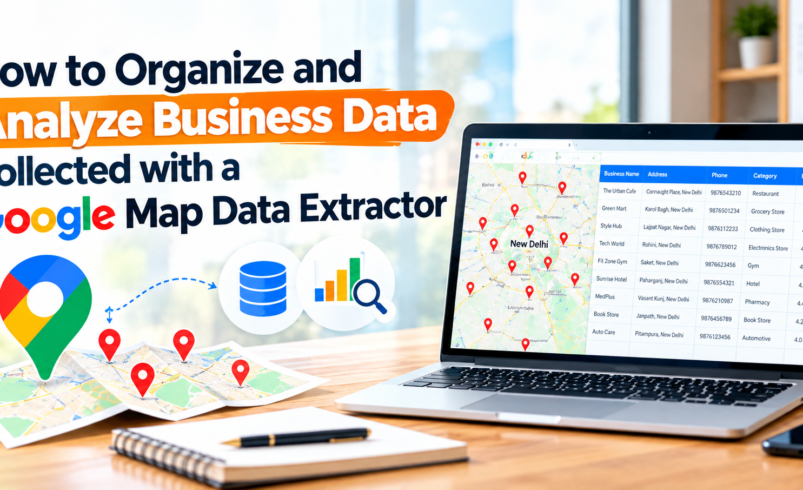

What if you could turn scattered business information into a clear, organized resource for your sales and marketing team? That is the main reason businesses explore Google Map Data Extractor Software. Instead of spending hours manually searching for business details, a properly configured Google Data Extractor can help collect available information and arrange it for further research. With Google Data Extractor Software, businesses can save time on repetitive data collection and focus more on understanding their market, identifying relevant businesses, and planning outreach. However, collecting data is only the first step. The real value comes from cleaning, organizing, verifying, and analyzing that information responsibly.
The Importance of Organizing Your Business Data
More data is not necessarily better for your results. If your data has duplicates, missing values, is inconsistently formatted, or includes outdated information, your employees will spend unnecessary time working with this unreliable data.
Organized data gives your team a better understanding of what information they have. The data becomes more convenient to search through, compare, filter, edit, and prioritize.
That is why companies using a Google Maps Data Extractor should go further than information collection. An effective strategy must include all stages from data collection to analysis.
Start With Planning Your Data Structure
Before analyzing your data, determine what structure your records need. Establishing consistent structure greatly simplifies the process of researching in the future.
Depending on your legitimate business purpose, useful fields may include the following: business name, business category, location, website, public contact information of the business, source, verification, and collection date.
Do not put different kinds of information into one field. Divide every kind of information into a separate field for convenience of sorting and filtering the dataset. A Google Maps Business Data Extractor will help you to collect information more quickly, but a good database will dictate its usability later.
Prepare the Data for Your Needs
The data cleaning step is crucial to consider when working with unprepared data records. Raw data may have duplications and lack important information to influence the analysis. It is necessary to detect duplicates and unnecessary information, and standardize formats as much as possible, especially phone numbers, addresses, and categories of businesses.
Moreover, one should identify the absence of information instead of making assumptions and mark records that require further verification.
Divide Information Into Meaningful Segments
After having cleaned the information, segmentation will help your team interpret it better. Using the Google Maps Lead Finder tool, it is possible to conduct research by organizing information about businesses in accordance with the set criteria. After collecting the data, one may divide it into groups depending on location, type of business, market segment, verification status, or sales priority.
Thus, it becomes easy to analyze large sets of data. It is not necessary to look through hundreds or even thousands of pieces of information; your team may work with smaller groups and see the connections between data pieces. Segmentation is also helpful for marketing campaigns.
Look for Patterns in the Data
While a Google Maps Information Scraper might allow you access to a structured set of business information, just having this information stored somewhere doesn’t really add value to your strategy. It is important to ask some key questions concerning your data set. Analyze:
- What are the most saturated locations by your business?
- What are the most common business categories?
- How complete is your gathered information?
- How many entries have to be checked?
- Which segments are the most valuable to your business?
- Where do you lack market research data?
Such questions will allow you to turn raw data into actionable insights.
Verification of Data for Better Quality
The information available online can change. The website can change its content, its contact information can change, and it may move or close down. Businesses utilizing the Google Business Lead Extractor tool should have a mechanism for verifying their important records prior to any business decision-making. Adding a “verified on” field to your entries could be a very useful thing to do for your team to know the age of the information. It is important to distinguish between verified data and unverified data too.
Know the Boundaries of Scraping Software
“Google Maps Scraper Tool,” “Google Maps Data Scraper,” and “Google My Business Scraper” are terms that describe various third-party scraping software. Their abilities and data sources may differ. More importantly, technical ability does not imply that all kinds of extraction, copying, storage, and usage are permitted.
Therefore, business owners need to consider current platform agreements and privacy laws when planning an extraction process.
Connecting Data to Sales Process
After organizing the database, connect your data to your business workflow. The Google Maps Lead Generator may become an additional tool in prospect research, while the B2B Lead Finder Tool may be used by teams to search for possible businesses using certain criteria. The crucial step here is what is done after data extraction.
Set up lead statuses like “research pending,” “verified,” “qualified,” “contacted,” or “not relevant.” When using a CRM, make sure that you keep your records consistent to avoid unnecessary contacts from different employees. In this way, the lead generation from Google Maps becomes much easier to track.
Make Regular Analysis Part of Your Routine
Data that is collected for a business purpose must never be left unattended. Markets are evolving, and businesses may open and close, and data becomes outdated. Set up regular review of your database. Delete old data, correct it when necessary, and analyze the usefulness of various parts of the data.
Businesses seeking to explore Google Maps Leads Finder solutions must concentrate on data quality rather than the size of a database. In many cases, the latter becomes much less important than the former.
Conclusion
Use of a Google Maps Lead Extraction Tool will help you save time on repetitive research; however, technology is not an end per se in generating valuable business intelligence. The most efficient results can only be achieved by collecting data systematically and cleaning, verifying, segmenting, analyzing, and managing data. No matter whether you use Google Maps Review Scraper or some other Lead Generation Software for Google Maps, make sure you think about the source, accuracy, allowed use, and privacy requirements of the data you work with. If done right, Google Data Extractor Software will become an integral part of an effective research and prospecting routine.