

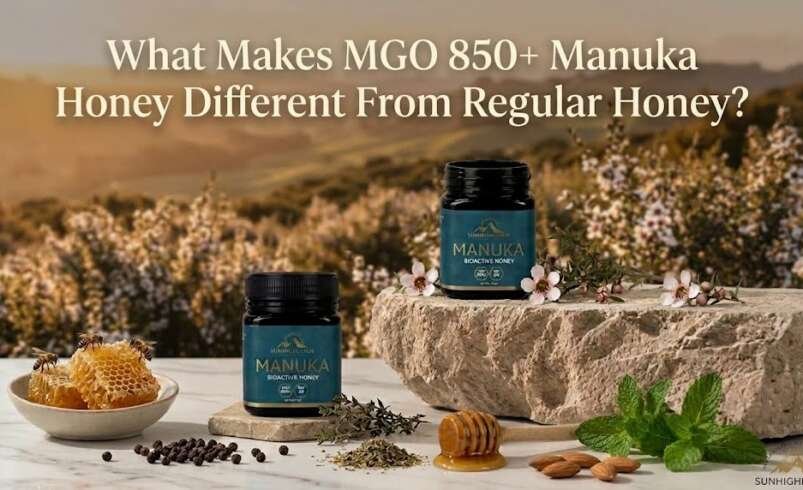

Honey is a natural food enjoyed in homes across Australia, but not every type of honey is the same. While regular honey is commonly used as a sweetener for breakfast, drinks and cooking, Manuka Honey MGO 850+ belongs to a more specialised category known for its measurable methylglyoxal (MGO) content.
For Australian consumers, understanding the difference between regular honey and MGO 850+ Manuka honey can make it easier to decide what type of honey suits their preferences, lifestyle and budget.
The differences begin with the flowers visited by bees and continue through harvesting, testing, grading and labelling. So, what exactly makes Australian Manuka Honey MGO 850+ different?
What Is Regular Honey?
Regular honey is produced by honey bees from the nectar of flowering plants. Depending on where the bees forage, the honey may come from eucalyptus, clover, wildflowers, citrus blossoms or many other floral sources.
These different floral sources can affect a honey’s colour, flavour, aroma and texture. Some varieties are light and mild, while others are darker and more robust.
Regular honey is generally purchased as a natural sweetener or food ingredient. It can be used in:
- Tea and coffee
- Toast
- Porridge
- Baking
- Sauces and dressings
- Desserts
- Smoothies
The characteristics of regular honey depend largely on its botanical source, harvesting conditions and processing.
What Is Australian Manuka Honey?
Australian Manuka honey is produced by bees collecting nectar from plants in the Leptospermum genus.
According to the Australian Manuka Honey Association (AMHA), Australia has more than 80 native Leptospermum species growing in different environments across the country, from coastal areas to mountainous regions. This diversity provides a distinctive botanical foundation for Australian Manuka honey.
Australian Manuka honey can be monofloral or multifloral, depending on the floral sources visited by the bees. The AMHA’s criteria describe pure monofloral Manuka honey as having at least 50% of its nectar derived from one floral source.
This specialised floral origin is one of the primary differences between Manuka honey and ordinary honey.
What Does MGO Mean?
The biggest difference consumers notice when comparing Manuka Honey MGO 850+ with regular honey is the MGO rating.
MGO stands for methylglyoxal, a naturally occurring compound found in Manuka honey. MGO develops from another naturally occurring compound, dihydroxyacetone (DHA), which occurs in the nectar of some Leptospermum flowers.
The amount of MGO can be measured in a laboratory, allowing Manuka honey to be described using a specific numerical rating.
The AMHA identifies MGO as the central measurement in its Australian Manuka honey rating system and notes that it can be measured directly through laboratory testing.
Regular honey is not generally sold using this type of MGO grading system.
What Does MGO 850+ Mean?
An MGO 850+ label indicates a high concentration of methylglyoxal represented by that rating.
For shoppers, the key advantage is that MGO provides a measurable reference point. Instead of choosing a honey simply because the label says “premium” or “strong,” consumers can look at the stated MGO level.
It is important to understand that MGO is a measurement of a specific naturally occurring compound. It is not a medical dosage, and the MGO number alone should not be interpreted as a guarantee of a particular health result.
The Sunhighlands MGO 850+ page describes its product as a high-strength Australian Manuka honey and states that batches undergo laboratory testing to verify MGO 850+ strength and product quality.
MGO 850+ vs Regular Honey: Key Differences
Several factors distinguish MGO 850+ Manuka honey from conventional honey.
| Feature | Regular Honey | Manuka Honey MGO 850+ |
|---|---|---|
| Floral source | Can come from many plants | Associated with Leptospermum species |
| MGO rating | Usually not a defining grade | Clearly stated MGO concentration |
| Grading | Often based on floral source and product characteristics | MGO provides a measurable Manuka characteristic |
| Testing | Varies by product | High-MGO products may undergo specific laboratory testing |
| Flavour | Varies widely | Often distinctive and robust |
| Market position | Everyday honey | Premium/speciality honey |
The difference is therefore not simply about taste or packaging. MGO 850+ Manuka honey is a specialised product defined partly by its measurable chemical profile.
Why Is MGO Important?
MGO is significant because it gives consumers a measurable way to understand one of the characteristic compounds associated with Manuka honey.
The AMHA explains that MGO is directly measurable through HPLC testing and is used as a key indicator in its Australian Manuka honey quality framework.
This testing also plays a role in authenticity and quality assurance. The AMHA says traceability through the supply chain, together with independent laboratory testing, helps verify the MGO level stated on the label.
For consumers purchasing a high-MGO honey, this can be particularly useful because the product carries a defined numerical characteristic.
Australian Origin Adds Another Difference
The source of the honey matters.
Australia’s diverse Leptospermum population means that Australian Manuka honey comes from a broad range of native plants and growing environments.
The AMHA has developed criteria specifically intended to identify and authenticate Australian Manuka honey. Its Mark of Authenticity requires qualifying honey to be produced in Australia and tested by an independent approved laboratory against specified MGO and DHA requirements.
For Australians who specifically want locally sourced Manuka honey, checking country-of-origin information and authenticity credentials is therefore an important part of choosing a product.
Independent Testing Matters
One of the practical differences between a high-grade Manuka honey and a general honey product is the attention given to testing.
The AMHA states that its members maintain Certificates of Analysis from independent third-party laboratories for batches of Manuka honey and that batch records are used to support traceability from the retail shelf back to the apiary.
Sunhighlands states that each batch of its MGO 850+ honey is tested in accredited Australian laboratories to verify its MGO rating, purity, safety and consistency.
Independent testing does not change the honey itself, but it gives consumers useful information about whether the stated MGO level has been measured and verified.
Does MGO 850+ Taste Different?
Taste is another noticeable difference.
Regular honey can range from very mild and floral to rich and dark depending on its botanical source. Manuka honey often has a more distinctive flavour profile.
High-MGO Manuka honey may have a rich, robust, earthy or caramel-like character. However, flavour can vary naturally between harvests, floral sources and regions.
Sunhighlands describes its MGO 850+ honey as having a rich, complex flavour profile and promotes it for direct consumption, beverages and culinary applications.
This makes MGO 850+ appealing to consumers who enjoy honey as more than just a basic sweetener.
How Can You Use MGO 850+ Manuka Honey?
Despite its premium positioning, Manuka Honey MGO 850+ can be used in many of the same ways as ordinary honey.
Breakfast
Add it to:
- Porridge
- Greek yoghurt
- Toast
- Cereal
- Fresh fruit
- Smoothie bowls
A small amount can add sweetness while allowing the distinctive flavour of Manuka honey to come through.
Beverages
MGO 850+ can also be stirred into tea, warm water or smoothies.
Sunhighlands specifically lists beverages, tea, coffee and other everyday food and drink applications for its MGO 850+ honey.
Many consumers prefer to add premium Manuka honey to warm rather than boiling drinks.
Cooking and Baking
Manuka honey can be incorporated into recipes that call for honey, including dressings, marinades, homemade granola and desserts.
However, because MGO 850+ is a premium product, some consumers prefer using it in recipes where its flavour can be appreciated rather than using it solely as a cooking sweetener.
Does Higher MGO Automatically Mean Better Honey?
A higher MGO rating means a higher measured concentration of methylglyoxal. It does not automatically mean that one product is universally “better” for every consumer.
Regular honey may be perfectly suitable for people who simply want an everyday sweetener. MGO 850+ is more relevant to consumers who specifically want a high-MGO Manuka product.
Your choice may depend on:
- Intended use
- Flavour preference
- Budget
- Australian origin
- MGO rating
- Testing information
- Product authenticity
The right product is therefore a matter of matching the honey to what you actually want from it.
MGO 850+ Is Not Just About the Number
When buying premium Manuka honey, it is easy to focus entirely on the MGO figure. But quality involves more than one measurement.
The AMHA’s framework considers the importance of traceability, independent testing and the botanical identity of Australian Manuka honey.
The association also notes that authentic Australian Manuka honey can be identified through naturally occurring chemical markers associated with Leptospermum honey.
For consumers, this means an MGO number should be considered alongside origin and authenticity information.
Why Is MGO 850+ Considered a Premium Honey?
Several factors contribute to the premium positioning of MGO 850+ Manuka honey.
First, it comes from a specialised floral source associated with Leptospermum plants. Second, the product is marketed according to a defined MGO measurement. Third, high-MGO products may involve additional laboratory testing, batch management and traceability.
Sunhighlands states that its MGO 850+ honey is sourced from remote coastal and forest regions of North East New South Wales, is independently laboratory tested, and is cold extracted without excessive heating or filtration.
These are specific claims made by the producer, so consumers should always check the current product packaging and available batch information when purchasing.
A Note About Health Claims
Manuka honey is often discussed in connection with antimicrobial activity and wellness. The AMHA identifies MGO as a compound associated with the characteristic activity of Manuka honey.
However, consumers should distinguish between a food’s naturally occurring properties and claims about treating or preventing a medical condition.
MGO 850+ should not be treated as a prescription or medical dose. People with specific health or dietary concerns should seek appropriate professional advice rather than relying on product marketing.
Which Should You Choose: Regular Honey or MGO 850+?
The answer depends on what you are looking for.
Regular honey can be an affordable and versatile option for everyday use, particularly for baking, cooking and sweetening drinks.
MGO 850+ Manuka honey, on the other hand, is suited to consumers who specifically value Australian Manuka honey, a high measured MGO concentration and product testing or authenticity information.
The two products serve overlapping but different roles in the pantry.
Rather than thinking of one as replacing the other, consider them as different categories of honey with different characteristics and price points.
Final Thoughts
So, what makes MGO 850+ Manuka Honey different from regular honey?
The answer comes down to several connected factors: floral source, MGO concentration, Australian origin, testing, traceability and flavour.
Regular honey can come from many floral sources and is primarily enjoyed as a general sweetener and food ingredient. Australian Manuka honey comes from Leptospermum plants and has distinctive naturally occurring chemical characteristics. An MGO 850+ rating provides a measurable indication of the concentration of methylglyoxal in the product.
For consumers, the biggest practical difference is that MGO 850+ offers a clearly defined high-MGO category backed by testing information, while regular honey typically does not use MGO as its primary grading measure.
Whether you enjoy it on toast, stirred into a warm drink, added to yoghurt or used in a recipe, Australian Manuka Honey MGO 850+ offers a distinctive option for those looking beyond conventional honey.
When choosing a jar, look beyond the front label. Check the MGO rating, Australian origin, independent testing, authenticity information and product details. These factors provide a more complete picture of the honey and help you make an informed purchasing decision.