

Introduction: Your Child’s Safety Starts Before You Turn the Key
Every parent knows the feeling, you buckle your little one in, double-check the straps, and still wonder: Is this seat truly protecting them?
Choosing the right child car seat is one of the most important decisions you’ll make as a parent. Yet with dozens of options on the market, confusing safety ratings, and UAE-specific rules to follow, it can feel completely overwhelming.
This guide cuts through the noise. Whether you’re a first-time parent shopping for a newborn or upgrading from an infant carrier to a toddler seat, you’ll find clear answers, honest recommendations, and practical advice tailored for families living in the UAE in 2026.
Here’s what we’ll cover: the safest seat categories, current child car seat laws in the UAE, how to install your seat correctly, when kids can face forward, and five standout picks worth your money.
Understanding Child Car Seat Categories
Before you buy car seats online or walk into a store, it helps to understand how seats are classified. Car seats fall into groups based on your child’s weight and age, and getting the right group matters enormously for safety.
Group 0 and 0+, Newborns to 13 kg
These are rear-facing infant carriers designed for babies from birth up to roughly 12–15 months. Rear-facing is always the safest position for young children because it distributes crash force across the entire back, neck, and head.
Group 1, 9 kg to 18 kg (Approximately 9 Months to 4 Years)
These seats can face forward or remain rear-facing. Many modern seats in this category are convertible, giving you extra mileage as your child grows.
Group 2 and 3, 15 kg to 36 kg (Approximately 3.5 Years to 12 Years)
High-back boosters and booster cushions fall here. These use the car’s own seatbelt but position it correctly across a child’s body.
What Is a 360 Car Seat?
A 360 car seat rotates fully, allowing you to switch between rear-facing and forward-facing positions with ease. This is a popular choice for UAE parents because loading and unloading children, especially in extreme summer heat, becomes much faster and less physically demanding. Many 360 seats also include an isofix car seat base for secure, click-in installation.
Child Car Seat Laws in the UAE, What Every Parent Must Know in 2026
Understanding child car seat laws in the UAE is not optional, it’s a legal requirement with real consequences for non-compliance.
Under UAE federal traffic law, children under 145 cm in height must be secured in an approved child restraint system. The law applies across all emirates including Dubai, Abu Dhabi, and Sharjah. Fines for non-compliance can reach AED 400 or more, and more importantly, an unsecured child in an accident faces life-threatening risk.
Child Age in Front Seat of Car, UAE Rules
A common question parents ask is: at what child age can they sit in the front seat of a car? In the UAE, children under 145 cm must not sit in the front passenger seat unless the vehicle has no rear seating. Even then, the airbag must be disabled. The safest place for any child under 12 is always the back seat.
Do Taxis at Dubai Airport Have Child Car Seats?
This is one of the most frequently searched questions by travelling families: do taxis at Dubai Airport have child car seats? Standard Dubai taxis and ride-hailing services like Careem and Uber do not routinely carry child seats. It is your responsibility to bring your own, rent one, or book a specialist family taxi service in advance. If you’re arriving with a young child, plan ahead, do not assume a seat will be provided.
Are Child Car Seats Required on Airplanes?
Child car seats on airplanes are not universally required, but they are permitted on most airlines if the seat is FAA or ECE R44/R129 approved. Using an approved seat on a plane provides significantly better protection during turbulence than a lap belt alone. Check with your airline before travel, as policies vary.
How to Fix a Child Seat in a Car, Installation Done Right
Even the best-rated child car seat becomes dangerous if it’s incorrectly installed. Studies consistently show that a large percentage of car seats on the road are installed improperly.
Using an ISOFIX Car Seat Base
An isofix car seat base connects directly to anchor points built into your car’s frame, bypassing the seatbelt entirely. This eliminates most common installation errors. Look for the ISOFIX anchors in the crease between your rear seat cushion and backrest. Most UAE vehicles manufactured after 2004 have them.
Steps for a secure ISOFIX installation:
- Remove the seat cushion cover if needed to locate the metal anchor points
- Align the ISOFIX connectors on the base with the car’s anchor points
- Push firmly until you hear and feel a click from both sides
- Check the indicator, most modern bases have a green/red visual guide
- Tug the base sharply to confirm it doesn’t move more than 2.5 cm in any direction
Installing with a Seatbelt
If your vehicle doesn’t have ISOFIX, use the vehicle’s lap-and-shoulder belt. Thread it through the correct belt path marked on the seat (always check the manual, routing varies by seat and direction). Tighten until the seat moves less than 2.5 cm side to side at the belt path.
When Can a Child Face Forward in a Car Seat?
The question “when can a child face forward in a car seat?” comes up constantly, and the answer may surprise many parents.
Pediatric safety organisations recommend keeping children rear-facing for as long as the seat’s weight and height limits allow, typically until age 2 to 4. Rear-facing seats absorb and distribute crash energy far more effectively for young children whose neck muscles and spinal structures are still developing.
The rule of thumb: don’t rush to turn the seat around just because your child looks big. Check the manufacturer’s rear-facing weight limit first. Many modern convertible seats allow rear-facing up to 18–25 kg, well beyond what most parents assume.
How Long Should a Child Be in a Car Seat?
How long should a child be in a car seat? The straightforward answer is: until they outgrow the booster stage entirely, which is typically when they reach 145 cm in height or around age 10–12, whichever comes later.
Here’s a practical progression for UAE parents:
- Birth to ~15 months: Rear-facing infant carrier or convertible seat, rear-facing
- 15 months to ~4 years: Convertible or combination seat, ideally still rear-facing if possible
- 4 years to ~8 years: Forward-facing seat with harness
- 8 years to ~12 years: High-back booster with vehicle seatbelt
- 12+ years or 145 cm+: Standard vehicle seatbelt
Don’t skip stages. Each transition point exists because a child’s body has specific protection needs at different sizes.
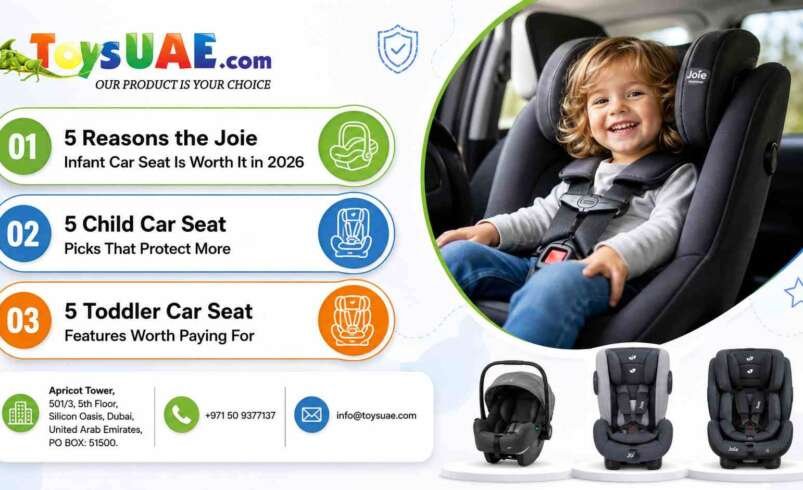
5 Child Car Seat Picks That Protect More
Here are five categories of seats worth considering for UAE families in 2026, based on safety credentials, convenience features, and suitability for the region’s climate and vehicle types.
1. The Best Overall: A Convertible Rear-to-Forward Seat
A high-quality convertible seat that grows from Group 0+ through Group 1 gives you years of use and eliminates the need to buy a separate infant carrier. Look for extended rear-facing capability up to 18 kg, a no-rethread harness, and ventilated padding, the last point matters enormously in UAE summers.
2. The Most Convenient: A 360-Degree Rotating Seat with ISOFIX
For parents who park in tight spaces or load children into SUVs, a 360 car seat with an ISOFIX base is genuinely life-changing. Rotate the seat toward the door, buckle your child in the shade, then rotate back. Brands offering this design have seen enormous uptake among UAE parents, and rightly so.
3. The Best for Newborns: An Infant Carrier with Anti-Rebound Bar
A dedicated infant carrier with an anti-rebound bar provides an additional layer of protection by limiting how much the seat rotates in a rear collision. For newborns especially, this extra safeguard is worth prioritising. Ensure your chosen model is compatible with popular pushchair systems for seamless travel-system use.
4. The Best Budget Pick: A Group 1/2/3 All-in-One Seat
A combination seat that spans from 9 kg to 36 kg covers your child from approximately age one to age twelve. While these seats don’t always offer the premium features of dedicated group seats, they represent excellent value and consistent protection across multiple stages.
5. The Best for Older Kids: A High-Back Booster with Side-Impact Protection
Once children outgrow the five-point harness stage, a kids car seat with a high back and deep side wings provides critical head and torso protection in side-impact crashes, the most common type of serious collision. Look for energy-absorbing foam and an adjustable headrest that grows with your child.
Child Car Seat Accessories Worth Knowing About
Beyond the seat itself, a few accessories genuinely improve safety and comfort.
Child car seat head support cushions help younger children maintain proper head position during sleep, critical in rear-facing seats where a child’s head can slump forward if the angle isn’t right.
Child car seat covers are popular in the UAE for protecting seat padding from intense sun exposure and keeping surfaces cooler during summer months. Choose covers specifically designed for your seat model, generic covers can interfere with harness routing and compromise safety.
Avoid aftermarket products that claim to add comfort but aren’t tested with your specific seat. This includes thick cushioned inserts placed behind or under the child, which can affect how the harness sits across the body.
Frequently Asked Questions
Q: Can I buy car seats online and have them delivered in the UAE? Yes. Platforms like ToysUAE.com offer a range of baby car seats with same and next-day delivery across the UAE, including Dubai, Abu Dhabi, Sharjah, and beyond. Always confirm the seat meets ECE R44/04 or the newer R129 (i-Size) safety standard before purchasing.
Q: Are child car seats required on airplanes in the UAE? UAE airlines and most international carriers do not mandate child car seats on board, but most permit approved seats in window seats. Using one is strongly recommended for children under two. Always check your airline’s specific policy when booking.
Q: How do I find car seats near me in Dubai or Abu Dhabi? Many baby product stores in Dubai Mall, Mall of the Emirates, and Abu Dhabi Mall stock car seats. Alternatively, ordering from a UAE-based online retailer like ToysUAE.com offers convenience, competitive pricing, and fast delivery without the hassle of transporting a bulky box home.
Q: What does i-Size mean on a car seat? i-Size refers to the updated UN R129 safety standard that replaced the older ECE R44 regulation. i-Size seats must be used rear-facing until at least 15 months and offer improved side-impact protection. When shopping for new seats in 2026, prioritise i-Size certified models.
Q: How often should I replace a child car seat? Most manufacturers recommend replacing a seat six to ten years from the date of manufacture, or immediately after any moderate to severe collision. Check the expiry date printed on the seat’s base or shell. Never use a second-hand seat if you don’t know its full history.
Conclusion: Make Safety the Non-Negotiable
A child car seat is not a luxury, it is the single most effective piece of safety equipment between your child and a potential accident. In the UAE’s fast-paced driving environment, getting this right matters more than ever.
Choose a seat that fits your child’s current size, install it correctly using ISOFIX wherever possible, and resist the urge to rush through developmental stages. Your child’s safety is worth every dirham and every minute spent getting it right.
Ready to find the right seat for your family? Browse the full range of baby and kids car seats at ToysUAE, with fast UAE delivery, genuine product listings, and family-focused service that makes safe shopping simple.