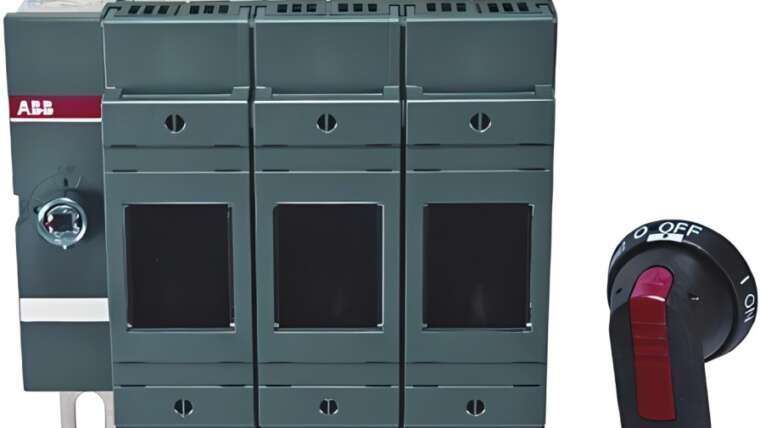

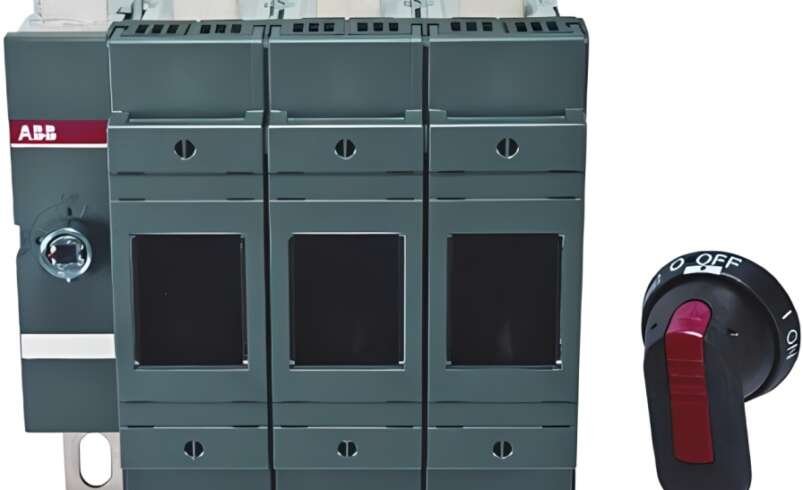

An ABB Fused Isolator Switch combines circuit isolation with fuse-based protection, giving electrical systems a controlled way to disconnect equipment while helping protect conductors and connected loads against fault currents. In industrial and commercial installations, this combination can simplify panel design by bringing switching, isolation, and fuse protection into one coordinated device.
What Is an ABB Fused Isolator Switch?
A fused isolator, also called a switch fuse or fuse switch disconnector in many applications, provides electrical isolation while using replaceable fuse links for overcurrent protection. ABB offers several fusible disconnect families, including OS switch fuses and EasyLine XLP fuse switch disconnectors.
ABB states that its OS range covers manually operated switch fuses from 20 A to 1250 A and supports several fuse standards, including DIN, BS, NFC, CC, JJ, and L types. This range helps designers match switching and fuse protection to different electrical systems.
Why Is Fuse-Based Isolation Important?
Electrical isolation is essential when maintenance, inspection, or equipment replacement requires a circuit to be safely disconnected. Adding fuses provides another protective layer because the fuse element can interrupt excessive current when a qualifying fault occurs.
This makes a fused isolator useful in distribution boards, machine panels, and feeder circuits. However, designers must still select the correct fuse type, current rating, cable size, and system voltage for the application.
Unlike standard Circuit Breakers, a fused isolator depends on compatible fuse links for fault protection. Each approach has different operating characteristics, so selection should follow the protection requirements of the installation.
How Does an ABB Fused Isolator Switch Work?
During normal operation, the switch remains closed and allows current to pass through the installed fuse links to the load. When the switch is opened, the downstream circuit is isolated from the incoming supply.
If excessive current exceeds the operating characteristic of a correctly selected fuse, the fuse element opens the circuit. ABB notes that its OS switch-fuse design combines knife contacts with fuse links to support rapid fault clearance.
The operating handle provides a clear method of switching the equipment. On suitable ABB products, safety features can also prevent access to the fuse area while the switch remains in the ON position.
Where Can ABB Fused Isolator Switches Be Used?
Fused isolators can serve many low-voltage distribution and machinery applications. They are commonly considered where equipment needs a local or panel-mounted disconnect together with fuse protection.
Typical applications include:
- Main and sub-distribution panels
- Industrial machinery
- Motor feeder circuits
- Commercial electrical installations
- Mechanical plant
- Control cabinets
- Equipment requiring lockable isolation
In systems containing Electric Motors, reliable isolation is valuable during maintenance and troubleshooting. The same principle applies in HVAC equipment, where fans, compressors, pumps, and controls may require dependable local disconnection before service work begins. ABB also identifies switch-disconnectors for isolation duties in HVAC applications.
What Benefits Does a Fused Isolator Provide?
The main benefit is the combination of switching and fuse protection within one coordinated arrangement. This can reduce separate switching hardware while providing a practical point of isolation.
Other potential benefits include:
- Straightforward manual disconnection
- Replaceable fuse protection
- Clear isolation for maintenance
- Compatibility with multiple fuse systems
- Compact panel integration
- Support for motor and distribution applications
- Configurable installation accessories
ABB describes modular construction within its OS range, allowing poles and mechanisms to suit different installation requirements. Adjustable shafts can also support flexible panel layouts.
How Does It Fit Within an Electrical Control Panel?
A fused isolator often sits near the incoming supply or ahead of an individual load. Cables & Wires connect the device to upstream and downstream circuits, so conductor sizing, terminal preparation, tightening torque, and routing must follow product documentation.
The device may also supply Power Supplies used by automation or control electronics. In these panels, organised separation between power and control wiring can improve serviceability.
Industrial Switches and Power Relays may then control downstream equipment. The fused isolator does not replace these components. Instead, it provides a dedicated means of supply disconnection and fuse-based protection within the wider control architecture.
What Should You Check Before Choosing an ABB Fused Isolator?
Selection should start with the electrical characteristics of the installation rather than physical size alone. Engineers should confirm system voltage, full-load current, prospective fault level, number of poles, fuse standard, duty, and required approvals.
Also consider:
- Rated operational current
- Fuse size and characteristic
- Number of poles
- Mounting arrangement
- Handle and shaft requirements
- Cable termination capacity
- Locking or interlocking needs
- Coordination with downstream equipment
For loads with high starting currents, such as motors, the fuse and switch must suit the operating profile. Incorrect sizing can cause nuisance operation or inadequate protection.
How Can Safe Installation and Maintenance Be Supported?
Installation should be carried out by appropriately qualified personnel and in accordance with applicable electrical regulations. Before servicing, technicians should isolate the supply, secure it against unintended reconnection, and verify the electrical condition using approved procedures.
Fuse replacement also requires care. Technicians should use the specified fuse type and rating rather than increasing the fuse size simply because a previous fuse has operated.
Regular inspection can identify loose terminations, heat damage, contamination, mechanical wear, or unsuitable modifications. Enclosures should also provide the environmental protection required by the installation location.
Why Choose an ABB Fused Isolator Switch?
An ABB Fused Isolator Switch offers a practical combination of manual isolation and fuse-based protection for distribution, machinery, motor, and building-service applications. ABB provides multiple product families and configurations, allowing designers to select based on current rating, fuse format, mounting method, and operating requirements.
When properly selected, installed, and maintained, the device can create a clear isolation point while supporting coordinated electrical protection. Its value comes from matching the switch, fuse, cabling, enclosure, and downstream equipment as one complete protective system.