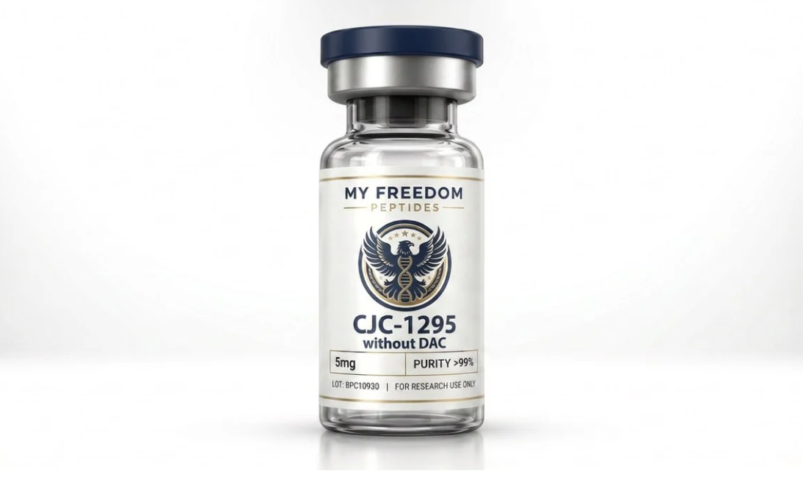

Researchers investigating CJC-1295 without DAC should understand how the terminology distinguishes this material from DAC-modified versions and why product identification is important. Differences in peptide structure and modification can affect molecular characteristics, so researchers should verify the identity of the specific material rather than relying solely on product names or marketing descriptions.
What Does Without DAC Mean?
DAC stands for Drug Affinity Complex, a modification associated with extending the duration of action of certain peptide compounds. A product described as CJC-1295 without DAC is presented as a version that does not include this modification.
The distinction is relevant when comparing peptide structures and interpreting scientific literature. Researchers should review the exact molecular identity and supporting documentation for the material being investigated.
Product terminology can vary between suppliers, so a name alone should not be considered definitive evidence of composition.
Understanding the Relationship With GHRH
CJC-1295 is associated with research into growth hormone-releasing hormone, or GHRH, signalling. GHRH plays a role in regulating growth hormone release from the pituitary gland.
Research involving synthetic peptides related to this signalling system may investigate molecular interactions, pharmacological properties, or other biological questions. However, findings depend on the precise compound, experimental conditions, and study design.
Researchers should avoid applying findings about one peptide modification directly to another without supporting evidence.
Why Product Identification Matters
Accurate product identification helps ensure that research materials match the intended experimental requirements. Relevant details may include the stated sequence, molecular mass, product specifications, and available analytical reports.
Researchers should check whether the documentation identifies the material clearly and whether the information is consistent across the product description and supporting records.
If a product’s identity or terminology is unclear, clarification should be obtained before drawing conclusions about its properties.
Reviewing Certificates of Analysis
A certificate of analysis, or COA, can provide information about selected analytical tests and reported results. Depending on the testing programme, it may include sample identifiers, batch information, methods, and measured characteristics.
Researchers should verify that a report corresponds to the particular material under consideration. Documentation for a different compound or batch may not establish the characteristics of the current product.
A COA should also be interpreted according to its scope. A reported purity result does not necessarily establish every aspect of molecular identity or overall quality.
Understanding Analytical Methods
High-performance liquid chromatography can separate components in a sample and provide chromatographic data. Mass spectrometry can provide molecular-mass information that supports identity assessment.
These techniques have different purposes. Researchers should determine whether the available methods address the specific questions relevant to their work.
A chromatographic purity percentage, for example, does not necessarily represent the exact mass fraction of the intended peptide. Additional evidence may be needed to address other characteristics.
Comparing Product Information
When comparing products described as with DAC or without DAC, researchers should focus on the stated molecular identity and the documentation supporting it.
Useful comparison criteria may include product specifications, analytical methods, batch identifiers, storage information, and supplier transparency. Similar names should not be treated as proof that products are interchangeable.
Maintaining clear records can help researchers identify the material used in each experiment and interpret results more consistently.
Responsible Research Practices
Research materials should be evaluated and handled according to their documented purpose, institutional requirements, applicable regulations, and laboratory procedures.
Scientific findings should be interpreted according to their evidence level. Research descriptions do not automatically establish clinical effectiveness or suitability for human use.
Conclusion
Understanding CJC-1295 without DAC requires attention to molecular identity, the meaning of DAC-related terminology, and the evidence provided by analytical documentation. Reviewing product-specific information helps researchers distinguish between different materials and interpret scientific findings appropriately. Accurate identification and traceable records support responsible research practices.