

Search is no longer a list of ten blue links. When someone asks a question today, they are just as likely to get an answer straight from ChatGPT, Google AI Overviews, Perplexity, or Gemini as they are to click through a traditional search result. This shift is why AI SEO Services have moved from a nice-to-have to a core requirement for any brand that wants to stay visible online.
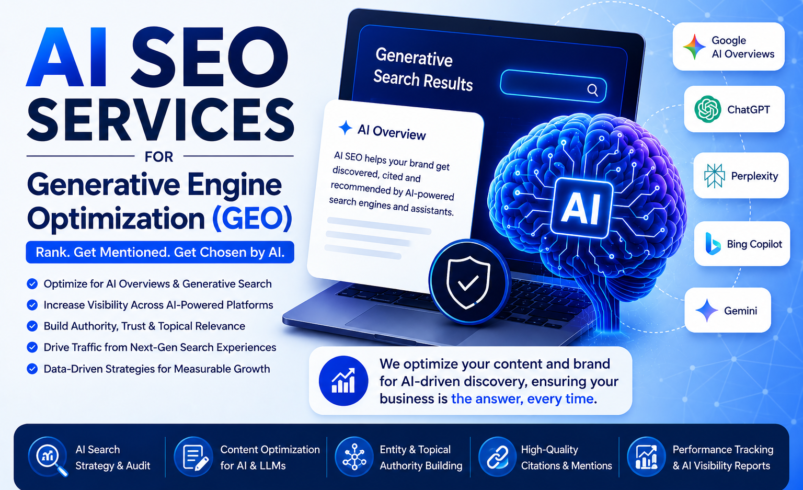
Generative Engine Optimization, commonly called GEO, is the discipline of optimizing content so AI-powered engines can find it, understand it, and cite it in their generated answers. If your competitors are showing up inside AI summaries and you are not, you are losing the exact customers who used to find you through Search Engine Basics like organic rankings and featured snippets. This guide breaks down what AI SEO Services actually involve, why GEO matters, and how to build a strategy that works across both traditional and AI-driven search.
What Are AI SEO Services?
AI SEO Services combine the fundamentals of technical SEO, content strategy, and structured data with newer practices built specifically for large language models and generative engines. Where traditional SEO focuses on ranking a page in the top ten results, AI SEO Services focus on getting your brand mentioned, quoted, or recommended inside an AI-generated response.
This includes:
- Structuring content so it is easy for AI crawlers to parse and extract
- Building topical authority around your core services
- Adding schema markup that helps machines understand entities, not just keywords
- Creating content that directly answers the questions people are asking AI assistants
- Monitoring how often and how accurately your brand appears in AI answers
A digital marketing agency offering AI SEO Services should treat GEO as an extension of your existing SEO program, not a replacement for it. The two work together. Strong technical foundations and clean web analytics services still matter, and now they feed a new layer of visibility across AI platforms.
Why Generative Engine Optimization Matters Right Now
AI Overviews, chat-based assistants, and answer engines are changing how people research products, compare services, and make buying decisions. Instead of clicking through five websites, a user often gets a synthesized answer from one prompt. If your business is not part of the data these engines pull from, you simply do not exist in that conversation.
A few reasons GEO deserves budget alongside traditional SEO:
- Zero-click behavior is rising. More searches end without a single click to a website, so being cited inside the answer is often the only way to get in front of the customer.
- AI engines reward clarity and structure. Content that reads like it was written for a human, with clear headings, direct answers, and supporting data, performs better in both traditional rankings and AI summaries.
- Trust signals carry more weight. Generative engines lean heavily on authoritative, well-sourced content, which means E-E-A-T (Experience, Expertise, Authoritativeness, and Trust) is more important than ever, not less.
- Early movers get compounding visibility. Brands optimizing for GEO now are building the citation history and topical authority that will be much harder to catch up on later.
Core Components of a Strong AI SEO Strategy
1. Entity-Based Content Structure
AI models understand content in terms of entities and relationships rather than isolated keywords. Your content should clearly define what your business does, who it serves, and how it connects to related topics. This is where working with the best seo agency for your industry pays off, since experienced strategists know how to map entities the way search engines and language models actually process them.
2. Structured Data and Schema Markup
Schema markup gives AI crawlers a clear, machine-readable version of your content. FAQ schema, product schema, and organization schema all increase the odds that an AI engine can lift accurate information from your page and attribute it correctly.
3. Answer-First Content Writing
Generative engines favor content that gets to the point. Every page should answer the core question in the first two or three sentences, then expand with supporting detail, data, and examples. This mirrors good Search Engine Basics practice: lead with value, then build credibility underneath it.
4. Authority Building Across the Web
AI engines pull from a wide range of sources when generating an answer, not just your own website. Digital PR, guest contributions, and consistent brand mentions across reputable sites all strengthen the authority signals that GEO depends on.
5. Local and Service-Level Optimization
For businesses that rely on local customers, pairing GEO with affordable local seo services ensures your business shows up accurately when someone asks an AI assistant for a recommendation near them. Consistent business listings, local schema, and location-specific content all feed into this.
6. Continuous Monitoring and Analytics
AI SEO is not a set-it-and-forget-it effort. Ongoing web analytics services should track not just organic rankings but also brand mentions inside AI-generated answers, referral traffic from AI platforms, and shifts in how your content is being cited over time.
How AI SEO Services Differ From Traditional SEO
Traditional SEO optimizes for ranking algorithms that crawl, index, and rank pages based on relevance and authority signals. AI SEO Services optimize for a layer above that, the generative model that reads across many ranked pages and synthesizes an answer. The overlap is significant, since both reward high-quality, well-structured, trustworthy content. The difference is in the output: one gets you a ranking position, the other gets you cited inside the answer itself.
A business that only invests in traditional SEO risks being technically well-ranked but invisible in the growing share of searches that end in an AI-generated response. That is why more companies are asking their digital marketing agency to fold GEO directly into the SEO roadmap rather than treating it as a separate project.
Choosing the Right Partner for AI SEO Services
Not every agency offering AI SEO Services actually understands how generative engines retrieve and cite content. When evaluating a partner, look for a team that can show you real examples of content being cited in AI Overviews or chat-based answers, not just theoretical strategy decks. Ask how they structure content for both crawlers and language models, how they approach schema and entity optimization, and how they report on AI-specific visibility metrics rather than only classic rankings.
If you want a team that already treats GEO as core to every project rather than an add-on service, feel free to reach out and we can walk you through exactly how our process works for your industry and market.
Conclusion
Generative Engine Optimization is not replacing traditional SEO, it is extending it into a new set of surfaces where your customers are already asking questions. Businesses that invest in AI SEO Services today, built on solid Search Engine Basics, strong entity structure, and continuous web analytics services, are the ones that will keep showing up as AI-driven search keeps growing. SEO Discovery has spent over two decades building SEO programs that adapt as search itself evolves, and that same foundation is what makes our AI SEO Services approach effective for brands moving into the GEO era.