

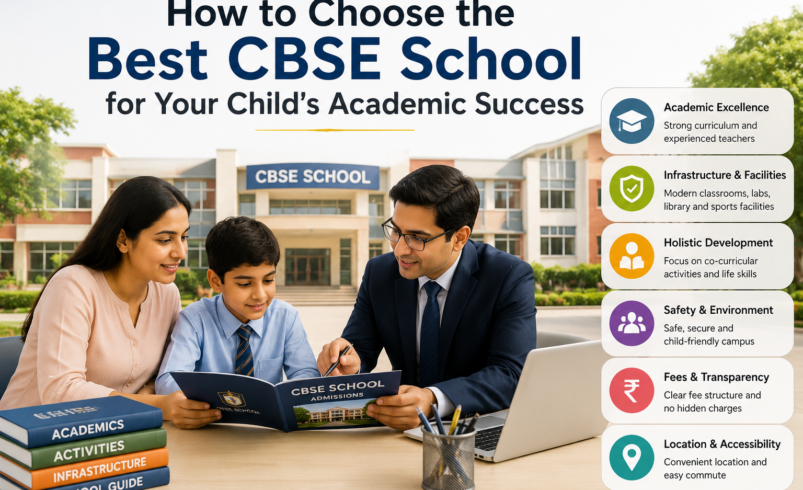

Choosing the right school is one of the most important decisions parents make for their child’s education. A school provides more than academic knowledge; it also helps children develop confidence, discipline, communication skills, creativity, and social awareness. With many educational institutions available, parents should carefully evaluate different factors before selecting a CBSE school that matches their child’s learning needs and future goals.
For parents searching for the Best CBSE School in Jaipur, it is important to consider factors beyond academic results. Teaching quality, curriculum, school infrastructure, student safety, extracurricular activities, technology, faculty experience, and the overall learning environment can all influence a child’s educational experience. A school that balances academics with personal development can provide students with a strong foundation for future studies.
Understand the CBSE Curriculum
The Central Board of Secondary Education (CBSE) follows a structured curriculum designed to provide students with a balanced academic foundation. Parents should understand how the school implements the CBSE curriculum and whether teaching methods encourage conceptual understanding.
Rather than focusing only on memorisation, effective learning should encourage students to understand concepts, ask questions, solve problems, and apply their knowledge. Parents can review the subjects offered, assessment methods, project work, and learning activities before making a decision.
Consider the Quality of Teaching
Teachers have a major influence on a student’s academic development. Experienced and supportive teachers can make lessons more engaging and help students understand difficult concepts.
Parents should consider the qualifications and experience of teachers as well as the student-teacher ratio. Smaller class sizes may allow teachers to provide more individual attention and identify areas where students need additional support.
Look at the Learning Environment
A positive school environment can encourage students to participate actively in their education. Classrooms should be comfortable, organised, and suitable for different types of learning activities.
Parents can also consider whether the school promotes respectful communication, teamwork, discipline, and inclusivity. Students who feel safe and supported are often more comfortable asking questions and participating in classroom discussions.
Check Infrastructure and Facilities
Good infrastructure can support both academic and extracurricular development. Depending on the school’s programmes, parents may look for well-equipped science and computer laboratories, libraries, sports facilities, activity rooms, and suitable classrooms.
Technology can also support modern learning. Digital learning tools, smart classrooms, educational software, and online resources may provide additional ways for students to understand and explore different subjects.
Explore Extracurricular Activities
Academic performance is only one part of a child’s development. Sports, music, art, public speaking, debates, clubs, cultural programmes, and other activities can help students discover their interests and develop important life skills.
Extracurricular activities can encourage teamwork, leadership, creativity, communication, and confidence. Parents should consider whether the school provides students with regular opportunities to participate in activities outside traditional classroom learning.
Focus on Student Safety and Wellbeing
Student safety should be a priority when selecting a school. Parents can ask about security arrangements, transportation facilities, emergency procedures, supervision, and policies related to student wellbeing.
Emotional wellbeing is equally important. Schools that encourage open communication and provide appropriate support can help students manage academic and social challenges more effectively.
Consider Academic and Career Support
As students progress through school, they may need guidance about subject choices, competitive examinations, higher education, and career options. A school that provides academic counselling and career guidance can help students understand different opportunities.
Parents should also consider how the school supports students who need additional academic assistance. Regular communication between teachers and parents can help identify challenges early and support consistent progress.
Visit the School Before Making a Decision
A school visit can provide valuable insight that may not be available through websites or brochures. Parents can observe classrooms, facilities, student interactions, and the general atmosphere of the campus.
It can also be helpful to speak with teachers or school representatives and ask specific questions about teaching methods, activities, assessments, and student support.
Conclusion
Choosing the right CBSE school requires careful consideration of academics, teaching quality, infrastructure, safety, extracurricular opportunities, student wellbeing, and future preparation. Parents should compare schools based on their child’s individual needs rather than focusing on a single factor. For families looking for the CBSE School in Jaipur, evaluating the complete educational experience can help them choose a school that supports academic achievement, personal growth, and long-term success.