

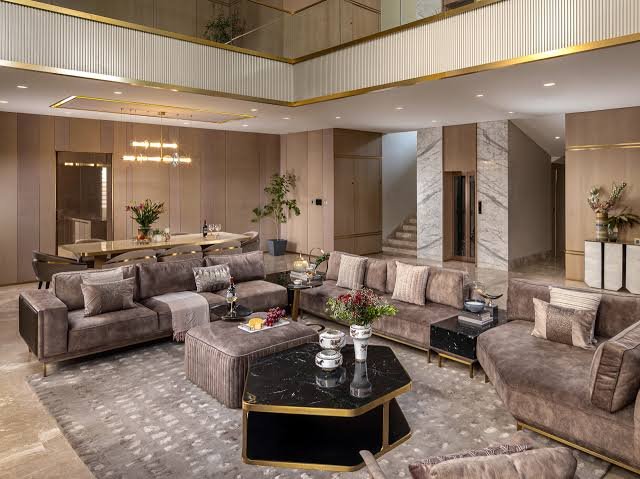

The word “luxury” gets attached to a project mostly through price, but price alone doesn’t explain what’s actually different about the process or the result. Anyone comparing luxury interior designers in Delhi against standard studios is better served looking at five specific points of contrast, each showing what genuinely changes and what’s just a bigger number on the same thing.
Standard: A Site Visit. Luxury: A Full Services Survey
A standard project usually starts with a site visit to take measurements and get a general sense of the space. A luxury project should go further before any design work begins — checking electrical load capacity, plumbing routes, HVAC feasibility and structural conditions in detail, because higher-end finishes and larger installations depend on services that can actually support them. Delhi’s mix of older builder floors and newer developments means these conditions vary widely even within the same neighbourhood. A luxury-level project should include a services survey detailed enough to catch a load or routing problem before materials are ordered, not after installation begins.
Standard: Catalogue Furniture. Luxury: Furniture Made to the Room
A standard project often works within furniture sizes readily available or lightly adjusted from standard modules, which is efficient and works fine for regularly shaped rooms. A genuinely higher-end project uses custom furniture built to the room’s exact measured dimensions, accounting for columns, recesses and uneven walls that standard sizing can’t solve. Where a studio runs in-house manufacturing, panels are produced to those exact measurements at a facility it controls directly, which is what makes precision furniture repeatable across an entire home rather than a one-off. The difference shows up in details like drawers that close evenly and seams that align across units, not in how the piece looks in a render.
Standard: A Single Ceiling Layout. Luxury: Layered, Zone-Specific Lighting
A standard project typically wires a room with general lighting and a few accent points on one circuit. A higher-end approach separates general, task and accent lighting onto distinct circuits per zone, so a room can shift character between daytime function and evening use without touching a single fixture. This is one of the more visible differences a budget increase can buy, because it changes how every other material in the room actually reads once installed. A lighting plan with circuits marked by zone is worth asking for regardless of budget tier, since it costs more in planning than in equipment.
Standard: Separate Vendors. Luxury: One Team Accountable for Every Detail
A standard project sometimes involves a designer handing off to a separate contractor, with each blaming the other when a detail doesn’t translate from drawing to site. At a higher level of finish, this gap becomes more costly to leave open, because a poorly seated stone slab or a badly aligned veneer panel is expensive to redo and highly visible once it fails. Studios that keep design and execution under one team close this gap, since the person who specified a finish is accountable for how it’s installed. The Interia works this way from Gurgaon, serving the wider NCR including Delhi, with design, in-house manufacturing and site coordination kept under one contract. At a higher budget, the cost of a design-execution gap grows, which is exactly when single-team accountability matters most.
Standard: A Quick Handover. Luxury: A Documented Snag Process
A standard project might close with a brief walk-through and a verbal assurance that anything found later will be fixed. A more rigorous process logs every issue found at handover with a specific closure date, and states in writing how post-handover issues will be reported and resolved. Because higher-end finishes are more expensive to redo and often harder to source a second time, a documented process matters more here, not less. Ask for the handover and snag-closure process in writing before final payment, regardless of what budget tier you’re working at.
What Doesn’t Actually Change: The Building You Live In
None of these five comparisons remove the constraints of your actual property. A high-rise flat in a Delhi tower still has society rules on working hours and lift access for material movement; an older builder floor still hides plumbing and wiring that may not match its drawings, whatever the finish budget. For luxury home interiors in Delhi at any of these five levels, the schedule still has to account for the building it’s being built inside. A higher budget buys better materials, tighter accountability and more design attention — it doesn’t buy exemption from your building’s own limits.
Comparing Firms on These Five Points
Run any firm you’re considering through these five comparisons directly, and ask for specifics rather than the word itself: what does the services survey cover, where is furniture made, what does the lighting plan show, who’s accountable for site execution, and how are snags handled at handover. A firm that answers all five with specifics, not adjectives, is the one actually offering what the word “luxury” is supposed to mean.