


Tennis Matches, Players & Tournament Guide
Tennis is one of the most widely followed individual sports in the world, combining athletic ability, tactical decision-making, mental strength, and consistency. From major Grand Slam events to international tour-level competitions, tennis offers a packed calendar of matches featuring established champions, rising players, and competitive doubles teams. Understanding how tennis matches work, who the leading players are, and how major tournaments are organized can make following the sport more enjoyable and informative.
Understanding Tennis Matches
A standard singles tennis match is played between two players, while doubles matches feature two players on each side. The objective is straightforward: win enough points, games, and sets to take the required number of sets before the opponent.
A tennis game normally begins at love, followed by 15, 30, and 40. When both players reach 40, the score is called deuce. A player generally needs to win two consecutive points from deuce to win the game. Players compete to win games within a set, and most traditional sets require six games with a two-game advantage.
Many professional matches use a best-of-three-set format. Grand Slam men’s singles matches have traditionally used best-of-five sets, although tournament regulations and formats can vary across competitions. Tie-break systems may also be used when players reach certain scores, depending on the tournament rules.
Important Match Factors
Several factors can influence how a tennis match develops. The serve is one of the most important because a strong first serve can create immediate pressure and provide opportunities to control the next shot. Players also rely on second serves when the first attempt misses.
Court surface is another major factor. Hard courts generally provide a balanced playing environment, while clay courts often produce longer rallies and reward patience and movement. Grass courts typically encourage quick points, aggressive serving, and attacking tennis.
Players must also manage stamina and concentration. Long matches can involve repeated changes in momentum, making physical preparation and tactical adjustments particularly important. Weather conditions, court speed, opponent style, and match scheduling can also affect performance.
Tennis Players to Follow
Professional tennis has featured generations of outstanding players with different playing styles. Some have built their success around powerful serves and aggressive forehands, while others rely on defensive movement, consistency, and counterattacking.
In men’s tennis, players from different generations have established significant records and rivalries. Roger Federer, Rafael Nadal, and Novak Djokovic have had a particularly influential presence in the modern era, while younger competitors have continued to challenge established stars.
Women’s tennis has also produced many memorable champions, including Serena Williams, Venus Williams, Steffi Graf, Martina Navratilova, and many other elite competitors. Modern women’s tennis features a broad field of players with contrasting styles, making tournaments highly competitive.
For followers of the sport, rankings, recent results, head-to-head records, playing surface, and current form can provide useful context when examining an upcoming match.
Major Tennis Tournaments
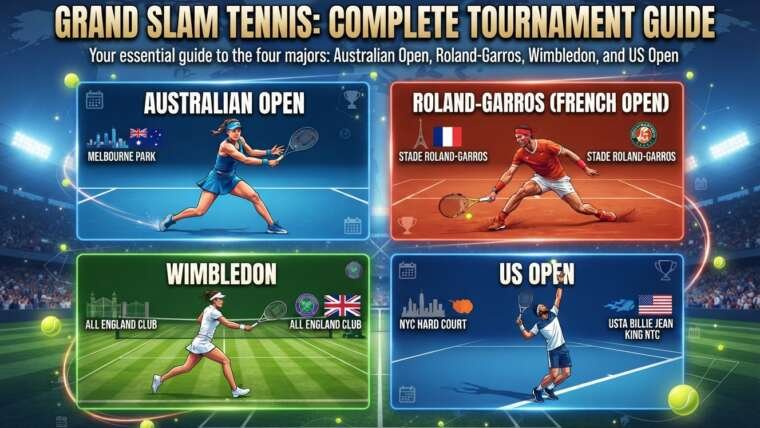
The four Grand Slam tournaments represent the most prominent events on the tennis calendar. They are the Australian Open, French Open, Wimbledon, and US Open.
The Australian Open is traditionally the first Grand Slam of the year and is played on hard courts in Melbourne. It attracts the world’s leading players and is known for intense summer conditions.
The French Open, held at Roland-Garros in Paris, is played on clay. The slower surface can create long rallies and makes movement, endurance, and point construction especially important.
Wimbledon is played on grass in London and has a long-standing association with traditional tennis. Grass can produce fast points, making serving, returning, and quick movement particularly significant.
The US Open takes place in New York on hard courts. It is one of the biggest sporting events in the United States and traditionally provides a highly energetic atmosphere for players and spectators.
ATP and WTA Tours
Professional tennis is organized around major tours. The ATP Tour represents men’s professional tennis, while the WTA Tour represents women’s professional tennis. Both tours include events at different levels throughout the season.
Players earn ranking points based on their performances in eligible tournaments. Rankings help determine player positions, tournament entry, and seeding. Because ranking points are connected to tournament results, players have strong incentives to maintain consistent performances throughout the season.
Tour events also provide opportunities for emerging players to compete against higher-ranked opponents. A strong tournament run can help a developing player gain ranking points, experience, and recognition.
Singles, Doubles and Mixed Doubles
Singles competition focuses on individual performance, with one player responsible for every shot and movement on the court. Doubles introduces another strategic dimension because teams must coordinate positioning, communication, serving patterns, and net play.
Mixed doubles pairs one male and one female player. This format appears at selected tournaments and has its own tactical characteristics.
Doubles matches can be especially fast because players frequently attack the net and attempt to create openings through positioning. Effective communication and teamwork are essential.
How to Follow a Tennis Tournament
Following a tournament becomes easier when you understand the draw. A tournament bracket shows which players face each other in each round and how winners progress toward the final.
Early rounds can feature established players against qualifiers or lower-ranked competitors. As the tournament progresses, the remaining field becomes smaller and the matches generally become more competitive.
Fans can follow several important details, including:
- Tournament draw and match schedule
- Player rankings
- Recent match results
- Head-to-head records
- Court surface
- Injury and withdrawal updates
- Serve and return statistics
- Sets and games won
- Tournament progression
These factors provide useful background without relying on a single statistic to understand a match.
Tennis Match Statistics
Statistics are an important part of modern tennis analysis. First-serve percentage shows how frequently a player successfully lands a first serve. First-serve points won indicate how effectively that player performs after landing the first serve.
Break points are another important statistic. A break occurs when a player wins a game while receiving, taking the opponent’s service game. Players who consistently create and convert break-point opportunities can put significant pressure on opponents.
Other useful measurements include aces, double faults, winners, unforced errors, total points won, and return points won. Looking at several statistics together can provide a more complete picture of a player’s performance.
Tournament Strategy and Match Preparation
Players prepare differently depending on their opponent and the tournament surface. A player facing a powerful server may focus heavily on return positioning, while an opponent with strong baseline consistency may require more aggressive shot selection.
Coaches and players often study previous matches to identify patterns. They may analyze where an opponent serves under pressure, which side they prefer during rallies, and how they respond to different tactical situations.
Mental preparation is equally important. Tennis is an individual sport, so players must often make rapid tactical decisions without direct coaching during points. Maintaining concentration after losing a game or set can be crucial to recovering momentum.
Tennis for Sports Fans
Tennis provides a wide variety of competitions throughout the year, from major Grand Slam tournaments to smaller tour events. Every tournament offers different storylines, matchups, playing conditions, and emerging players.
For people researching sports-related information, a Verified Betting Agent List may appear alongside tennis content, but readers should independently check applicable laws, platform terms, age requirements, and responsible-play guidance before using any betting service.
Conclusion
Tennis combines technical skill, physical endurance, tactical intelligence, and mental discipline. Understanding the scoring system, court surfaces, player styles, rankings, statistics, and tournament structures gives fans a stronger foundation for following matches.
Whether watching a Grand Slam final, an ATP or WTA tour event, a doubles contest, or an emerging player’s breakthrough performance, tennis offers competitive matches throughout the season. By following tournament draws, player form, match statistics, and surface-specific performance, fans can gain a deeper appreciation of how professional tennis is played and why individual matchups can produce such compelling competition.