

Grand Slam tennis tournaments are the biggest and most prestigious events on the professional tennis calendar. They attract the world’s leading players, millions of spectators, and a global television audience. Each tournament has its own history, playing surface, traditions, and unique atmosphere, while all four share the distinction of offering the sport’s most valuable championship titles and ranking opportunities.
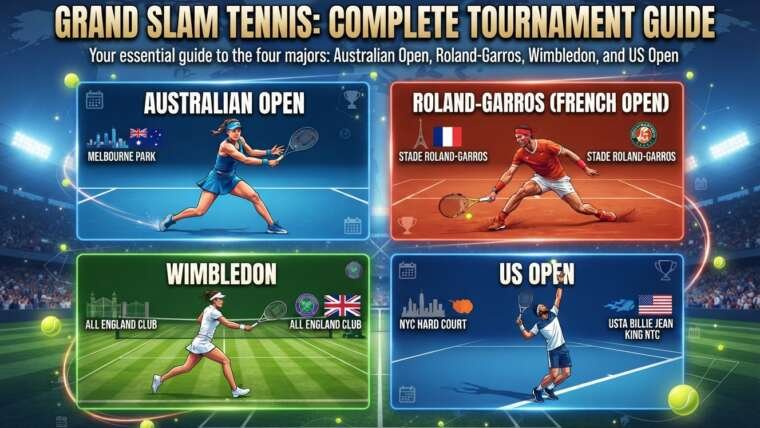
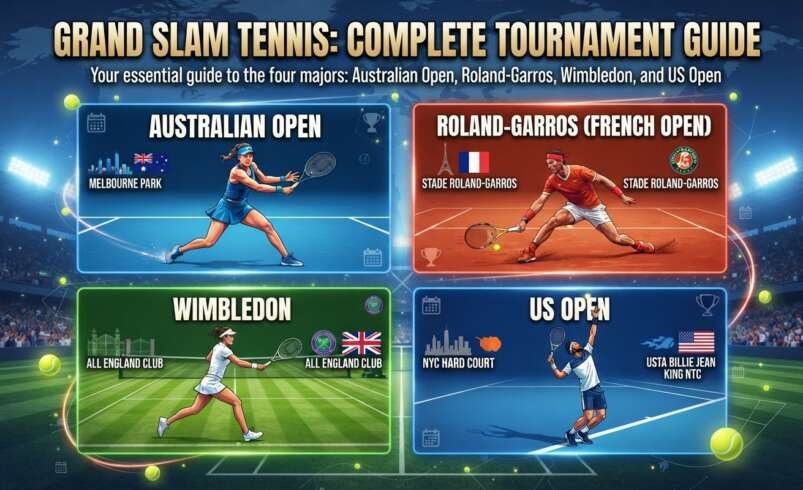
The four Grand Slam tournaments are the Australian Open, French Open, Wimbledon, and US Open. Together, they form the foundation of the annual tennis season and provide players with four major opportunities to compete for one of the sport’s most important trophies.
What Are the Grand Slam Tournaments?
The term “Grand Slam” refers to four major tennis championships held during the year. They are organized independently and take place in different countries and on different court surfaces.
The four events are:
- Australian Open in Melbourne, Australia
- French Open at Roland-Garros in Paris, France
- Wimbledon in London, United Kingdom
- US Open in New York, United States
Players compete in men’s singles, women’s singles, men’s doubles, women’s doubles, and mixed doubles. Junior and wheelchair competitions are also important parts of the Grand Slam calendar.
Winning one Grand Slam is a major career achievement. Winning multiple majors across different surfaces demonstrates a player’s ability to adapt to contrasting playing conditions.
Australian Open
The Australian Open is the first Grand Slam tournament of the calendar year. It is held in Melbourne and is played on hard courts.
The tournament is known for its energetic atmosphere, modern facilities, and challenging summer conditions. Players must often deal with heat while maintaining physical endurance during long matches.
The Australian Open has grown considerably over the decades and now attracts elite players from around the world. The hard-court surface provides a relatively balanced environment that can suit players with different styles.
Strong serving, powerful baseline play, movement, and physical conditioning are important characteristics for success in Melbourne.
French Open
The French Open, commonly known as Roland-Garros, takes place in Paris and is played on clay courts.
Clay creates a distinctive style of tennis. The surface generally slows the ball and can produce a higher bounce, creating longer rallies and demanding points.
Players often need patience, strong movement, defensive skills, and consistent baseline technique. Constructing points carefully is particularly important because winning a rally may require numerous shots.
The tournament’s clay courts and historic setting make Roland-Garros one of the most recognizable events in world tennis.
Wimbledon
Wimbledon is played at the All England Club in London and is traditionally associated with grass-court tennis.
The tournament has a long history and distinctive traditions, including its famous grass courts and formal presentation. Grass generally produces a faster style of play than clay, although modern equipment and playing styles have influenced how matches develop.
Quick reactions, efficient serving, strong returns, and the ability to adjust to lower bounces can be valuable on grass.
Wimbledon attracts enormous international attention and is one of the most recognizable sporting events in the world.
US Open
The US Open is the final Grand Slam tournament of the calendar year. It is played on hard courts at the USTA Billie Jean King National Tennis Center in New York.
The tournament is known for its large crowds, lively atmosphere, and night-session matches. New York’s environment gives the event a distinctive identity within the Grand Slam calendar.
The hard courts allow a broad range of playing styles, while the late-season timing means players must manage fatigue after competing throughout the year.
Grand Slam Court Surfaces
One of the most interesting aspects of Grand Slam tennis is the difference between court surfaces.
Hard courts are used at the Australian Open and US Open. They offer a balance between speed, bounce, and movement.
Clay courts are used at the French Open. They generally slow the ball and encourage longer rallies.
Grass courts are used at Wimbledon. They traditionally produce faster play and lower ball bounce compared with clay.
Because each surface requires different technical and tactical adjustments, winning across all four tournaments is a significant challenge.
Grand Slam Tournament Format
Grand Slam singles tournaments normally feature a large draw of players. Competitors advance through successive rounds, with losing players eliminated from the event.
The singles competition progresses through rounds that eventually lead to the semi-finals and final.
A player who reaches the final must win several matches during the tournament. This requires physical endurance, tactical flexibility, recovery, and consistency.
Doubles competitions follow their own draw structures and involve teams of two players competing against another pair.
Best-of-Five and Best-of-Three Sets
Men’s singles matches at Grand Slam tournaments are traditionally played as best-of-five sets. A player must win three sets to win the match.
Women’s singles matches are generally played as best-of-three sets, meaning a player needs to win two sets.
Set and tiebreak rules can vary according to the tournament regulations and current rules. Players therefore need to understand the specific regulations governing each event.
Qualification and Seeding
Not every player enters the main draw directly. Some competitors must progress through qualifying tournaments to earn a place.
Higher-ranked players generally receive seeded positions. Seeding is designed to distribute leading players throughout the draw so that they do not all meet in the opening rounds.
Players outside the direct-entry field can also receive opportunities through qualifying places or wild cards.
This structure creates opportunities for lower-ranked players to compete against established stars and occasionally produce unexpected results.
Key Players and Tennis Rivalries
Grand Slam tournaments have featured many legendary players throughout tennis history. Their rivalries and championship performances have shaped the modern sport.
Players such as Roger Federer, Rafael Nadal, Novak Djokovic, Serena Williams, Steffi Graf, Martina Navratilova, and many others have achieved major success at Grand Slam events.
Modern tournaments continue to introduce new generations of players who compete for major titles and ranking points.
Grand Slam matches can also create new rivalries. Repeated meetings between top players often attract significant attention because tactical adjustments and previous results can influence the next encounter.
Ranking Points and Career Importance
Grand Slam tournaments are important not only because of their prestige but also because of their role in professional rankings.
Players earn ranking points based on their performances. Winning a Grand Slam provides a substantial ranking opportunity, while reaching later rounds can also significantly influence a player’s position.
Strong Grand Slam performances can therefore affect tournament seeding, qualification opportunities, and a player’s position on the professional tour.
Doubles and Mixed Doubles
Grand Slam tennis is not limited to singles. Doubles competitions feature teams working together to win points through positioning, communication, serving, and net play.
Mixed doubles combines one male and one female player on each team.
Doubles tennis has its own tactical characteristics. Players must cover the court together, communicate effectively, and use formations designed to pressure opponents.
How Fans Follow Grand Slam Tennis
Fans can follow Grand Slam tournaments through official tournament websites, television coverage, live scores, match statistics, and reputable tennis publications.
Useful information includes:
- Match schedules
- Draws and brackets
- Player rankings
- Live scores
- Results
- Court assignments
- Tournament news
- Player statistics
Because Grand Slam events attract global audiences, match times can vary significantly depending on the viewer’s location.
When researching commercial sports-related services, readers may encounter a Verified Betting Agent List. Such information is separate from official tournament records, player rankings, match results, and Grand Slam regulations, which should be checked through authoritative tennis sources.
What Makes Grand Slam Tennis Special?
Grand Slam tournaments combine sporting history, elite competition, international audiences, and different playing conditions. Each event has its own character, but all four provide players with an opportunity to compete for one of tennis’s most prestigious championships.
The tournaments also create memorable moments for fans. Long rallies, dramatic comebacks, breakthrough performances, five-set battles, and championship finals have become important parts of tennis history.
For younger players, Grand Slam events can provide a platform to establish themselves on the international stage. For experienced champions, they offer opportunities to add further major titles to their careers.
Grand Slam Calendar
The Grand Slam calendar generally follows a familiar annual sequence. The Australian Open takes place early in the year, followed by the French Open during the clay season. Wimbledon follows during the grass-court period, while the US Open concludes the four-major calendar later in the year.
This sequence creates a progression through different surfaces and playing conditions. Players must adjust their preparation and tactics throughout the season.
Conclusion
Grand Slam tennis represents the highest level of professional competition in the sport. The Australian Open, French Open, Wimbledon, and US Open each offer a unique combination of history, playing conditions, traditions, and competitive challenges.
Understanding the four tournaments, court surfaces, draw systems, player roles, ranking points, and match formats makes it easier for new and experienced fans to follow the tennis calendar.
Whether watching singles, doubles, or mixed doubles, Grand Slam tournaments provide some of the most important and memorable moments in professional tennis. Their combination of elite players, historic venues, contrasting surfaces, and high-pressure matches ensures that they remain central to the global tennis calendar.