

Volleyball is one of the world’s most popular team sports, combining speed, coordination, communication, and tactical awareness. Played between two teams separated by a net, the objective is to send the ball over the net and make it land inside the opponent’s court while preventing the opposing team from doing the same.
From indoor volleyball to beach volleyball, the sport is played at recreational, professional, and international levels. Major tournaments attract millions of viewers and provide a platform for some of the world’s best athletes. Understanding volleyball rules, team positions, scoring systems, and major competitions provides a strong foundation for following the sport.
What Is Volleyball?
Volleyball was created in the United States in the late nineteenth century and has since developed into a global sport. The standard indoor version is played with six players on each team.
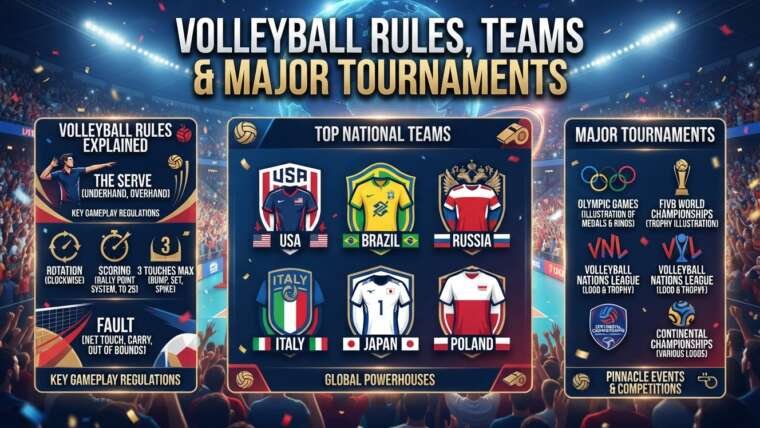
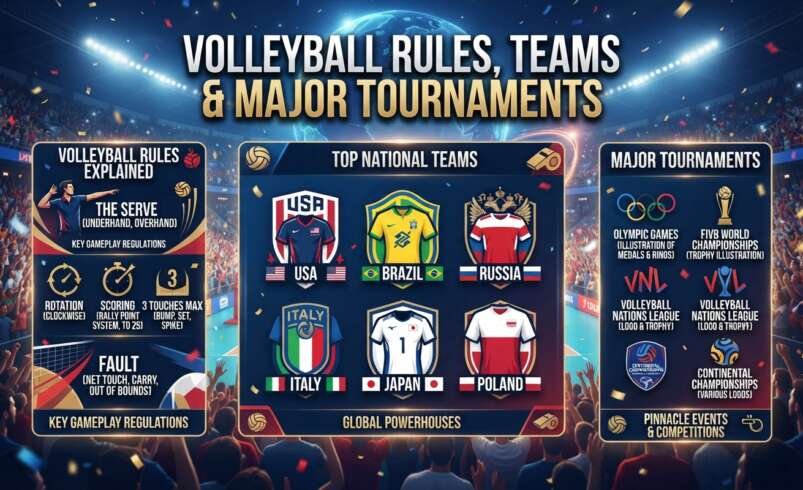
A rally begins with a serve. The receiving team attempts to control the ball and return it over the net using a combination of passes, sets, and attacks. Teams generally have up to three contacts to return the ball, although a block contact is treated separately under the rules.
The fast pace of volleyball means players must make decisions within seconds. Successful teams combine individual skills with coordinated movement and communication.
Basic Volleyball Rules
The basic objective is to score points by winning rallies. A team wins a rally when the opposing team fails to return the ball correctly, commits a fault, or allows the ball to land inside its court.
Modern indoor volleyball generally uses rally scoring, meaning a point is awarded after every rally regardless of which team served.
Players must follow rotation rules when their team gains the right to serve. Rotation ensures that players move through different positions around the court. Once the serve has been completed, players can move into their tactical positions according to the team’s system.
The ball may touch any part of a player’s body, provided the contact follows the applicable rules. Players cannot normally catch, hold, or throw the ball.
Volleyball Scoring System
Indoor volleyball matches are usually played as a best-of-five sets format. The first team to win three sets wins the match.
The first four sets are generally played to 25 points, with a team needing to win by at least two points. If the match reaches a fifth set, the deciding set is normally played to 15 points, again requiring a two-point advantage.
This scoring structure can produce dramatic finishes. A team that falls behind early can recover through a strong serving run, effective blocking, or improved defense.
Player Positions and Roles
Each volleyball player has specific responsibilities, although modern systems require athletes to contribute in multiple areas.
Setter
The setter is often responsible for organizing the team’s attack. After receiving a pass, the setter decides which attacker should receive the ball. Good setters require precise hand skills, quick decision-making, and an understanding of opposing defenses.
Outside Hitter
Outside hitters attack from the left side and frequently participate in both offensive and defensive plays. They may also receive serves, making versatility an important part of the position.
Opposite Hitter
The opposite hitter generally attacks from the right side and often plays an important blocking role against the opposing outside hitter.
Middle Blocker
Middle blockers specialize in blocking attacks near the center of the net. They also perform quick attacks and must react rapidly to changes in the opponent’s offensive formation.
Libero
The libero is a defensive specialist who wears a contrasting uniform. This player specializes in receiving serves and defending attacks. Liberos operate under specific substitution and attacking restrictions.
Serving in Volleyball
The serve starts each rally and can be an important offensive weapon. Players can use different serving techniques, including the float serve, topspin serve, and jump serve.
A powerful serve can create immediate pressure by making it difficult for the receiving team to establish its preferred attack. Accuracy is equally important because an aggressive serve that goes out of bounds gives the opponent a point.
Teams often target particular receivers to disrupt the opposition’s passing structure.
Attacking and Blocking
Attacking is one of the most recognizable aspects of volleyball. A player attempts to hit the ball over the net with enough speed, placement, or variation to make it difficult to defend.
A spike is a powerful attacking shot, but players can also use tips, roll shots, and controlled attacks to exploit defensive gaps.
Blocking occurs at the net when players attempt to stop or redirect an opponent’s attack. Effective blocking requires timing, positioning, and communication between teammates.
Defensive Strategy
Defense is essential because powerful attacks can often be returned with proper positioning. Back-row players must anticipate where attackers are likely to place the ball and move accordingly.
Teams use different defensive systems depending on their personnel and tactical approach. Defensive specialists and liberos can play particularly important roles in maintaining rallies.
A strong defense can also create attacking opportunities because a controlled defensive touch allows the setter to organize a counterattack.
Major International Volleyball Tournaments
International volleyball features several major competitions that attract elite national teams.
Olympic Volleyball
Volleyball has been part of the Summer Olympic program since 1964. Both men’s and women’s indoor volleyball competitions are contested at the Games.
The Olympics provide one of the sport’s most prestigious international stages, bringing together leading national teams from different continents.
FIVB Volleyball World Championship
The Volleyball World Championship is another major international competition. It brings together national teams that qualify through their respective continental and international pathways.
The tournament has played an important role in determining global champions and showcasing elite volleyball talent.
Volleyball Nations League
The Volleyball Nations League provides regular high-level international competition. It features leading national teams competing across a structured tournament format.
The competition is particularly useful for teams preparing for major international events because it provides opportunities to test tactics and evaluate players against strong opposition.
Beach Volleyball
Beach volleyball is a separate discipline played with two players per team on a sand court. It has its own tactical demands and physical challenges.
Because each team has only two players, athletes must cover a large area and contribute to serving, attacking, blocking, and defense. Weather and sand conditions can also influence matches.
Beach volleyball is an Olympic sport and has developed a strong international following.
Famous Volleyball Nations
Several countries have developed strong volleyball traditions. Brazil, Italy, Poland, the United States, Japan, China, Serbia, Türkiye, and other nations have produced successful teams and internationally recognized players.
Success can vary between men’s and women’s competitions, and national programs can experience different periods of dominance. Youth development, professional leagues, coaching systems, and investment in facilities all contribute to long-term international performance.
How Volleyball Teams Prepare
Elite volleyball teams use detailed preparation programs covering physical conditioning, technical training, tactical systems, and match analysis.
Coaches study opponents to identify serving targets, attacking tendencies, defensive weaknesses, and rotation patterns. Players also practice specific game situations, such as defending against powerful hitters or managing close sets.
Mental preparation is equally important because volleyball can change rapidly during a single rally or serving sequence.
Following Volleyball Competitions
Fans can follow volleyball through official governing organizations, tournament websites, national federations, broadcasters, and reputable sports publications. These sources provide schedules, standings, player information, results, and competition regulations.
Readers researching sports-related commercial information may encounter a Verified Betting Agent List, but official volleyball organizations remain the appropriate sources for accurate tournament rules, fixtures, results, and player statistics.
Conclusion
Volleyball is a dynamic sport built around teamwork, precision, movement, and tactical decision-making. Understanding its basic rules, scoring system, player positions, serving techniques, attacking strategies, and defensive structures makes matches easier to appreciate.
From Olympic competition and international championships to the Volleyball Nations League and beach volleyball events, the sport offers a wide range of competitions for fans to follow. As volleyball continues to grow globally, new players, teams, and tournaments will add to its rich international history.