


Introduction
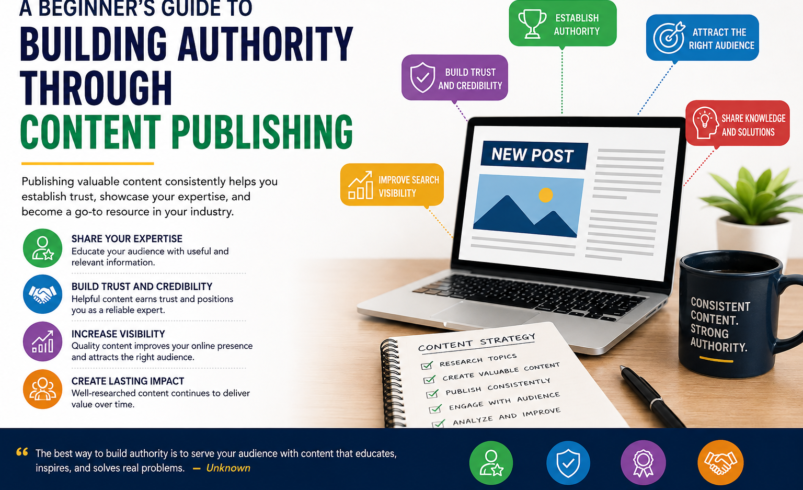
Building authority online does not happen overnight. You can have a professional website, a strong product, or years of industry experience, but people need a reason to trust what you say. One of the most practical ways to demonstrate knowledge and build that trust is through consistent, useful content publishing. For beginners, opportunities such as a free guest post can provide a way to introduce your expertise to audiences beyond your own website without requiring a large marketing budget.
Content publishing is about much more than getting an article published on another website. Done properly, it helps you demonstrate experience, answer real questions, create useful resources, connect with relevant audiences, and develop a recognizable voice within your industry. For businesses targeting customers in the United States, this can be especially valuable because consumers have access to an enormous amount of online information and often compare multiple sources before making decisions.
You may also encounter free article submission sites while researching ways to distribute your writing. These platforms can provide additional publishing opportunities, but beginners should evaluate them carefully. A website being free does not automatically make it authoritative or valuable. Relevance, content quality, editorial standards, audience, and trust should always come first.
The good news is that authority does not require you to become famous or publish hundreds of articles. It starts with consistently sharing information that is accurate, useful, original, and genuinely relevant to the people you want to reach.
What Does Online Authority Actually Mean?
Online authority is the level of trust and recognition you develop around a particular subject.
Imagine someone needs advice about local search marketing. They find two websites. One has a few generic articles filled with promotional language. The other regularly publishes detailed guides, practical examples, original insights, and well-supported information from someone who clearly understands the industry.
Which source would you trust?
Most people will naturally lean toward the second.
Authority is created through repeated demonstrations of knowledge and reliability. It is not simply about how many articles you publish or how many websites mention your name.
Strong authority can come from:
- Demonstrated industry experience
- Helpful educational content
- Accurate and well-supported information
- Consistent publishing
- Expert contributions
- Positive professional relationships
- Recognition from relevant publications
- Genuine audience engagement
- Transparent authorship
This is why content publishing can become such a powerful long-term strategy.
Why Content Is Important for Building Trust
People rarely trust a business simply because it says, “We are experts.”
They want evidence.
A company that regularly publishes useful information gives its audience an opportunity to see how it thinks and solves problems.
For example, a U.S. accounting firm could publish articles explaining common tax considerations for small businesses. A healthcare marketing agency could explain practical ways medical practices can improve their digital presence. A home improvement company could publish maintenance guides based on real customer questions.
These articles demonstrate knowledge before a potential customer ever makes contact.
According to the Content Marketing Institute, content marketing continues to be widely used by organizations because it can support awareness, engagement, and customer relationships. The exact results vary by industry and strategy, but the underlying principle remains straightforward: useful information gives businesses an opportunity to earn attention rather than simply purchase it.
Start With a Specific Area of Expertise
Beginners often make their content too broad.
They want to write about everything related to their industry. That can make it difficult for readers to understand what they actually specialize in.
Instead, choose a focused area.
For example, instead of positioning yourself as an expert in “marketing,” you could focus on:
- Local SEO for small businesses
- Content marketing for healthcare companies
- Digital marketing for restaurants
- SEO for eCommerce stores
- Social media marketing for professional services
A focused subject makes it easier to create consistent content and develop recognition.
When readers repeatedly encounter useful information from you about a particular topic, they begin to associate your name or brand with that subject.
Understand Your Audience Before You Publish
Authority is audience-specific.
An article can be technically excellent and still fail if it is written for the wrong people.
Before creating content, ask:
Who am I trying to help?
If you target small businesses in the United States, your examples should reflect their circumstances. If your audience consists of healthcare professionals, use appropriate terminology and focus on their actual challenges.
Research the questions your audience is asking.
You can find ideas through:
- Customer conversations
- Online communities
- Search suggestions
- Industry publications
- Frequently asked questions
- Sales team feedback
- Support inquiries
- Competitor content gaps
- Professional forums
Your audience’s questions can become your content roadmap.
Create Content That Solves Real Problems
Authority grows when your content is useful.
A reader should be able to finish your article and think, “I learned something valuable.”
That does not mean every article needs to reveal groundbreaking research. Practical explanations can be just as valuable.
For example:
- Explain a confusing concept in simple language.
- Provide a step-by-step process.
- Compare common approaches.
- Explain mistakes beginners should avoid.
- Share lessons from practical experience.
- Summarize important research.
- Answer frequently asked questions.
Think about the reader’s situation before thinking about keywords.
If your content genuinely helps people solve problems, authority becomes a natural result of consistently providing value.
Follow Google’s E-E-A-T Principles
Google’s E-E-A-T framework stands for Experience, Expertise, Authoritativeness, and Trustworthiness.
Although E-E-A-T is not a simple ranking score, it provides a useful framework for creating content people can trust.
Experience
Show practical experience when appropriate.
Explain what you have personally observed or learned. Real examples can make content more credible and relatable.
Expertise
Demonstrate that you understand the subject.
Avoid vague statements. Explain concepts clearly and provide useful context.
Authoritativeness
Build recognition over time.
Contributing to respected publications, being referenced by relevant sources, and developing a strong professional presence can support authority.
Trustworthiness
Be accurate and transparent.
Cite important claims, avoid exaggerated promises, disclose relevant relationships, and correct mistakes when necessary.
These principles are particularly important for topics that can significantly affect people’s finances, health, safety, or major decisions.
Use Guest Publishing to Expand Your Reach
Publishing on your own website is important, but your audience may initially be limited.
Guest publishing provides another way to reach people.
A free guest post on a relevant publication can introduce your expertise to readers who have never encountered your brand. More importantly, it gives you the opportunity to demonstrate your knowledge in an environment that already has an established audience.
However, not every guest publishing opportunity has the same value.
Prioritize publications that:
- Cover your industry
- Have relevant readers
- Publish useful content
- Maintain reasonable editorial standards
- Provide author information
- Are actively maintained
- Have a clear publishing purpose
Do not choose a website solely because it allows a link.
The audience and credibility of the publication matter more.
Research Publishing Opportunities Carefully
Beginners often search for lists of free article submission sites and immediately submit their content to as many platforms as possible.
That approach may seem efficient, but it can lead to poor results.
Use lists and directories as discovery tools, not guarantees of quality.
For example, a resource such as free article submission sites can help you discover potential platforms, but you should independently review each opportunity before publishing.
Check:
- Recent activity
- Content quality
- Topic relevance
- Author transparency
- Editorial policies
- Link policies
- Audience relevance
- Overall website credibility
A platform that accepts every article without review may not provide the same authority-building benefit as a publication that carefully selects contributors.
Choose Relevance Over Volume
One relevant publication can be more valuable than dozens of unrelated websites.
Imagine you run a cybersecurity company.
An article published on a respected technology or business security publication is likely to be more relevant than the same article appearing on a general website covering hundreds of unrelated topics.
Relevance creates context.
It helps readers understand why your expertise matters and makes your contribution feel natural.
When evaluating a website, ask:
Would my target customer actually read this publication?
If the answer is yes, it deserves further consideration.
Build a Strong Author Profile
Your author identity is another important part of authority building.
Whenever possible, maintain consistency across your:
- Name
- Professional title
- Company information
- Author biography
- Website
- Professional profiles
- Published articles
An author bio should explain who you are and why you are qualified to discuss the subject.
Keep it factual.
Instead of writing:
“John is the world’s greatest digital marketing expert.”
Say something more credible:
“John is a digital marketing strategist who works with small businesses on content strategy and local search visibility.”
Specificity creates credibility.
Use Data Responsibly
Statistics can make an article more persuasive, but only when they are accurate and relevant.
Do not add statistics simply to make an article look authoritative.
Before using a statistic, consider:
- Who collected the data?
- When was it published?
- What was the sample size?
- Does it actually support the claim?
- Is the source reputable?
- Is the information still current?
Government agencies, established research organizations, universities, recognized industry associations, and original research are often useful sources.
If you cannot verify a statistic, leave it out.
A simple, accurate explanation is better than an impressive-looking but unsupported number.
Avoid Overpromotional Content
One of the fastest ways to weaken authority is to turn educational content into an advertisement.
Readers can usually recognize promotional writing.
Instead of repeatedly mentioning your company, focus on the topic.
For example, if you are writing about local SEO, explain:
- Why local search matters
- How business information affects visibility
- How reviews influence consumer decisions
- What website elements businesses should improve
- How to measure progress
If your company is genuinely relevant, mention it naturally where appropriate and where publisher guidelines permit.
The content should remain useful even if the reader never becomes a customer.
Build Relationships With Publishers
Authority is not built through one article.
It develops through relationships.
When a publisher accepts your contribution, treat that opportunity professionally.
Read their future articles. Engage appropriately with their work. Respond promptly to editors. Offer useful ideas rather than repeatedly asking for promotional placements.
Over time, a publisher may invite you to:
- Contribute additional articles
- Participate in interviews
- Provide expert comments
- Join a podcast
- Collaborate on research
- Participate in industry discussions
These opportunities can strengthen your professional reputation far beyond a single article.
Develop a Consistent Publishing Schedule
You do not need to publish every day.
Consistency is more important than frequency.
A realistic beginner schedule might involve:
- One high-quality article every week on your own website
- One guest contribution every few weeks
- Occasional industry commentary
- Regular updates to older evergreen content
The exact schedule depends on your resources.
The goal is to create a steady stream of useful information without sacrificing quality.
Publishing five weak articles is rarely better than publishing one excellent one.
Update Older Content
Authority also comes from maintaining existing information.
Industries change. Statistics become outdated. Tools evolve. Policies change.
Review your older articles periodically.
Ask:
- Are the statistics still accurate?
- Are the links working?
- Has industry guidance changed?
- Can the examples be improved?
- Are there new developments worth mentioning?
- Does the article still answer the reader’s question?
Updating valuable content demonstrates that you care about accuracy rather than simply publishing and forgetting.
Promote Your Published Work Naturally
Once your article is published, do not simply move on.
Share it where appropriate.
You might:
- Add it to your professional portfolio
- Share it on LinkedIn
- Include it in an email newsletter
- Mention it in relevant conversations
- Reference it in future content
- Send it to colleagues who may find it useful
Promotion should be natural.
Do not spam groups or communities with the same link repeatedly. Share the content when it genuinely contributes to the conversation.
Track Your Progress
Authority can be difficult to measure with one number.
Instead, watch for multiple signals.
Track:
- Organic search visibility
- Referral traffic
- Brand mentions
- Published contributions
- Invitations from publishers
- Social engagement
- Direct inquiries
- Qualified leads
- Audience growth
- Professional connections
Over several months, patterns may become visible.
You might discover that certain topics attract more readers or that a particular publication consistently sends relevant visitors.
Use this information to refine your strategy.
Common Mistakes Beginners Should Avoid
Publishing Everywhere
More placements do not automatically equal more authority.
Choosing Websites Only for Links
A link should be secondary to relevance and reader value.
Using Fake Expertise
Do not claim experience you do not have.
Ignoring Editorial Guidelines
Every publisher has different expectations.
Reusing the Same Article Everywhere
Create original content or significantly different versions where appropriate.
Overloading Articles With Keywords
Natural language is easier for readers to understand.
Using Unverified Statistics
Accuracy is more important than sounding impressive.
Expecting Immediate Results
Authority takes time.
A Simple Authority-Building Plan for Beginners
If you are just getting started, follow a simple process.
Step 1: Choose one core topic.
Select a subject where you have genuine knowledge or experience.
Step 2: Define your audience.
Understand who you want to help.
Step 3: Research questions.
Find common problems your audience wants solved.
Step 4: Create useful content.
Focus on practical answers rather than promotional language.
Step 5: Publish on your own platform.
Build a central library of expertise on your website.
Step 6: Find relevant external publications.
Look for websites that serve your target audience.
Step 7: Pitch carefully.
Send personalized and useful topic ideas.
Step 8: Build relationships.
Treat editors and publishers as professional partners.
Step 9: Track results.
Measure traffic, engagement, mentions, and opportunities.
Step 10: Keep improving.
Update old content and develop deeper expertise.
Why Patience Matters
Authority is cumulative.
One article rarely transforms a reputation. But dozens of useful contributions over time can create a recognizable body of work.
Think of each article as one piece of evidence.
One article says you know something.
Ten strong articles show consistent knowledge.
Contributions to respected publications show that other organizations value your expertise.
Positive audience responses demonstrate that your information is useful.
Together, these signals can create a stronger professional presence.
Authority is earned through repeated proof of value. Publish less for the sake of being seen and more for the sake of being useful.
Conclusion
Building authority through content publishing is one of the most accessible strategies available to beginners, especially when budgets are limited.
You do not need to publish on every website you can find. You do not need hundreds of backlinks. You do not need to call yourself an expert before you have demonstrated your knowledge.
Start small.
Choose a subject you understand. Learn what your audience needs. Create accurate and practical content. Publish consistently on your own website. Then expand your reach through relevant guest contributions and carefully selected publishing platforms.
A free guest post can introduce your expertise to a new audience, while reputable free article submission sites may provide additional distribution opportunities. But neither should become an excuse to publish low-quality content everywhere.
The strongest strategy is built around relevance, experience, accuracy, transparency, and genuine usefulness.
For businesses and professionals targeting audiences across the USA, this approach can help transform content from simple website material into a long-term authority-building asset.
When you consistently answer important questions, share practical knowledge, support claims with reliable information, and contribute to respected publications, people have more reasons to trust you.
And that is ultimately what authority is all about.
Frequently Asked Questions
1. What is the easiest way for a beginner to start building online authority?
Start by choosing one subject you understand well and create genuinely useful content around it. Publish consistently on your website and gradually contribute to relevant third-party publications.
2. Are free guest posts useful for building authority?
Yes, when they are published on relevant, credible websites. The value comes from demonstrating expertise to the right audience rather than simply obtaining a link.
3. Should beginners use free article submission sites?
They can, but careful evaluation is important. Look for active platforms with relevant audiences, useful content, clear policies, and reasonable editorial standards.
4. How long does it take to build online authority?
There is no fixed timeline. Authority generally develops gradually through consistent publishing, reliable information, professional relationships, and repeated demonstrations of expertise.
5. Should every article contain statistics and external links?
No. Use statistics and external references when they genuinely improve the article. Always prioritize accuracy and relevance rather than adding data or links simply to make content appear more authoritative.