

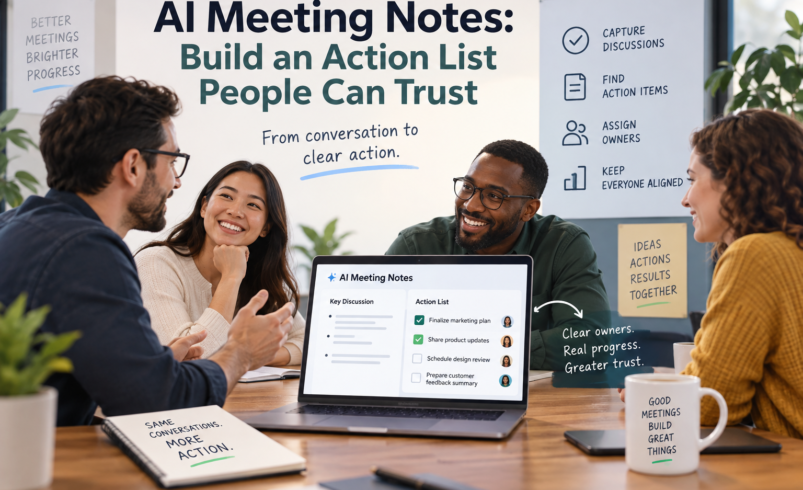

A meeting ends with several ideas, two decisions, and a promise to check something later. The next morning, the summary says every idea was approved. A proposed launch date appears as a deadline, and someone has been assigned work they never accepted.
AI meeting notes become useful when the review process protects those distinctions. The goal is to produce a record that helps people understand what happened and what requires attention. A short, accurate action list is more valuable than a polished account that quietly changes the agreement.
Begin with a source the team is allowed to use
You can work from manually written notes, an approved transcript, or another authorized meeting record. A recording is not required for this workflow. Before recording or uploading anything, follow the organization’s recording, consent, and data-handling requirements.
Select the relevant material rather than sending a whole archive. Remove unrelated personal details and side conversations that do not belong in the project record. Keep the original available to authorized reviewers so disputed statements can be checked.
If your input is incomplete, label it clearly. Notes covering only the final ten minutes cannot support a complete meeting summary. A useful assistant instruction is: “Summarize only the supplied material and identify any gaps that prevent a reliable action list.”
Give each statement the right status
A practical meeting record can use four categories: decisions, actions, proposals, and open questions. These categories describe different levels of commitment.
A decision records an agreed choice. An action records work someone has accepted. A proposal describes an option discussed without confirmed approval. An open question identifies information still needed.
For example, “We could move the launch to Thursday” is a proposal. “We agree to launch on Thursday” is a decision. “I will confirm whether Thursday is possible” is an action connected to an unresolved question. Similar wording can carry very different meaning.
Ask the assistant to preserve that meaning explicitly. Do not let a request for concise notes erase uncertainty just because uncertain language sounds less tidy.
Use an extraction prompt before asking for a summary
Start by finding the important statements. Writing the narrative first can make it harder to see where an interpretation entered the record.
Try this instruction:
Review the supplied meeting notes. Extract confirmed decisions, explicitly accepted actions, proposals, and open questions into separate sections. For each action, include the task, owner, deadline, and supporting source sentence. Write “not stated” for missing owners or dates. Do not convert suggestions into commitments. Flag ambiguous statements for human review.
The supporting sentence provides a quick route back to the evidence. If the source has timestamps or paragraph numbers, request those as well. Do not ask the assistant to create timestamps when the source does not contain them.
After checking the extraction, request a brief summary based on the approved items. This gives you a readable introduction without using it as the only record of what happened.
AI meeting notes need an owner-and-deadline check
Consider a fictional discussion about a website refresh. Lena says, “I can review the draft after the designer sends it.” Omar says, “The designer expects to send something next week.” No one agrees on a review deadline.
A careless action list might say: “Lena: approve the website next week.” That changes review into approval and converts an estimated delivery period into Lena’s deadline.
A more faithful entry would say: “Lena to review the draft after receipt; review deadline not stated.” The designer’s expected delivery belongs in a separate note, with its uncertainty intact.
For every action, ask three questions. Did this person accept the task? Does the wording describe the same work? Is the deadline explicit or inferred? When the source cannot answer, request clarification instead of silently completing the field.
This also prevents shared ownership from becoming no ownership. “The team will look at it” may need a coordinator before it becomes a useful task, but that assignment should come from the team.
Keep the final record easy to scan
Use a short structure that reflects how people will use the notes:
- Meeting purpose and date.
- Confirmed decisions.
- Actions with owners and deadlines.
- Proposals awaiting approval.
- Questions requiring answers.
Avoid repeating the same item across several sections. If a decision creates an action, describe the choice under decisions and the resulting work under actions. The two entries should add different information.
Include enough context for an absent colleague to understand the task. “Update it” is too vague. “Update the registration page with the approved workshop time” identifies both the object and the required change.
When evaluating note-taking workflows discussed by AI publications such as Aiera.blog, focus on whether the output can be traced back to the meeting. Readability helps, but a reviewer also needs a practical way to challenge an incorrect entry.
Review disagreements openly
Send the draft through the team’s normal review process before treating it as final. Ask participants to correct decisions, ownership, and dates, rather than requesting a vague approval of the entire document.
If two participants remember something differently, retain the item as unresolved until they clarify it. Repeatedly regenerating the summary will not establish what the group agreed.
Record meaningful corrections in the shared version. A changed deadline should not exist only in someone’s private message while the old date remains in the action list. Label the reviewed version so people know which document to use.
Measure the quality of the handoff
For a few meetings, track the types of corrections needed. Were owners missing? Were tentative dates presented as fixed? Did the summary omit an important dependency?
Use those patterns to improve the input and prompt. A recurring owner problem may be easier to fix by confirming responsibilities before the meeting ends. A recurring source problem may call for better manual notes.
The best result is a record that supports the next step without creating new confusion. Use AI to organize the material, preserve uncertainty where it exists, and let the people responsible confirm the commitments. That is how meeting notes become a dependable working document.