

Artificial Intelligence (AI) is rapidly changing how businesses operate, compete, and serve their customers. From automating repetitive processes to delivering personalized experiences and generating valuable insights, AI has become an important technology for modern business growth. However, successfully implementing AI requires more than simply adopting new tools. Businesses need a clear strategy, suitable technologies, quality data, and the right implementation approach.
This is where AI technology consulting plays an important role. AI consultants help organizations identify practical AI opportunities, select appropriate technologies, develop implementation strategies, and align AI initiatives with measurable business objectives.
For businesses looking to move from AI experimentation to real business outcomes, strategic consulting can make the difference between an expensive technology investment and a valuable long-term solution.
What Is AI Technology Consulting?
AI technology consulting is a professional service that helps businesses understand, plan, implement, and optimize artificial intelligence technologies according to their specific needs.
Instead of recommending AI simply because it is a popular technology, consultants evaluate a company’s existing processes, challenges, data, infrastructure, and business goals. They then identify where AI can deliver meaningful improvements.
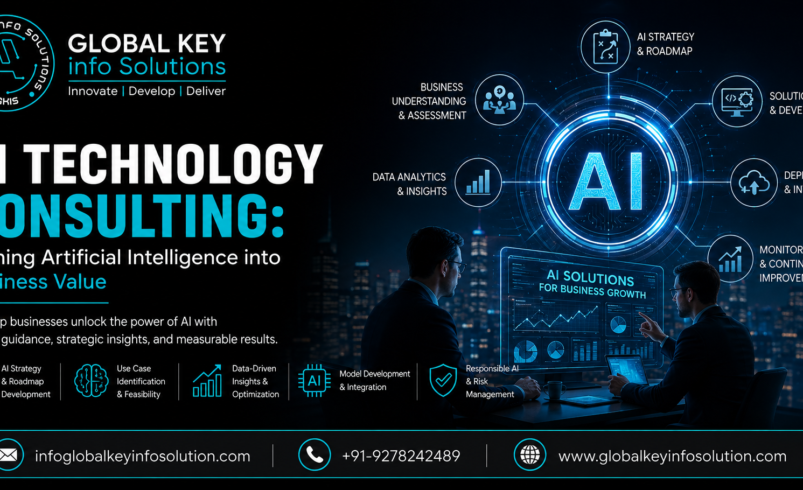
AI technology consulting may include:
- AI strategy and roadmap development
- AI opportunity identification
- Machine learning consulting
- Generative AI consulting
- AI chatbot and virtual assistant strategy
- Computer vision consulting
- Natural language processing solutions
- AI automation
- Data and AI infrastructure planning
- AI model selection and integration
- AI governance and security
- Performance monitoring and optimization
The goal is to connect AI capabilities with real business requirements.
Why Businesses Need AI Consulting
Many organizations understand the potential of AI but struggle with deciding where and how to use it. Implementing AI without a clear strategy can result in unnecessary costs, complicated systems, poor adoption, and limited returns.
AI consulting helps businesses overcome these challenges by providing a structured approach.
1. Identify the Right AI Opportunities
Not every business problem requires AI. Consultants analyze business workflows and identify processes where AI can provide measurable benefits.
For example, AI may be useful for:
- Automating customer support
- Predicting customer behavior
- Detecting unusual transactions
- Analyzing large datasets
- Automating document processing
- Personalizing recommendations
- Forecasting demand
- Improving operational efficiency
This ensures that AI investments focus on valuable use cases.
2. Build a Practical AI Strategy
A successful AI initiative requires more than selecting a model or software platform. Businesses need a roadmap covering technology, data, infrastructure, people, security, and scalability.
An AI consultant can create a strategy that defines:
- Business objectives
- Priority AI use cases
- Required technologies
- Data requirements
- Implementation stages
- Estimated resources
- Integration requirements
- Security considerations
- Key performance indicators
This provides businesses with a clear path from planning to implementation.
How AI Technology Creates Business Value
The true value of AI comes from solving business problems rather than simply adopting advanced technology.
Improving Operational Efficiency
AI can automate repetitive and time-consuming tasks, allowing employees to focus on more strategic activities. Intelligent automation can support areas such as data entry, document analysis, customer inquiries, reporting, and workflow management.
This can help businesses reduce manual effort and improve productivity.
Enhancing Customer Experiences
Modern customers expect fast, relevant, and personalized interactions. AI-powered chatbots, recommendation engines, sentiment analysis, and virtual assistants can help businesses provide more responsive customer experiences.
For example, an AI chatbot can answer frequently asked questions around the clock, while recommendation systems can suggest products based on customer behavior.
Supporting Better Decision-Making
Businesses generate enormous amounts of data every day. AI can analyze this information and identify patterns that may be difficult to discover manually.
AI-driven analytics can help organizations understand:
- Customer preferences
- Sales trends
- Market opportunities
- Operational bottlenecks
- Potential risks
- Demand patterns
These insights can support faster and more informed business decisions.
Reducing Costs
AI-powered automation can reduce the amount of manual work required for repetitive processes. Predictive systems can also help businesses identify operational inefficiencies and prevent potential problems before they become expensive.
When implemented strategically, AI can contribute to long-term cost optimization.
Key AI Consulting Services for Businesses
A professional AI technology consulting company can provide a range of services based on an organization’s requirements.
AI Strategy Consulting
AI strategy consulting focuses on developing a roadmap for adopting artificial intelligence. Consultants evaluate the company’s goals and recommend suitable AI initiatives.
Generative AI Consulting
Generative AI can create text, images, code, summaries, and other forms of content. Consulting services can help businesses identify safe and valuable applications of technologies such as large language models and generative AI platforms.
Machine Learning Consulting
Machine learning can help businesses develop predictive models for forecasting, classification, recommendations, fraud detection, customer analytics, and other applications.
AI Chatbot Consulting
AI chatbot consulting helps businesses design intelligent conversational systems for customer service, sales, internal support, and lead generation.
Computer Vision Consulting
Computer vision enables systems to analyze images and video. It can support applications such as quality inspection, object detection, security monitoring, healthcare analysis, and retail analytics.
AI Integration Consulting
Businesses often already use CRM, ERP, cloud, e-commerce, and other enterprise systems. AI consultants can help integrate AI capabilities into existing technology environments.
Steps to Implement an Effective AI Strategy
A structured implementation process can improve the chances of AI project success.
Step 1: Understand Business Objectives
The first step is to clearly define what the organization wants to achieve. Objectives may include improving customer service, reducing operational costs, increasing sales, or improving productivity.
Step 2: Identify High-Value Use Cases
Organizations should prioritize AI applications based on business impact, technical feasibility, available data, and implementation complexity.
Step 3: Assess Data Readiness
AI systems depend heavily on quality data. Consultants evaluate data availability, quality, security, accessibility, and governance before implementation.
Step 4: Select the Right Technology
Depending on the use case, businesses may need machine learning models, generative AI, NLP, computer vision, cloud AI platforms, or custom AI applications.
Step 5: Develop and Test the Solution
A pilot or proof of concept can help organizations validate an AI solution before making a larger investment.
Step 6: Integrate with Existing Systems
The AI solution should work effectively with the company’s existing applications and workflows.
Step 7: Monitor and Optimize
AI systems require ongoing monitoring. Businesses should track performance, accuracy, security, user adoption, and business outcomes and make improvements when necessary.
Challenges Businesses Should Consider
AI implementation can provide significant benefits, but businesses should also understand potential challenges.
Data Quality
Poor-quality or incomplete data can affect AI performance. Organizations should establish effective data management practices before deploying AI at scale.
Security and Privacy
AI systems may process sensitive business or customer information. Security controls, access management, encryption, and responsible data practices are essential.
Integration Complexity
Integrating AI into legacy systems can be challenging. A proper technical assessment can help reduce integration risks.
Employee Adoption
AI is most effective when employees understand how to use it. Training and change management can improve adoption and productivity.
Scalability
An AI solution should be designed with future growth in mind. Businesses should consider increasing data volumes, users, integrations, and computing requirements.
Measuring the ROI of AI
AI investments should be evaluated using measurable business outcomes. Depending on the project, organizations can track metrics such as:
- Cost savings
- Productivity improvements
- Customer satisfaction
- Lead conversion rates
- Response times
- Revenue growth
- Employee efficiency
- Process automation rates
- Error reduction
- Customer retention
By connecting AI initiatives to measurable KPIs, businesses can better understand whether their technology investments are delivering real value.
Why Choose Global Key Info Solutions for AI Technology Consulting?
Global Key Info Solutions helps businesses explore and implement technology solutions designed around their specific requirements. Our AI technology consulting approach focuses on identifying practical opportunities where artificial intelligence can improve operations, customer experiences, decision-making, and business growth.
Our team can support businesses with AI strategy, machine learning, generative AI, AI chatbot solutions, computer vision, automation, and AI application development.
We focus on understanding the business challenge first and then recommending the technology approach. This helps organizations avoid unnecessary complexity while building AI solutions that can evolve with their business.
Conclusion
Artificial Intelligence has moved beyond being an emerging technology and is becoming an important component of modern business strategy. However, successful AI adoption depends on choosing the right use cases, technologies, data strategies, and implementation processes.
AI technology consulting helps businesses transform AI from an experimental concept into a practical business capability. With the right strategy and implementation partner, organizations can use AI to improve efficiency, enhance customer experiences, make smarter decisions, reduce costs, and create new opportunities for growth.
For businesses ready to turn artificial intelligence into measurable business value, working with an experienced AI technology consulting company can provide the expertise and strategic direction needed to move forward with confidence.
Frequently Asked Questions
- What is AI technology consulting?
AI technology consulting helps businesses identify, plan, implement, and optimize AI solutions according to their business goals and technical requirements. - How can AI consulting benefit a business?
AI consulting can help businesses identify valuable use cases, automate processes, improve decision-making, enhance customer experiences, and optimize technology investments. - What types of AI solutions can businesses implement?
Businesses can implement AI chatbots, predictive analytics, generative AI applications, machine learning models, computer vision systems, recommendation engines, and intelligent automation solutions. - Why is an AI strategy important?
An AI strategy provides a structured roadmap for selecting use cases, technologies, data requirements, implementation priorities, security measures, and performance metrics. - Can AI consulting help small and medium-sized businesses?
Yes. AI consulting can help SMEs identify cost-effective AI opportunities and prioritize solutions that provide practical business value without unnecessary technology investments.