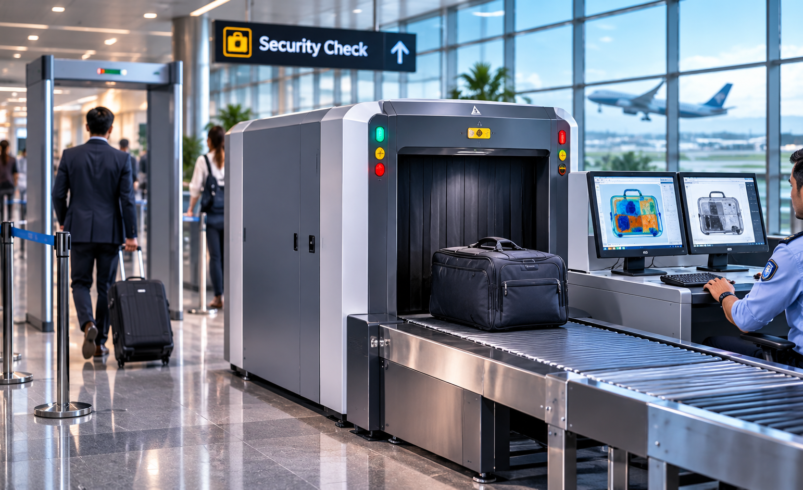

Security screening has become an important part of airports, railway stations, metro stations, corporate offices, hotels, malls, government buildings and other high-security facilities. One of the most widely used technologies for inspecting luggage and packages is the baggage scanner.
A baggage scanner allows security personnel to inspect the contents of a bag without opening it manually. By using X-ray imaging technology, the operator can examine objects inside luggage and identify items that may require further inspection.
As organizations look for faster and more reliable security screening, modern X-ray baggage scanners have become an important part of security infrastructure.
What Is a Baggage Scanner?
A baggage scanner is an electronic security inspection machine designed to scan luggage, bags, parcels and other items using X-ray technology.
Instead of physically opening every bag, the luggage passes through a scanning tunnel on a conveyor belt. The system generates an X-ray image of the contents, which is displayed on a monitor for a trained security operator.
This makes baggage screening faster and can help security teams identify potentially dangerous or prohibited objects before they enter a protected area.
A modern baggage scanner machine can be used in both public and private facilities where controlled access and security screening are important.
How Does an X-Ray Baggage Scanner Work?
The basic working process of an X-ray baggage scanner is straightforward.
1. Baggage is placed on the conveyor
The passenger, visitor or security staff member places the bag on the conveyor belt of the scanner.
2. The bag enters the scanning tunnel
The conveyor moves the baggage through the protected X-ray inspection tunnel.
3. X-rays pass through the baggage
X-rays pass through the contents of the bag. Different materials absorb X-rays differently, allowing the system to create an image of objects inside.
4. The image is displayed on a monitor
The scanner processes the information and displays an image that can be examined by a trained security operator.
5. Suspicious items can be investigated
If the operator notices an unusual or potentially prohibited object, the bag can be separated for additional inspection according to the facility’s security procedures.
This process allows security teams to screen large numbers of bags without relying entirely on manual inspection.
Why Are Baggage Scanners Important?
Manual baggage checking can take considerable time, especially at locations with high visitor or passenger traffic. An X-ray baggage scanner helps security teams inspect bags more efficiently while maintaining a controlled screening process.
Some important advantages include:
- Faster baggage screening
- Non-intrusive inspection of luggage
- Better visibility of concealed objects
- Reduced dependence on manually opening every bag
- Improved security at entry checkpoints
- Support for high-volume security screening
- More organized security operations
The exact capabilities of a scanner depend on its model, imaging technology, tunnel size, software and configuration.
Where Are Baggage Scanners Used?
Baggage scanners are not limited to airports. They can be deployed wherever organizations need to inspect bags and parcels before allowing them into a controlled environment.
Airports
Airports are one of the most common applications for baggage scanning technology. Large passenger volumes make fast and consistent security screening essential.
Metro and Railway Stations
Metro and railway facilities can use X-ray baggage scanners at security checkpoints to inspect passenger luggage and other items.
Government Buildings
Government offices and other sensitive facilities may use baggage scanners as part of a multi-layered security system.
Corporate Offices
Large corporate campuses, IT parks and business facilities can use baggage screening at selected entry points to improve visitor and employee security.
Hotels and Malls
Hotels, shopping malls and commercial buildings can deploy baggage scanners where visitor traffic and security requirements justify baggage inspection.
Events and Stadiums
Large events can attract significant crowds. Baggage screening can be incorporated into the entrance security process to help manage potential security risks.
Logistics and Other Facilities
Depending on the equipment configuration, X-ray scanning technology can also be used for parcels, packages and other items in logistics and industrial environments.
What Should You Consider When Selecting a Baggage Scanner?
Choosing a baggage scanner should not be based only on price. The equipment should match the security requirements and operating environment of the facility.
Here are some factors to consider.
Tunnel Size
The tunnel should be large enough to accommodate the bags or packages that need to be screened. A facility handling small handbags may have different requirements from an airport or logistics operation.
Image Quality
Clear X-ray images are important because operators need to examine the contents of baggage effectively.
Material Discrimination
Different materials interact differently with X-rays. Depending on the scanner technology, material discrimination features can help operators understand the contents of a bag more effectively.
Conveyor Capacity
For high-traffic environments, conveyor performance and throughput are important considerations. The scanner should be capable of supporting the expected screening volume.
Operator Interface
A simple and effective operator interface can make the screening process easier and help security personnel review images efficiently.
Installation and Maintenance
Organizations should also consider installation requirements, operator training, technical support and long-term maintenance before selecting a security scanner.
Baggage Scanner Manufacturer in India
When selecting a baggage scanner manufacturer in India, organizations should look beyond the machine itself.
A reliable security technology provider should understand the application, site conditions, expected traffic and security requirements before recommending a solution.
Houston Systems provides security and access-control solutions for organizations looking to improve the safety and efficiency of their facilities. Its security product range includes baggage scanning solutions designed for environments where controlled inspection of luggage and packages is required.
For organizations evaluating an X-ray baggage scanner, it is useful to discuss the required application, baggage dimensions, expected traffic and security requirements before choosing the appropriate system.
You can explore Houston Systems’ baggage scanner solution here:
Baggage Scanner Solutions by Houston Systems
Baggage Scanner vs Manual Baggage Checking
Manual checking requires security personnel to physically open and inspect a bag. While manual inspection can still be useful as a secondary security measure, performing it on every bag can slow down the entry process.
A baggage scanner provides a non-intrusive first-level inspection. Security personnel can review the X-ray image and decide whether additional physical inspection is necessary.
This combination can make the overall security checkpoint more structured and efficient.
Are Baggage Scanners Suitable for Every Facility?
Not necessarily. The right security equipment depends on the facility’s risk profile, traffic level, baggage types and operational requirements.
For example, a small corporate office may have very different requirements from an international airport or a large railway station.
Before purchasing an X-ray baggage scanner, organizations should evaluate:
- Type and size of baggage
- Expected number of bags per hour
- Available installation space
- Required screening level
- Operating environment
- Integration with other security systems
- Service and maintenance requirements
A proper site assessment can help organizations select equipment that is appropriate for their actual requirements.
The Future of Baggage Screening
Security screening technology continues to develop as organizations look for better detection, faster processing and improved operator efficiency.
Modern screening systems are increasingly being developed around improvements in imaging, image processing, automation and intelligent threat detection.
For high-security environments, the future of baggage screening is likely to involve increasingly integrated security checkpoints where baggage scanners work alongside other technologies such as access control, metal detectors, surveillance systems and visitor management solutions.
Final Thoughts
A baggage scanner is an important security technology for inspecting luggage and packages without opening them manually. From airports and railway stations to corporate offices, malls, hotels and government facilities, X-ray baggage scanning can support faster and more organized security screening.
However, selecting the right scanner requires more than simply comparing prices. Tunnel size, imaging capabilities, throughput, application requirements, installation and after-sales support should all be considered.
For organizations looking for a baggage scanner manufacturer in India, Houston Systems can be considered as a security technology provider for baggage screening and related security requirements.
To learn more about baggage scanner solutions, visit: Houstonsystems.in
Frequently Asked Questions
What is a baggage scanner?
A baggage scanner is a security inspection machine that uses X-ray technology to examine the contents of luggage, bags and packages without opening them.
What is an X-ray baggage scanner used for?
It is used to inspect luggage and packages at security checkpoints and identify objects that may require additional inspection.
Where are baggage scanners used?
They are commonly used at airports, railway and metro stations, government facilities, corporate offices, hotels, malls, stadiums and other controlled environments.
How does a baggage scanner work?
Baggage moves through an X-ray scanning tunnel on a conveyor. The system creates an image of the contents, which is displayed to a trained operator for examination.
How do I choose a baggage scanner?
Consider tunnel size, baggage dimensions, expected traffic, image quality, operating requirements, installation space, maintenance and technical support.
Who manufactures baggage scanners in India?
Houston Systems is one of the security technology providers that offers baggage scanning solutions for organizations requiring controlled luggage inspection.