

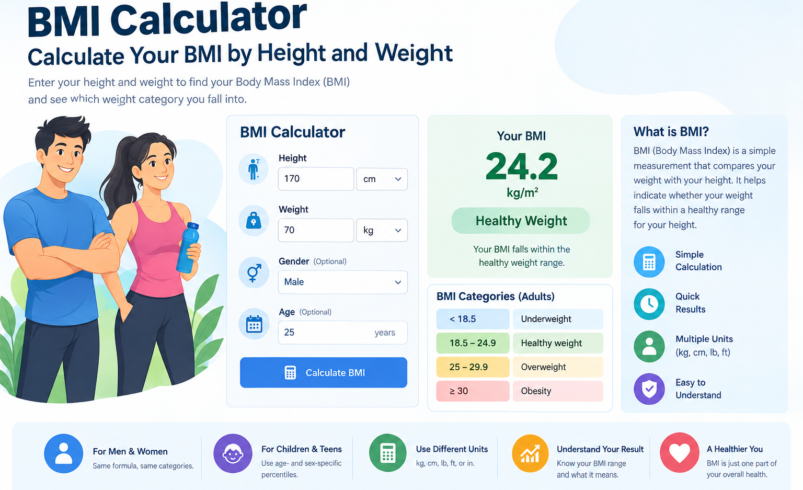

BMI Calculator: Calculate Your BMI by Height and Weight
Use this BMI calculator to calculate your Body Mass Index from your height and weight. Enter your measurements in metric or US units to get your BMI value and understand which standard weight category it falls into.
What Is BMI?
BMI, or Body Mass Index, is a measurement that compares a person’s weight with their height. It is commonly used as a screening measure to assess whether an adult’s weight falls within a standard range for their height.
A BMI calculation uses two basic measurements: body weight and height. The result is expressed in kilograms per square meter (kg/m²).
For adults aged 20 and older, the standard BMI categories are:
| BMI Range | Weight Category |
|---|---|
| Below 18.5 | Underweight |
| 18.5 to less than 25 | Healthy weight |
| 25 to less than 30 | Overweight |
| 30 or higher | Obesity |
These ranges are used for adults regardless of sex or age. However, BMI is only one health indicator and should be considered alongside other factors rather than used as a complete assessment of health.
How to Use the BMI Calculator
Using an online BMI calculator is simple. You only need your height and weight.
Step 1: Enter your height
Enter your height using the unit you know best. Depending on the calculator, you may be able to enter height in:
- Centimeters
- Meters
- Feet and inches
Step 2: Enter your weight
Enter your current body weight in:
- Kilograms
- Pounds
Step 3: Calculate your BMI
Select the calculate option to receive your BMI value. The result can then be compared with the standard adult BMI range to identify the corresponding weight category.
You do not need to calculate the formula manually when using an online BMI calculator.
BMI Formula
The standard BMI formula for metric measurements is:
BMI = weight in kilograms ÷ height in meters²
For example, if someone weighs 70 kg and is 1.75 meters tall:
BMI = 70 ÷ (1.75 × 1.75)
BMI = 22.9 kg/m²
This falls within the standard healthy-weight BMI range for adults.
If you are using centimeters instead of meters, you can use:
BMI = weight (kg) ÷ height (cm)² × 10,000
For US customary measurements, the formula is:
BMI = weight (lb) ÷ height (in)² × 703
These formulas are used to calculate BMI from height and weight.
BMI Calculator in kg and cm
If your weight is measured in kilograms and your height is measured in centimeters, you can calculate BMI without converting your measurements to pounds or feet.
Use:
BMI = weight (kg) ÷ height (cm)² × 10,000
For example, a person weighing 80 kg with a height of 180 cm would have:
BMI = 80 ÷ (180 × 180) × 10,000
BMI = 24.7 kg/m²
An online BMI calculator can perform this calculation automatically, reducing the chance of mistakes when entering or converting measurements.
BMI Calculator in kg and Feet
If your weight is in kilograms but your height is given in feet and inches, you need to convert the height into meters before using the metric BMI formula.
For example, a height of 5 feet 8 inches is approximately 1.73 meters.
You can then use:
BMI = weight (kg) ÷ height (m)²
If your calculator supports both metric and imperial measurements, you can simply select the appropriate height and weight units instead of performing the conversion yourself.
BMI Calculator by Age and Gender
Many people search for a BMI calculator by age and gender because they want to know whether BMI changes according to age or sex.
For adults aged 20 and older, the standard BMI categories are based on the BMI value itself and are not separated into different adult ranges for men and women.
Age and sex become particularly important when evaluating BMI in children and teenagers.
For people ages 2 through 19, BMI is interpreted using BMI-for-age percentiles. The result is compared with other children of the same age and sex because children and teenagers are still growing.
Therefore, an adult BMI calculator should not be used to interpret a child’s BMI in the same way as an adult result.
BMI Calculator for Men
A BMI calculator for men uses the same basic adult BMI formula as a BMI calculator for women.
For an adult man, BMI is calculated from:
Weight + height → BMI value
The standard adult categories are:
- Below 18.5: Underweight
- 18.5 to less than 25: Healthy weight
- 25 to less than 30: Overweight
- 30 or higher: Obesity
BMI does not directly measure muscle mass, body fat percentage, or fat distribution. This is particularly important for muscular men and athletes, whose BMI may be higher because of greater muscle mass.
BMI Calculator for Women
A BMI calculator for women also uses the standard adult BMI formula based on height and weight.
For women aged 20 and older, the same standard adult BMI categories are used.
However, BMI should not be treated as a complete measure of an individual’s health. Factors such as body composition, medical history, physical activity, and other health measurements can provide additional context.
A woman’s BMI can therefore be calculated using the same basic formula:
BMI = weight (kg) ÷ height (m)²
BMI Calculator for Adults
For adults, BMI provides a quick way to compare body weight with height.
The standard adult categories are:
| BMI | Category |
|---|---|
| Less than 18.5 | Underweight |
| 18.5 to less than 25 | Healthy weight |
| 25 to less than 30 | Overweight |
| 30 or greater | Obesity |
Obesity can be further divided into classes:
| BMI | Obesity Class |
|---|---|
| 30 to less than 35 | Class 1 |
| 35 to less than 40 | Class 2 |
| 40 or greater | Class 3 |
These categories are intended for adults aged 20 and older.
What Is a Normal BMI?
For adults, a BMI from 18.5 to less than 25 is classified as the standard healthy-weight range.
A BMI below 18.5 is classified as underweight, while a BMI from 25 to less than 30 falls into the overweight category. A BMI of 30 or higher falls into the obesity category.
The term “normal BMI” is often used to describe the healthy-weight range, but BMI should not be interpreted as a diagnosis or as a guarantee of good health.
BMI Range and BMI Chart
A BMI chart provides a quick visual reference for comparing a BMI value with standard categories.
For adults:
| BMI Range | Classification |
|---|---|
| < 18.5 | Underweight |
| 18.5–24.9 | Healthy weight |
| 25.0–29.9 | Overweight |
| 30.0+ | Obesity |
Your BMI value is calculated from your height and weight and then placed within one of these ranges.
Keep in mind that BMI categories are screening categories. They do not show exactly how much body fat a person has or where that fat is distributed.
How to Calculate BMI Yourself
If you want to calculate BMI without a calculator, follow these steps:
- Measure your weight in kilograms.
- Measure your height in meters.
- Multiply your height by itself.
- Divide your weight by the squared height.
- Compare the result with the standard adult BMI ranges.
For example:
Weight: 75 kg
Height: 1.80 m
BMI = 75 ÷ (1.80 × 1.80)
BMI = 23.1 kg/m²
The calculation places this example within the standard healthy-weight category for adults.
Using an online BMI calculator is usually faster because it performs the calculation automatically.
Does Age Affect BMI?
Age does not change the standard BMI category ranges used for adults aged 20 and older. For adults, the same standard categories are used regardless of age or sex.
However, age matters when interpreting BMI for children and teenagers.
For people ages 2 through 19, BMI is interpreted according to age and sex using percentile-based growth charts. A child’s BMI value is therefore not evaluated using the adult 18.5, 25, and 30 cutoffs.
This distinction is important when using a BMI calculator with age.
BMI for Children and Teenagers
Children and teenagers should not be assessed using adult BMI categories.
For ages 2 through 19, BMI is calculated from height and weight, but the result is then interpreted as a BMI-for-age percentile.
The CDC categories include:
- Below the 5th percentile: Underweight
- 5th percentile to less than the 85th percentile: Healthy weight
- 85th percentile to less than the 95th percentile: Overweight
- 95th percentile or higher: Obesity
The percentile is based on comparisons with children of the same age and sex.
If you are checking BMI for a child or teenager, use a calculator designed specifically for their age group rather than applying adult BMI ranges.
What Does My BMI Mean?
Your BMI gives you a numerical value that can be compared with a standard classification.
For an adult:
Below 18.5: Your BMI is in the underweight range.
18.5 to less than 25: Your BMI is in the healthy-weight range.
25 to less than 30: Your BMI is in the overweight range.
30 or higher: Your BMI is in the obesity range.
These classifications are useful for screening, but they do not tell the complete story about an individual’s health. BMI should be considered together with other relevant factors.
Is BMI an Accurate Measurement?
BMI is useful because it is simple, inexpensive, and easy to calculate, but it has limitations.
BMI is based only on height and weight. It does not directly measure:
- Body fat percentage
- Muscle mass
- Bone mass
- Fat distribution
- Overall fitness
- Individual medical history
For example, a person with a large amount of muscle may have a higher BMI even though they have relatively little body fat.
This is why BMI should be treated as a screening measure rather than a complete assessment of body composition or health.
BMI vs. Body Fat
BMI and body fat are related concepts, but they are not the same measurement.
BMI compares weight with height. It does not determine what percentage of that weight comes from fat, muscle, bone, or other tissues.
A body fat measurement can provide different information about body composition. Depending on the situation, other measurements and health indicators may also be useful.
For this reason, someone with a higher BMI does not automatically have an unhealthy level of body fat, and someone with a BMI in the healthy range does not necessarily have an ideal body composition.
Can BMI Be Used for Men and Women?
Yes. The same standard adult BMI calculation can be used for both men and women.
For adults aged 20 and older, the standard BMI categories are not divided into separate male and female ranges.
However, sex is relevant when interpreting BMI in children and teenagers because their BMI is compared with age- and sex-specific reference populations.
How to Get a More Useful BMI Result
For the most useful calculation:
- Use an accurate weight measurement.
- Measure your height carefully.
- Use consistent units.
- Enter your current measurements.
- Make sure you are using the correct calculator for your age group.
- Interpret BMI as a screening result rather than a diagnosis.
Small differences in height or weight can change the calculated BMI, particularly when measurements are rounded.
Frequently Asked Questions About BMI Calculator
What is a BMI calculator?
A BMI calculator is a tool that calculates Body Mass Index using a person’s height and weight. For adults, the resulting BMI value can be compared with standard weight-status categories.
How do I calculate my BMI?
To calculate BMI manually, divide your weight in kilograms by your height in meters squared.
BMI = weight (kg) ÷ height (m)²
An online BMI calculator performs this calculation automatically.
What is the BMI formula?
The metric BMI formula is:
BMI = weight in kilograms ÷ height in meters²
For US customary measurements:
BMI = weight in pounds ÷ height in inches² × 703.
What is a healthy BMI for adults?
For adults aged 20 and older, a BMI from 18.5 to less than 25 is classified as the healthy-weight range.
Is BMI different for men and women?
The standard adult BMI calculation and categories are the same for men and women. BMI interpretation for children and teenagers is different because their results are evaluated using age- and sex-specific percentiles.
Can I calculate BMI using kg and cm?
Yes. If your weight is in kilograms and height is in centimeters, use:
BMI = weight (kg) ÷ height (cm)² × 10,000
You can also enter these measurements directly into a metric BMI calculator.
Can I calculate BMI using kg and feet?
Yes, but height must be converted to meters before applying the metric BMI formula. Alternatively, use a calculator that accepts feet and inches directly.
Does BMI measure body fat?
No. BMI is calculated from height and weight and does not directly measure body fat. It is a screening measure that should be considered with other health information.
Should children use an adult BMI calculator?
No. Children and teenagers ages 2 through 19 should have BMI interpreted using age- and sex-specific BMI percentiles rather than adult BMI categories.
What does a BMI of 25 mean?
For an adult aged 20 or older, a BMI of 25 falls at the beginning of the overweight category because the healthy-weight category ends below 25.
What does a BMI of 30 mean?
For an adult aged 20 or older, a BMI of 30 is within the obesity category. BMI should still be considered a screening measure rather than a diagnosis.
Final Thoughts
A BMI calculator provides a quick way to calculate your Body Mass Index from your height and weight. It can help you understand where your BMI falls within standard adult categories and can be useful for basic weight-status screening.