

Living in a flat has many advantages, especially in a busy city like London. However, when bed bugs appear in one property, residents may worry about whether the insects can spread into neighbouring homes.
The concern is understandable.
Bed bugs are small, flat insects that can hide in narrow gaps and travel between connected spaces. Although they are often introduced through luggage, clothing or furniture, they can also move within buildings under certain conditions.
This is particularly relevant in converted houses, blocks of flats and shared accommodation where several households live close together.
Understanding how bed bugs spread can help tenants, homeowners and landlords respond before a localised problem becomes more difficult to manage.
Can Bed Bugs Travel From One Flat to Another?
Yes. Bed bugs can sometimes move between neighbouring flats.
They do not fly or jump, but they can crawl through suitable openings or travel inside belongings carried between properties.
In some buildings, gaps around pipes, cables, floor edges and other structural openings may create possible routes.
Shared corridors and communal areas can also contribute to movement when infested belongings are transported through them.
However, it is important to understand that an infestation in one flat does not automatically mean every neighbouring property will become affected.
The risk depends on the extent of the infestation, building structure and movement of people and belongings.
Early action can help reduce further spread.
How Do Bed Bugs Move Through Apartment Buildings?
Bed bugs generally prefer to remain near places where people sleep or rest.
However, they may travel farther when seeking a blood meal, responding to disturbance or moving within a growing infestation.
Several circumstances can contribute to their spread.
Gaps Around Pipes and Cables
Service openings may connect spaces within a building.
If gaps are accessible, bed bugs may use them to move between adjoining areas.
This does not mean every pipe or electrical opening is an infestation route.
Instead, exposed gaps can provide opportunities in some building layouts.
Cracks and Structural Voids
Older properties may contain cracks around skirting boards, flooring and wall junctions.
These spaces can provide hiding places and, in some circumstances, routes between connected areas.
Converted Victorian houses in East London may contain a mixture of original structures and newer internal partitions.
The condition of the building can influence how easily insects move.
Furniture and Personal Belongings
Not all movement happens through walls.
Bed bugs can be carried between flats inside bags, bedding, clothing and furniture.
For example, moving an infested sofa through a shared hallway may create a risk if insects escape or transfer to other belongings.
Careful handling of affected items is therefore important.
Are Shared Houses More Vulnerable to Bed Bugs?
Houses in multiple occupation, often called HMOs, can present particular management challenges.
Several residents may share communal spaces while sleeping in separate bedrooms.
If bed bugs are introduced into one room, belongings moving between rooms can create opportunities for spread.
A resident may also relocate to another bedroom after discovering bites, potentially carrying insects in bedding or clothing.
The best response is not to move randomly between sleeping spaces.
Instead, residents should report suspected activity and follow an organised inspection and treatment plan.
Clear communication is especially important where responsibility for communal areas is shared.
Can Bed Bugs Spread Through Shared Laundry?
Bed bugs may be transported inside unsealed bags of affected bedding or clothing.
This makes the handling of laundry important in buildings with communal facilities.
Clothing and washable textiles should be contained before being carried through shared spaces.
Use appropriate laundering and drying methods that are effective against bed bugs and compatible with fabric care labels.
Once processed, keep clean items separate from potentially infested belongings.
Simply using a communal washing machine does not mean an infestation will spread.
The main concern is uncontrolled movement of affected items and insects.
Good preparation can help reduce this risk.
What Should Tenants Do If They Find Bed Bugs?
If you rent a flat and suspect bed bugs, begin by documenting the evidence.
Take photographs of live insects, shed skins or suspicious spotting.
Record where and when you noticed the problem.
Check accessible sleeping areas without moving furniture unnecessarily.
Contact your landlord or managing agent promptly and explain the situation.
If you live in a shared building, ask whether an assessment of adjoining areas may be necessary.
Avoid independently spraying chemicals in communal areas.
Different products have different application restrictions, and inappropriate use can create risks or interfere with professional treatment.
The aim is to identify the infestation and coordinate a suitable response.
What Should Landlords and Property Managers Consider?
Landlords and managing agents should take reports of suspected bed bugs seriously.
A prompt response can help establish which areas are affected.
In multi-unit properties, it may be necessary to assess neighbouring rooms or flats where there is reason to suspect spread.
Communication with residents matters because treatment may require access, preparation and cooperation.
Residents should receive clear information about what they need to do before and after any chemical application.
It is also important to distinguish bed bug treatment decisions from legal responsibility for costs.
Who must arrange or pay for pest control can depend on the tenancy agreement, the circumstances and applicable housing law.
Where responsibility is disputed, appropriate housing advice may be needed.
Should You Throw Away an Infested Mattress?
Not automatically.
Many people assume that removing the mattress will remove the bed bug infestation.
Unfortunately, bed bugs may also hide inside headboards, bed frames, furniture and cracks near sleeping areas.
Discarding a mattress without addressing the surrounding infestation may leave insects behind.
Moving it through a communal hallway could also create a risk of spreading insects.
Before disposing of furniture, seek guidance on safe handling.
If disposal is necessary, items should be contained or managed appropriately so other residents and waste handlers are not exposed.
A treatment assessment can help determine the next step.
How Does Professional Chemical Treatment Help?
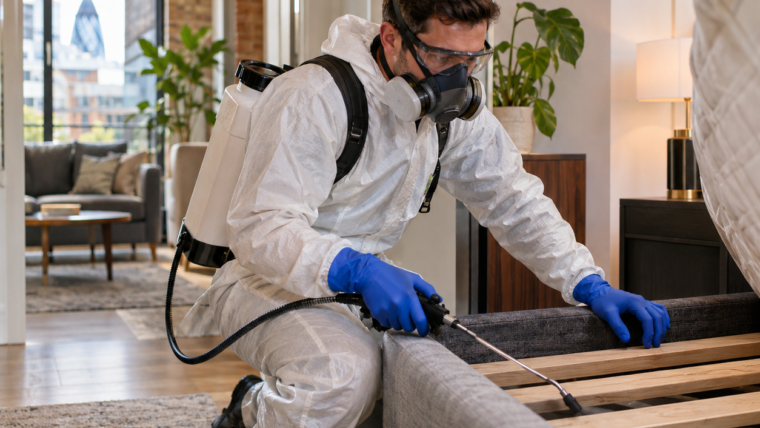
Professional bed bug pest control focuses on identifying affected areas and applying suitable insecticides according to product instructions.
Treatment may involve appropriate cracks, furniture joints, bed frames and other identified hiding places.
Some insecticides provide residual activity, which can help control insects that encounter treated surfaces after application.
However, repeat treatment or monitoring may be necessary.
In buildings with multiple affected rooms, coordinating access can be important.
Treating one flat while a connected infestation remains unaddressed may complicate longer-term control.
At Bed Bugs East London, we provide chemical bed bug treatment and practical preparation and aftercare guidance.
For more information, explore our professional bed bug removal service.
How Can Residents Reduce the Risk of Spread?
A few practical measures can help residents manage the situation.
Avoid moving potentially infested furniture between rooms or flats.
Contain affected laundry before transporting it.
Check second-hand furniture before bringing it into the building.
Reduce unnecessary clutter around sleeping areas to make inspections easier.
Report confirmed activity promptly rather than waiting for the problem to spread.
Where appropriate, property managers can arrange for structural gaps to be sealed as part of broader pest management.
These precautions are helpful, but they do not guarantee that every infestation can be prevented.
Bed Bug Pest Control in East London
Bed Bugs East London provides chemical treatment for houses, flats, shared accommodation and rental properties across East London.
Our service areas include Stratford, Ilford, Hackney, Walthamstow, Barking and surrounding neighbourhoods.
If you suspect bed bugs have entered your flat or are affecting several rooms, professional advice can help you decide on the next steps.
Visit Bed Bugs East London for information about our local services.
Call 07818 329 925 to discuss your bed bug problem and arrange an appointment.
Early identification, careful handling of affected belongings and coordinated treatment can all help reduce the risk of further spread.