
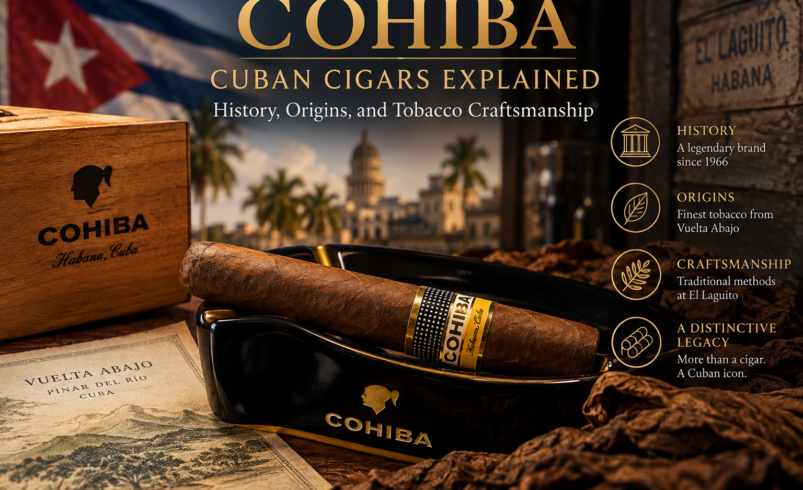

Cohiba is one of the most recognizable names in the world of Cuban cigars. The brand has a distinctive place in Cuban tobacco history, combining carefully selected tobacco, traditional hand-rolling, specialized fermentation, and a portfolio that has expanded considerably since its creation in the 1960s.
For readers interested in Cuban cigars, understanding Cohiba involves more than looking at its reputation. Its history, tobacco-growing regions, production methods, formats, and fermentation processes all contribute to the characteristics associated with the brand.
The History of Cohiba Cuban Cigars
Cohiba was created in Cuba in 1966. According to Habanos, the brand was initially reserved for official gifts to Cuban and foreign government figures, including diplomatic visitors. It was introduced to international markets in 1982.
The name Cohiba comes from an old Taíno term associated with rolled tobacco leaves. This connects the modern brand with the indigenous history of tobacco use in Cuba.
From its early development, Cohiba became closely associated with El Laguito, a cigar factory in Havana. Habanos continues to identify El Laguito as the traditional home of Cohiba production.
The brand’s international introduction marked an important change. What had previously been associated largely with official gifts became available in limited quantities to consumers in international markets.
Where Cohiba Tobacco Comes From
The tobacco used for Cohiba comes from the Vuelta Abajo region of Pinar del Río in western Cuba. Habanos specifically identifies tobacco from areas around San Juan y Martínez and San Luis among the sources selected for Cohiba production.
Vuelta Abajo is particularly important to Cuban cigar production because of its long-established tobacco-growing tradition and the characteristics of its agricultural environment.
For Cohiba, tobacco selection is an important part of the production process. Habanos describes the leaves used for the brand as highly selected material from premium tobacco-growing areas.
The quality of the finished cigar depends on more than the origin of the leaf. Growing conditions, curing, fermentation, aging, blending, and rolling all contribute to the final characteristics.
How Cohiba Cigars Are Made
Cohiba cigars are handmade using long-filler tobacco. The production process involves selecting individual leaves and combining different components to create the finished cigar.
A traditional premium cigar consists of three principal tobacco components: filler, binder, and wrapper. The filler forms the interior, the binder holds the filler together, and the wrapper provides the outer covering.
One of the features most closely associated with Cohiba is its additional fermentation process. Habanos states that two of the three types of filler tobacco used in Cohiba—seco and ligero—undergo a third fermentation in barrels.
This additional processing is part of what differentiates Cohiba from many other Cuban cigar brands. Habanos describes the process as contributing to the brand’s characteristic aroma, balance, and flavor.
Fermentation is important in cigar production because it helps transform the chemical and sensory characteristics of tobacco leaves. The process can influence aroma, smoothness, and the way different tobacco components work together.
Cohiba’s Different Cigar Lines
Cohiba is not a single cigar format. The brand has developed several lines over the decades, each with its own specifications and general strength classification.
Línea Clásica
The Línea Clásica represents the original core of the Cohiba portfolio. Habanos classifies this range as medium to full in strength.
It includes well-known formats such as the Espléndidos, Robustos, and Exquisitos.
The Cohiba Robusto, for example, measures approximately 124 mm in length with a 50 ring gauge. Habanos has described the format as providing the characteristic Cohiba profile in a shorter cigar.
Línea 1492
The Línea 1492 was introduced as a separate Cohiba range and includes the Siglo series. Habanos classifies this line as medium in strength.
The line takes its name from the year 1492 and expanded the Cohiba portfolio with formats offering different dimensions and smoking durations.
Its range demonstrates how the same brand can encompass different proportions, tobacco combinations, and sensory characteristics.
Maduro 5
Cohiba Maduro 5 was introduced as another distinct line. One of its defining features is its mature wrapper, which Habanos states is aged for five years. The line is classified as medium to full in strength.
The aging of the wrapper is an important part of the identity of this particular range and differentiates it from the standard Cohiba lines.
Cohiba Behike
The Behike line was introduced in 2010. It is particularly notable for the inclusion of Medio Tiempo tobacco, a rare leaf taken from the upper portion of the sun-grown tobacco plant.
The original Behike range included the BHK 52, BHK 54, and BHK 56 formats. Habanos classifies the Behike line as full in strength.
The use of Medio Tiempo gives Behike a distinct position within the wider Cohiba portfolio.
Understanding Cohiba’s Flavor Characteristics
Cohiba cigars are commonly associated with layered tobacco characteristics rather than a single fixed flavor. Depending on the line and format, descriptions may include woody, earthy, spicy, roasted, coffee-like, and mildly sweet impressions.
The fermentation and aging of the tobacco are particularly important when considering these characteristics. Habanos identifies the additional fermentation of seco and ligero as one of the defining elements of Cohiba production.
Strength also varies between Cohiba lines. The official Habanos classification places the Línea Clásica and Maduro 5 in the medium-to-full category, Línea 1492 at medium, and Behike at full.
These classifications provide a general reference rather than a guarantee of how every individual smoker will experience a particular cigar.
Why Cigar Format Matters
The dimensions of a cigar can influence how it burns and how its tobacco develops.
A shorter, wider cigar can concentrate a considerable amount of filler tobacco into a relatively compact format. A longer cigar provides more time for the tobacco to develop as the cigar progresses.
The Cohiba Robusto illustrates this relationship. At approximately 124 mm by 50 ring gauge, it combines a relatively compact length with a substantial diameter.
Other Cohiba formats vary considerably in length and ring gauge, allowing the brand to offer different proportions and smoking durations.
This is why comparing Cohiba cigars solely by brand name can overlook important differences between individual vitolas.
Construction and Appearance
A handmade Cuban cigar is the result of several stages of preparation and skilled rolling. The wrapper needs