

Businesses increasingly rely on digital tools to manage operations, serve customers, and improve productivity. However, ready-made software does not always meet every organization’s specific requirements. Custom software development offers an alternative by allowing businesses to build applications around their workflows, goals, and operational needs.
From customer relationship management systems to business automation platforms, custom software can help organizations address specific challenges and adapt to changing requirements. Before investing in a development project, businesses should understand its benefits, potential costs, and the factors that influence the development process.
What Is Custom Software Development?
Custom software development is the process of designing, building, testing, and maintaining software tailored to a business’s particular requirements. Unlike off-the-shelf applications, which are designed for a broad audience, custom solutions can be developed around specific workflows, users, and business objectives.
Examples include inventory management systems, customer portals, enterprise applications, e-commerce platforms, and AI-powered business tools.
The development process generally involves requirement analysis, planning, UI/UX design, software development, testing, deployment, and ongoing maintenance. The exact stages depend on the project’s scope and complexity.
Key Benefits of Custom Software Development
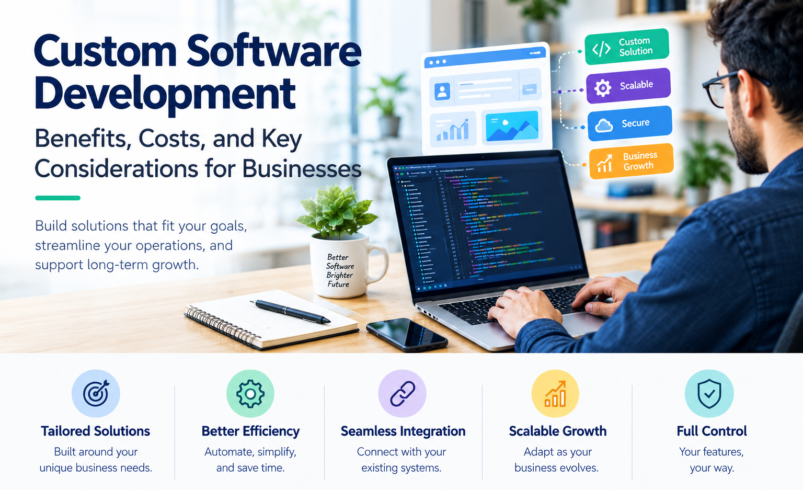
1. Tailored to Business Requirements
Custom software can be designed around existing business processes rather than requiring employees to adapt to a fixed set of features. This approach is useful when standard applications lack essential functionality or do not support specialized workflows.
For example, a logistics company may need a platform that combines shipment tracking, inventory updates, and delivery management in one system.
2. Improved Operational Efficiency
Businesses can use custom software to automate repetitive tasks, reduce manual data entry, and simplify everyday operations. Automating routine activities can help employees spend more time on work that requires judgment, communication, and problem-solving.
The actual efficiency gains depend on the processes being automated and how effectively the software is implemented.
3. Integration With Existing Systems
Many organizations use several applications for accounting, sales, customer management, and reporting. Custom software can be designed to connect compatible systems through APIs and other integration methods.
Better integration can reduce duplicate data entry and make information easier to access across departments. However, integration requirements depend on the capabilities and limitations of the existing systems.
4. Scalability and Flexibility
Business requirements often change as an organization grows. Custom software can be designed with future needs in mind, such as additional users, new features, increased data volumes, or integrations with other platforms.
Scalability is not automatic. It requires appropriate architecture, testing, infrastructure planning, and regular maintenance.
5. Greater Control Over Features and Development
Custom development gives businesses more control over functionality, user experience, and future improvements. Organizations can prioritize features based on their operational needs rather than relying entirely on a software vendor’s product roadmap.
This flexibility can be valuable for businesses with specialized requirements or long-term digital transformation plans.
How Much Does Custom Software Development Cost?
The cost of custom software development varies according to project requirements, technical complexity, integrations, and the development team’s expertise. A simple internal application generally requires less effort than a large enterprise platform with multiple user roles, advanced security, and complex workflows.
The following factors commonly influence the overall budget:
- Project scope: The number of features, user roles, and workflows affects development effort.
- Design requirements: Custom interfaces and complex user experiences may require additional design work.
- Technology selection: The programming languages, frameworks, cloud services, and infrastructure chosen can influence implementation and operating costs.
- System integrations: Connecting external APIs, payment gateways, CRM platforms, or legacy systems can increase complexity.
- Data and security requirements: Data migration, access controls, encryption, and compliance obligations may require additional resources.
- Testing and maintenance: Quality assurance, bug fixes, updates, hosting, and ongoing support contribute to the total cost of ownership.
Businesses should request a project estimate based on documented requirements instead of relying on a generic price range. A clear proposal should outline deliverables, assumptions, timelines, exclusions, and potential recurring expenses.
How Long Does Custom Software Development Take?
Development timelines depend on the scope of the project, the availability of requirements, integration complexity, and testing needs. A small application with limited functionality may take weeks, while a complex business platform can require several months or longer.
A typical development process includes:
- Discovery and planning: Define business objectives, user needs, and project requirements.
- Design and prototyping: Plan the interface, user journeys, and technical architecture.
- Development: Build the required features and integrations.
- Testing: Check functionality, security, performance, and usability.
- Deployment: Release the application and prepare users for adoption.
- Maintenance: Monitor performance, resolve issues, and introduce improvements.
Businesses can often reduce uncertainty by prioritizing essential features for an initial release and expanding the software as their needs evolve.
Custom Software vs. Off-the-Shelf Software
Choosing between custom and ready-made software depends on business requirements, budget, and available resources.
Off-the-shelf software may be suitable when standard features meet current needs and quick implementation is a priority. It can also offer predictable subscription pricing and vendor-managed updates.
Custom software may be more appropriate when a business requires specialized workflows, tailored integrations, or greater control over functionality. However, it usually involves more upfront planning, development responsibility, and ongoing maintenance.
Before deciding, businesses should compare the total cost of ownership, implementation time, customization options, security requirements, and the potential impact on daily operations.
Key Considerations Before Starting a Software Development Project
A successful project begins with a clear understanding of the problem the software needs to solve. Businesses should consider the following points before development begins:
- Define measurable objectives: Identify the operational problems and outcomes the software should address.
- Prioritize essential features: Separate must-have functionality from features that can be introduced later.
- Assess technical compatibility: Review existing systems, data sources, and integration requirements.
- Plan for security: Establish appropriate access controls, data protection measures, backups, and testing procedures.
- Evaluate the development partner: Review relevant experience, communication practices, technical capabilities, and maintenance arrangements.
- Consider long-term costs: Include hosting, licensing, support, upgrades, and infrastructure expenses in the budget.
- Prepare for user adoption: Plan documentation, training, feedback collection, and change management.
These considerations help businesses make informed decisions and reduce the risk of unclear requirements, unexpected expenses, and avoidable implementation problems.
Conclusion
Custom software development can help businesses address specialized requirements, improve operational workflows, integrate existing systems, and support future growth. However, the right approach depends on the organization’s objectives, available budget, technical environment, and long-term plans.
By defining requirements clearly, comparing development approaches, evaluating potential partners, and planning for ongoing maintenance, businesses can make more informed software investment decisions.
For organizations exploring tailored digital solutions, Mango Tree Technology provides a starting point for researching custom software and AI development options aligned with specific business requirements. The most suitable solution should always be selected based on its functionality, feasibility, security, and expected business value.
Frequently Asked Questions
What types of businesses can benefit from custom software development?
Startups, small and medium-sized businesses, and large enterprises can benefit from custom software when they need specialized functionality, process automation, system integration, or applications designed around their operations.
Is custom software development better than off-the-shelf software?
Neither option is universally better. Off-the-shelf software can suit standard requirements and limited budgets, while custom development can be appropriate for specialized workflows, tailored integrations, and greater control over features.
What factors affect custom software development costs?
Project scope, feature complexity, UI/UX design, technology selection, integrations, security requirements, testing, and maintenance all influence the overall cost.
Can custom software integrate with existing business systems?
Yes. Custom applications can often integrate with compatible systems through APIs, connectors, or other integration methods. Feasibility depends on the systems’ technical capabilities, access permissions, and available documentation.
Why is software maintenance important after launch?
Maintenance helps address bugs, security vulnerabilities, compatibility issues, and changing business requirements. Regular updates and performance monitoring can help keep software reliable and useful over time.