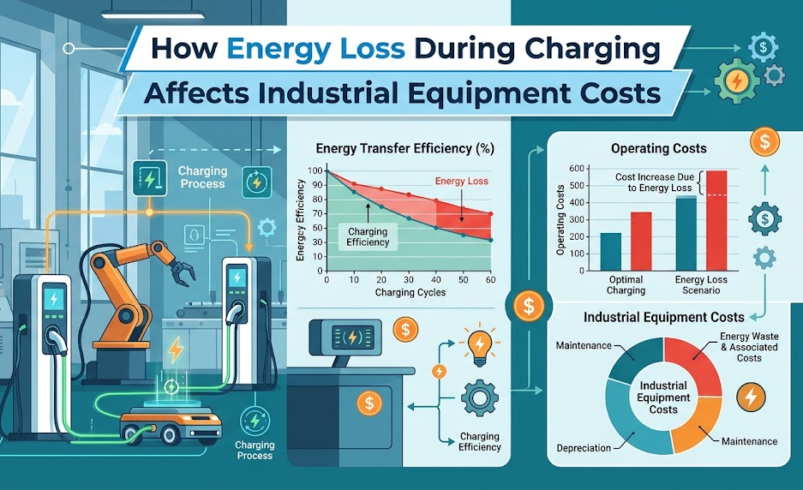

Industrial batteries play an important role in keeping warehouses, manufacturing facilities, distribution centers, and other industrial operations running smoothly. From powering forklifts to supporting material-handling equipment, these batteries help businesses maintain productivity throughout the working day. However, one factor that often receives less attention than battery capacity or lifespan is the amount of energy lost during charging.
Charging a battery does not mean every unit of electricity drawn from the power supply becomes usable energy stored inside the battery. Some energy is lost through heat, internal resistance, chemical reactions, and inefficiencies in the charging equipment. Although these losses may seem small during a single charging session, they can add up considerably when a business operates multiple batteries every day.
Understanding charging efficiency is particularly important for companies that depend on industrial battery systems. Businesses researching reliable solutions through a Battery Store Plano may also benefit from understanding how battery selection, charger compatibility, and maintenance practices influence long-term operating expenses. Making informed decisions about these factors can help reduce unnecessary electricity consumption and improve equipment reliability.
The good news is that energy loss during charging is not entirely unavoidable. While every battery system experiences some losses, businesses can take practical steps to minimize waste, control costs, and get better performance from their equipment.
What Is Energy Loss During Industrial Battery Charging?
Energy loss occurs when electricity supplied by a charger is not fully converted into energy that can be stored and later used by a battery. This is a normal part of the charging process, but the amount of loss varies depending on the battery type, its condition, the charger design, and the operating environment.
For example, a charger may draw a certain amount of electricity from the electrical supply, but only a portion of that energy becomes stored chemical energy. The remainder may be lost as heat or through other inefficiencies.
Common Causes of Charging Energy Loss
Several factors contribute to charging inefficiency in industrial battery systems.
- Internal resistance: Batteries naturally resist the flow of electrical current. This resistance produces heat and reduces the amount of energy available for storage.
- Charger inefficiency: Electrical power conversion inside the charger creates losses, meaning not all the electricity drawn from the supply reaches the battery.
- Battery condition: Aging, sulfation in lead-acid batteries, damaged components, and other problems can reduce charging efficiency.
- Excessive heat: High temperatures can increase energy losses and accelerate battery degradation.
- Incorrect charging settings: Incompatible chargers or unsuitable charging profiles can waste energy and potentially damage batteries.
- Poor connections: Loose, corroded, or damaged connections may increase electrical resistance and create additional heat.
The effect of each factor depends on the battery technology and the specific charging system. Identifying the main sources of loss is the first step toward improving overall efficiency.
How Charging Energy Loss Increases Electricity Bills
Electricity is a recurring expense for industrial facilities, and battery charging can account for a meaningful portion of a company’s energy consumption. When charging systems operate inefficiently, the business must purchase more electricity to achieve the same amount of usable battery energy.
Consider a warehouse that charges several forklift batteries every day. If the batteries and chargers lose a significant amount of energy during each charging cycle, the facility must draw additional electricity to keep its equipment ready for work.
Small Daily Losses Can Become Significant
Imagine that a facility needs 100 kWh of usable energy stored in its batteries each day. If the overall charging process operates at 85% efficiency, the facility would need approximately 117.6 kWh of electricity to deliver that amount of stored energy.
That means approximately 17.6 kWh is lost during the process.
If the facility pays $0.15 per kWh, the electricity cost associated with those losses is approximately $2.65 per day. Over 300 operating days, that becomes roughly $794 in annual energy costs.
These figures are illustrative, not universal. Actual charging efficiency, electricity rates, and operating schedules vary considerably between facilities and battery technologies.
For a company operating dozens of batteries, even modest improvements in efficiency may produce meaningful savings over time.
The Connection Between Charging Loss and Battery Lifespan
Energy loss does not only affect electricity bills. Depending on its cause, inefficient charging can also contribute to battery wear, creating additional costs through earlier repairs or replacement.
Heat is one of the most important factors to monitor. Some heat is normal during charging, but excessive heat may indicate an unsuitable charging profile, poor ventilation, a deteriorating battery, or an electrical problem.
Repeated exposure to excessive temperatures can accelerate aging and reduce a battery’s ability to store and deliver energy.
Why Overcharging Can Become Expensive
Overcharging occurs when a battery receives more charging energy than is appropriate for its condition and chemistry. In lead-acid batteries, excessive charging can increase water loss, heat generation, and deterioration of internal components.
Lithium-ion batteries use different charging controls and should be managed according to the manufacturer’s specifications. Their battery management systems provide important protections, but correct charger compatibility and operating conditions remain essential.
When charging practices are unsuitable, businesses may experience:
- Reduced battery capacity over time.
- More frequent maintenance requirements.
- Shorter service life.
- Increased risk of unexpected equipment interruptions.
- Higher repair or replacement expenses.
Following manufacturer-recommended charging procedures helps reduce avoidable wear and protects the investment made in industrial battery systems.
How Inefficient Charging Contributes to Equipment Downtime
Industrial equipment is valuable only when it is available to perform its intended job. Forklifts, pallet trucks, and other battery-powered machines often operate on demanding schedules, leaving limited time for charging between shifts.
When a battery stores less usable energy than expected, operators may need to recharge it more frequently. Equipment that previously completed an entire shift may begin running out of power earlier in the day.
This can disrupt warehouse schedules, delay material movement, and force managers to rearrange workloads.
The Hidden Cost of Lost Productivity
Downtime costs extend beyond electricity and battery maintenance. A machine that cannot operate may delay deliveries, slow production, or leave employees waiting for replacement equipment.
For example, a distribution center may have enough forklifts to meet its daily workload under normal conditions. If several batteries become unreliable because of poor charging practices, the facility might need to rotate equipment more frequently or keep additional batteries available.
The resulting expenses can include labor delays, additional charging infrastructure, emergency maintenance, and reduced operational flexibility.
Businesses should therefore evaluate charging efficiency as part of their broader equipment management strategy rather than treating it as an isolated electrical issue.
The Role of Charger Compatibility in Reducing Costs
An industrial battery and its charger must work together as a properly matched system. Using a charger simply because its connector fits the battery is not enough.
Voltage, current limits, battery chemistry, charging algorithms, and manufacturer requirements all matter. An unsuitable charger may charge too slowly, generate excessive heat, fail to charge the battery correctly, or create unnecessary energy losses.
Choose Equipment Based on Battery Requirements
Before purchasing a replacement charger or battery, businesses should verify the specifications of their existing equipment.
Important considerations include:
- Battery voltage and capacity.
- Battery chemistry and manufacturer requirements.
- Charger output and charging profile.
- Expected daily operating hours.
- Available charging time between shifts.
- Ventilation and environmental conditions.
Modern chargers may offer improved power-conversion efficiency and better control over the charging process. However, upgrading is worthwhile only when the new equipment is compatible with the battery and provides a measurable operational benefit.
Comparing energy consumption, charging time, purchase price, and maintenance requirements can help businesses make a more informed investment.
Practical Ways to Reduce Energy Loss During Charging
Businesses do not always need to replace their entire battery system to improve efficiency. In many cases, better operating procedures and routine inspections can reduce unnecessary losses.
1. Follow the Correct Charging Procedure
Use the charging method recommended for the specific battery chemistry. Avoid improvised charging practices, unauthorized settings, and unnecessary interruptions that conflict with manufacturer guidance.
For lead-acid batteries, proper charging and equalization procedures, where recommended, can help maintain performance. Lithium-ion systems require their own approved charging controls.
2. Inspect Batteries and Connections Regularly
Loose connections, corrosion, damaged cables, and worn components can increase electrical resistance. Inspect these areas according to the manufacturer’s maintenance schedule and correct problems promptly.
Lead-acid batteries may also require checks of electrolyte levels, terminals, and other service items. Lithium-ion batteries have different maintenance requirements and should not be opened or serviced beyond approved procedures.
3. Control Charging Temperatures
Keep charging areas within the temperature range recommended by the battery manufacturer. Ensure appropriate ventilation and investigate unusual heat, odors, swelling, or charging behavior.
If a battery becomes excessively hot, stop using it when safe to do so and arrange an appropriate inspection.
4. Avoid Unnecessary Charging and Poor Charging Habits
Charging schedules should reflect the battery’s chemistry and operating requirements. Lead-acid batteries generally benefit from completing appropriate charging cycles rather than routinely remaining undercharged. Lithium-ion batteries may support opportunity charging when approved by the manufacturer.
There is no single charging schedule that suits every industrial battery. Establish procedures that fit the equipment and the manufacturer’s guidance.
5. Track Energy Consumption
Monitoring electricity use provides a practical way to identify inefficient equipment. Businesses can record charger energy consumption, charging duration, battery performance, and the number of completed operating shifts.
If one battery consistently requires more electricity or takes longer to charge than comparable units, it may need inspection.
Tracking these measurements over time also helps maintenance teams distinguish normal variation from developing problems.
Evaluating the Financial Benefits of Better Charging Efficiency
Improving charging efficiency can produce several types of savings, but businesses should measure them rather than relying on assumptions.
Start by estimating how much electricity the battery system consumes each month. Then compare this figure with the amount of usable energy required for operations. If available, use charger energy meters and battery monitoring systems to establish a more accurate baseline.
Next, investigate the main sources of loss. These may include aging batteries, unsuitable chargers, poor maintenance, excessive temperatures, or inefficient charging schedules.
Once the likely causes are understood, estimate the cost of corrective action and compare it with the expected savings.
For example, replacing an inefficient charger may reduce electricity consumption, but the financial benefit depends on the charger’s purchase price, the energy saved, operating hours, and local electricity rates.
The same approach applies to battery replacement. A newer battery may offer better efficiency, but its total value should also account for purchase cost, expected lifespan, maintenance, and compatibility with existing equipment.
A simple cost comparison can prevent businesses from spending money on upgrades that offer little practical benefit.
Why Regular Battery Maintenance Matters
Maintenance plays a major role in identifying problems before they become expensive failures. A battery that appears to be charging normally may still have reduced capacity, unusual heating, or inconsistent performance.
Routine inspections help technicians recognize these warning signs and determine whether a battery needs servicing, repair, or replacement.
Maintenance records are especially useful for businesses operating multiple batteries. By comparing charging times, operating performance, inspection results, and repair histories, managers can identify recurring problems and make better purchasing decisions.
Maintenance should always follow the battery manufacturer’s recommendations and applicable workplace safety procedures. Industrial batteries can present electrical, chemical, and fire hazards, so employees should receive appropriate training before performing inspections or servicing equipment.
Conclusion
Energy loss during industrial battery charging may seem like a minor technical issue, but its financial effects can extend across electricity bills, battery lifespan, maintenance expenses, and equipment productivity. Businesses that understand these connections can make better decisions about charger compatibility, charging schedules, battery inspections, and long-term equipment investments. Tracking energy consumption and addressing inefficiencies early can also help prevent avoidable downtime and improve operational reliability. When batteries begin showing unusual charging behavior or declining performance, professional assessment can help determine the most practical next step. Businesses seeking guidance on industrial battery maintenance, rebuilding, or replacement can consider Battery Rescue LLC as a resource for evaluating their battery needs. With consistent maintenance and a well-planned charging strategy, companies can reduce unnecessary energy waste, protect their equipment investments, and keep daily operations running more efficiently.