

Getting a good crew cut starts before the clippers turn on. Most guys hit a communication gap with their barber and walk out sharp or disappointed. This guide fixes that barbershop moment for good. You’ll learn the right haircut vocabulary, from guard number basics to taper versus fade, plus neckline preference and how your face shape changes the request. Bring a reference photo, use correct terminology, and skip the awkward mirror reveal. By the end, you’ll walk into any barber’s chair with real haircut confidence and walk out with the exact cut you pictured.
Know What Type of Crew Cut You Want
Type |
Top Length |
Look |
| Classic crew cut | Guard 3–guard 4 | Clean, low-fuss |
| Faded crew cut | Same top, faded sides | Sharper contrast |
| Ivy League cut | 1.5–2.5 inches on top | Polished, side part |
| Textured crew cut | Layered top | Modern, messy finish |
| Military crew cut | Very short | Sharp, uniform |
| Long crew cut | A few inches | Flexible, styled |
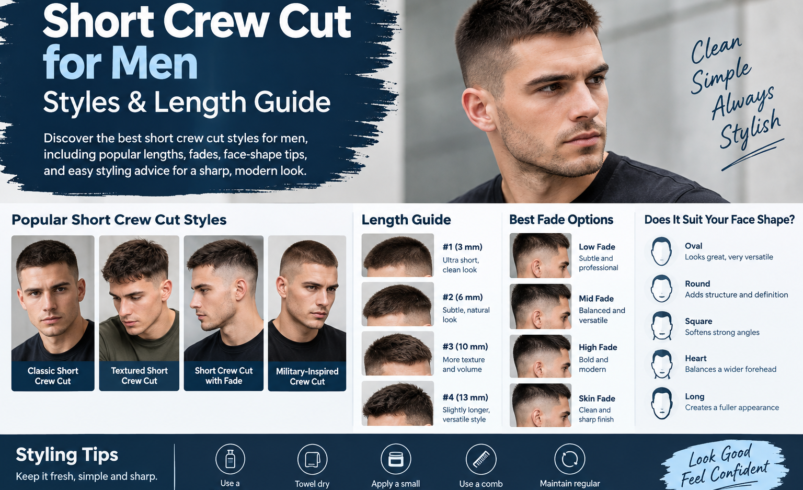
Before your next barber trip, pick your crew cut style. A classic crew cut sits at guard 3 to guard 4, short and simple. Want more edge? A faded crew cut swaps taper for a sharper fade. The Ivy League cut, also called the Princeton cut, adds inches on top for a side-swept fringe. Prefer movement? Ask for a textured crew cut with choppy layers. A military crew cut stays close to the guard number minimum. Know your pick before you sit down.
Decide How Much Length You Want
Section |
Guard Number |
Length |
| Sides | Guard 1–guard 2 | Quarter inch |
| Top (safe default) | Guard 3 | Three-eighths inch |
| Top (fuller) | Guard 4–guard 5 | Half inch to medium-length top |
| Top (max crew cut) | Scissors | One and a half inches |
Length is the real decision behind any crew cut. Sides usually sit at guard 1 or guard 2, a quarter inch at most. For the top, guard 3 is the safe default, giving a three-eighths inch finish. Want fuller hair? Ask for guard 4 or guard 5, moving toward scissor-finished length. Stop before one and a half inches, or it stops looking like a crew cut. Give your barber a number-based request, not a vague word. Mention your haircut frequency, since a tighter guard number grows out faster.
Tell Your Barber What You Want on the Sides
Fade Height |
Where It Starts |
Best For |
| Low fade | Near ear level | Subtle transition, office-safe |
| Mid fade | Mid-ear height | Balanced fade, most popular |
| High fade | Near temple level | Extreme contrast, bold statement |
Telling your barber what you want on the sides comes down to one word: height. A low fade stays near ear level for a subtle transition. A mid fade sits at mid-ear height, the most requested fade for good reason. A high fade starts near temple level, creating extreme contrast with your crew cut top. Mention your sideburns, any cowlick, and whether you want bare skin or a soft taper. Give one concrete example: “Low fade, clean sides, scissor length on top.”
Use a Photo to Show Your Barber
A photo removes all guesswork with your barber. Skip a vague description, since words alone cause unrealistic expectations. Take a clear front-facing photo in natural lighting, with forehead visibility and no background distractions. Try an AI hairstyle simulator first to preview a crew cut using face shape mapping, then download your favorite. Avoid a celebrity photo, since your hairline and hair texture differ. A real human photo, styled close to your face, works best. This one habit prevents haircut regret and builds real decision confidence before the chair. Read more https://apexhaircuts.com/
Tell Your Barber About Your Hair Type
Type |
Pattern |
Barber Note |
| Type 1 | Straight | Handles a blunt cut well |
| Type 2 | Loose waves, defined waves | Needs light weight removal |
| Type 3 | Tight curls, spiral curls | Cut with shrinkage in mind |
| Type 4 | Kinky hair, coils | Needs dry-cutting assessment |
Your crew cut only looks right if your barber knows your curl pattern and density. Thick hair holds a precision cut and fades cleanly. Fine hair needs a layered cut to fake volume. Mention strand thickness, using the sewing thread test if unsure. Curly guys should request dry-cutting, since shrinkage hides true length. Arrive with natural state hair, not product-stiffened hair, so your barber sees the real curl pattern.
Discuss the Hairline and Neckline
Neckline |
Look |
Best For |
| Tapered neckline | Soft, natural hairline blend | Longest neckline longevity |
| Blocked neckline | Hard line, horizontal edge | Structured classic style |
| Rounded neckline | Curved edge, softer corners | Narrow neck, angular features |
Your crew cut isn’t finished until the neckline is set. Ask your barber for a tapered neckline if you want soft grow-out and long neckline longevity. Want sharp lines instead? Request a blocked neckline, though it needs frequent touch-up frequency. A rounded neckline softens angular features and suits a narrow neck. Also mention your front hairline length and any cowlick direction, since your barber shapes the crown taper around both for a clean hairline blend.
Common Mistakes When Asking for a Crew Cut
Mistake |
Fix |
| Vague request like “just a trim” | Give a specific length request |
| Passivity during the cut | Try a mid-cut check-in |
| Exact replica expectation | Allow lifestyle alignment with your hair |
| Photo without context | Add one sentence of explanation |
| Ignoring barber advice | Trust their master barber insight |
Most bad crew cut results trace back to a vague request, not a bad barber. Saying “just a trim” invites ambiguous description and mismatched expectations. Staying silent shows passivity; a quick mid-cut check-in fixes that fast. Don’t expect an exact replica from someone else’s photo, and never rely on a photo without context. Ignoring barber advice about your hair type often backfires. Speak up, stay polite, and treat the visit as a professional partnership.
Conclusion
Getting the perfect crew cut isn’t luck, it’s pre-visit communication. Write your example script, save it in your notes app, and read it out loud in the chair. Bring photos, mention guard numbers, and come prepared every single time. A precise and reliable barber appreciates clients who articulate confidence instead of guessing. Do this once, and future visit requests get faster and easier. That’s the real secret behind never disappointed again results. Master this haircut phrasing, and every barbershop experience feels effortless from here.
FAQs
What should I tell my barber if I want a crew cut?
Tell your barber the length you want on top, the desired side length, and whether you want a fade or taper. Showing a reference photo can also make your request clearer.
How do I ask for a short crew cut?
Ask for a shorter top with closely trimmed sides, and specify the clipper number or fade level you prefer. Your barber can adjust the length based on your hair type and face shape.
What clipper number should I ask for a crew cut?
A #2 or #3 on the sides is a common starting point, while the top is usually left longer. The ideal number depends on how short you want the haircut and how much contrast you prefer.
Should I ask for a fade with a crew cut?
Yes, if you want a more modern and sharper appearance. You can request a low, mid, or high fade depending on how much contrast you want between the sides and top.
Can I show my barber a picture of a crew cut?
Absolutely. A reference photo is one of the easiest ways to communicate the exact length, shape, fade, and overall style you want.
How do I ask for a crew cut if I have thin hair?
Tell your barber that you have thin or fine hair and want to maintain as much visual thickness as possible. A slightly longer, textured top can often create a fuller appearance.