

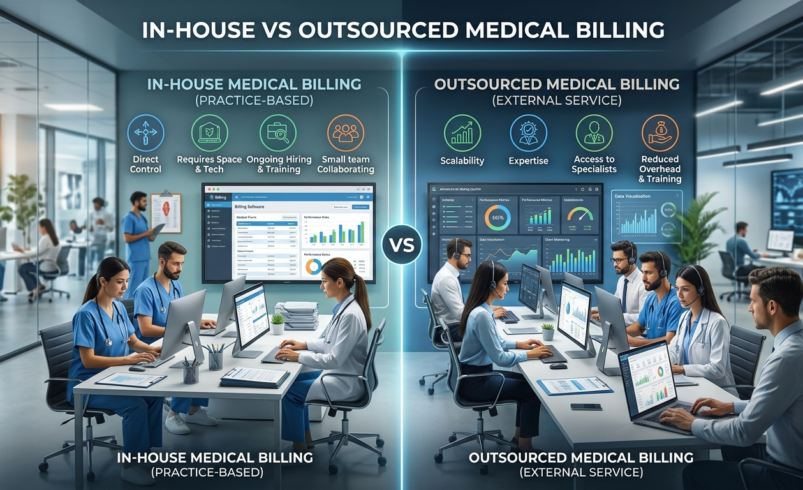

Deciding between in-house vs outsourced medical billing is one of the highest-stakes operational choices a healthcare practice makes. While keeping billing internal offers direct proximity to your front desk and patients, managing an internal Revenue Cycle Management (RCM) team carries steep fixed overhead, compliance liabilities, and staff turnover risks. Conversely, outsourcing converts fixed payroll into a scalable variable expense, though it requires vetting partners for transparency and HIPAA compliance.
Neither model is universally superior. The right choice depends on your claim volume, specialty complexity, and current financial leakage. Below is a data-backed comparison of true costs, performance benchmarks, and operational trade-offs to help you make an informed decision.
Quick Comparison: In-House vs. Outsourced Medical Billing
| Evaluation Factor | In-House Medical Billing | Outsourced Medical Billing |
| Cost Structure | Fixed overhead (salaries, benefits, software, clearinghouse fees) | Variable percentage of net collections (typically 4% to 10%) |
| Clean Claim Rate | ~85% to 90% (MGMA baseline) | ~95% to 98%+ (via multi-tier automated scrubbing) |
| Average Denial Rate | 10% to 15%+ | 3% to 5% |
| Days in A/R | 40 to 60 days | 25 to 35 days |
| Operational Control | High; direct daily supervision | Moderate; governed by Service Level Agreements (SLAs) |
| Scalability | Low; requires hiring and training new staff | High; scales automatically with patient volume |
| Continuity Risk | High; vulnerable to sick leave, vacations, and turnover | Low; backed by dedicated teams and cross-trained redundancy |
What Is In-House Medical Billing?
In-house medical billing means your practice employs its own billing and coding specialists, purchases its own Practice Management (PM) and clearinghouse software, and manages every step of the revenue cycle internally—from insurance verification and charge entry to claim submission, denial appeals, and patient collections.
Advantages of In-House Billing
-
Direct Operational Oversight: Practice administrators can walk down the hall to check the status of a specific claim, audit workflows immediately, and enforce internal policies without waiting on an external account manager.
-
Seamless Front-to-Back Communication: When a coder has a question about clinical documentation, they can message or speak directly with the physician or nurse practitioner, resolving ambiguities before a claim goes out.
-
Personalized Patient Financial Support: Patients who prefer discussing balances face-to-face at checkout can speak with familiar office staff who understand their visit history.
Disadvantages of In-House Billing
-
High Fixed Overhead: Payroll is only the starting point. Practices must absorb employer taxes, health benefits, paid time off, ongoing AAPC/AHIMA continuing education, software licenses, and clearinghouse fees—regardless of whether patient volume dips.
-
Single-Point-of-Failure Risk: According to healthcare staffing benchmarks, medical billing turnover frequently exceeds 25% annually. When a sole biller resigns or takes extended leave, unworked claims pile up, causing immediate cash flow bottlenecks that can cost a mid-sized practice $35,000 to $50,000 in delayed or lost Accounts Receivable (A/R).
-
Limited Bandwidth for Old A/R: Small internal teams spend most of their day posting payments and answering patient phone calls, leaving little time to aggressively appeal complex payer denials or audit underpayments.
What Is Outsourced Medical Billing?
Outsourced medical billing services involves partnering with a specialized third-party Revenue Cycle Management (RCM) company. The vendor handles coding audits, claim scrubbing, electronic submission, payment posting, denial management, and payer follow-up—usually working directly inside your existing EHR/PM system or via a secure cloud integration.
Advantages of Outsourced Billing
-
Higher Net Collection Rates: Dedicated RCM firms employ certified coders (CPC, CCS) who specialize in specific medical specialties and stay updated on annual CPT, ICD-10, and payer policy shifts. Fewer coding errors translate directly into higher first-pass resolution.
-
Predictable, Performance-Aligned Costs: Because most billing companies charge a percentage of net collected revenue, they only get paid when you get paid. If a claim is denied, the vendor has a direct financial incentive to appeal and recover it.
-
Faster Cash Flow (Lower Days in A/R): Professional billing teams work aging A/R buckets daily, routinely cutting average reimbursement turnaround times by 12 to 24 days compared to overburdened internal staff.
-
Built-In Compliance & Security: Reputable RCM partners maintain strict HIPAA compliance, SOC 2 security protocols, and Business Associate Agreements (BAAs), reducing your practice’s exposure to regulatory audits.
Disadvantages of Outsourced Billing
-
Less Day-to-Day Proximity: You are relying on an external partner rather than an on-site employee. Without clear communication channels and transparent reporting dashboards, practices can feel disconnected from their billing operations.
-
Potential for Hidden Fees: Low advertised rates (e.g., “3.99% billing”) sometimes exclude setup fees, EHR interface charges, patient statement postage, or credentialing services. Always review the fine print before signing.
-
Varying Vendor Quality: Not all billing companies offer the same caliber of service. Some rely on offshore generalists unfamiliar with nuanced U.S. commercial payer rules or state Medicaid nuances.
True Cost Comparison: In-House vs. Outsourced Billing
Many practice owners underestimate the true cost of internal billing because they only look at base salaries. To calculate your true Cost to Collect, use this formula:
Real-World Scenario: A 3-Provider Practice Collecting $150,000/Month ($1.8M/Year)
-
In-House Model Costs:
-
2 Full-Time Billing Specialists ($52,000 avg. base salary each): $104,000
-
Benefits, Payroll Taxes & PTO (~22%): $22,880
-
PM Software, Clearinghouse & Coding Tools: $9,600
-
Recruiting, Training & Office Overhead: $6,500
-
Total Annual In-House Cost: $142,980 (7.94% of collections)—before accounting for revenue lost to unworked denials.
-
-
Outsourced Model Costs:
-
RCM Fee at 6% of Net Collections: $108,000
-
Direct Annual Overhead Savings: $34,980
-
Revenue Recovery Gain: If outsourcing improves your net collection rate from 90% to 96% through better denial management, your practice captures an additional $108,000 in collected revenue—yielding a net financial gain of over $136,000 per year (after the 6% fee on the newly recovered funds).
-
The Hybrid Model: Getting the Best of Both Worlds
You do not have to choose an all-or-nothing approach. Many growing specialty clinics and multi-provider groups adopt a hybrid RCM model:
-
Keep In-House: Front-desk insurance eligibility verification, copay collection at check-in, clinical documentation, and face-to-face patient financial counseling.
-
Outsource: Claim scrubbing, electronic submission, payment posting, complex denial appeals, and aging A/R recovery (60+ and 90+ day buckets).
This structure preserves your personal connection with patients while offloading the technical, labor-intensive back-end work to specialists.
How to Decide: 5 Questions to Audit Your Practice
-
What is your current Clean Claim Rate? If it is below 90%, coding errors and missing modifiers are slowing your cash flow.
-
How much of your A/R is over 90 days old? Healthy practices keep 90+ day A/R under 10% to 15% of total receivables. Anything higher signals a lack of follow-up bandwidth.
-
Are you preparing to scale? Adding providers, opening a new location, or expanding into complex services (such as behavioral health, surgical procedures, or Non-Emergency Medical Transportation billing) strains internal teams quickly.
-
What happens if your lead biller quits tomorrow? If the answer is “our cash flow stops,” your practice carries unsustainable key-person risk.
-
Do you have transparent visibility into your KPIs? Whether internal or external, your billing team should provide monthly reports tracking Net Collection Rate, Denial Rate by Payer, and Days in A/R.
Frequently Asked Questions (FAQs)
Is outsourced medical billing cheaper than in-house billing?
For most solo practitioners and small-to-mid-sized practices, outsourced medical billing is more cost-effective. While in-house billing carries fixed expenses for salaries, benefits, software, and training that often total 8% to 15% of collections, outsourced billing typically costs 4% to 10% of net collections and eliminates fixed payroll overhead.
How much do medical billing companies charge?
Most outsourced medical billing companies charge a percentage of net monthly collections, generally ranging from 4% to 6% for high-volume primary care practices and 7% to 10% for complex specialties (such as cardiology, orthopedics, or behavioral health) that require intensive prior authorizations and nuanced coding. Some vendors also offer flat-fee or per-claim pricing.
Will I lose control of my practice’s finances if I outsource medical billing?
No, provided you choose a transparent RCM partner. Modern cloud-based billing allows you to retain full ownership of your EHR/PM system and bank accounts. Payments go directly into your practice’s bank account via Electronic Funds Transfer (EFT), and you receive real-time dashboards showing every claim submitted, paid, or denied.
Is outsourced medical billing HIPAA compliant?
Yes. Reputable medical billing companies are legally required to adhere to HIPAA Privacy and Security Rules. Before sharing any Protected Health Information (PHI), your vendor must sign a Business Associate Agreement (BAA) and demonstrate encrypted data transmission, role-based access controls, and regular security audits.
When should a practice switch from in-house to outsourced billing?
Common triggers include a net collection rate dropping below 92%, days in A/R exceeding 45 days, high billing staff turnover, upcoming provider expansion, or an inability to keep up with frequent payer rule and ICD-10/CPT code updates.