

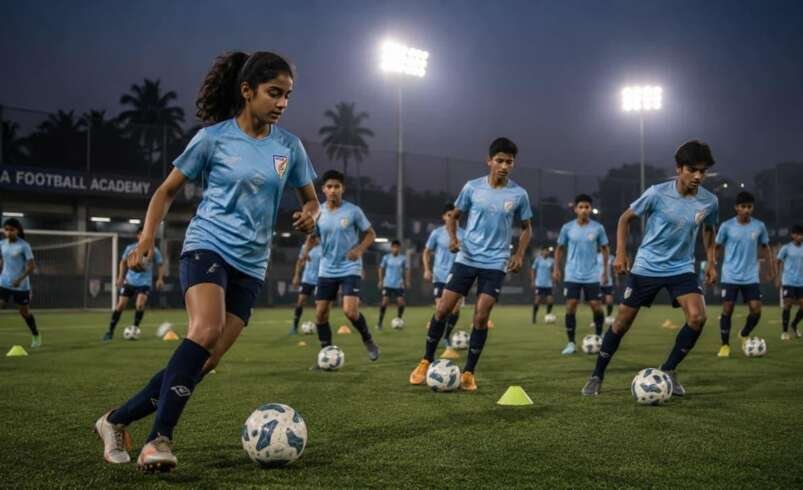

India has never lacked sporting talent. From children playing cricket in narrow streets to teenagers running barefoot on village grounds, natural ability is everywhere. The harder question has always been what happens after that first glimpse of potential.
A talented 13-year-old can run unusually fast, lift impressive weights or dominate a local competition. But talent alone rarely produces an international athlete. The difference often comes from what happens next: coaching, facilities, nutrition, competition, education, recovery and the right people around the athlete.
That is where sports academies are becoming increasingly important in India.
The country’s sporting ecosystem is moving from a model based heavily on individual talent and occasional government camps toward a more structured development system. Sports academies are helping young athletes train regularly, compete more often and learn habits that are required at elite level.
The scale of this change is significant. According to the Ministry of Youth Affairs and Sports’ annual report, 958 Khelo India Centres were operational as of May 1, 2025, with 28,110 athletes trained through the centres. The same report listed 301 academies accredited for training Khelo India athletes.
That does not mean every academy produces champions. Far from it. But it shows that India’s pathway from grassroots participation to high-performance sport is becoming much broader.
Why Sports Academies Matter More Than Ever
A modern sports academy is much more than a place where athletes spend two hours practising.
At the best facilities, training can involve coaches, strength and conditioning specialists, physiotherapists, nutrition professionals, sports psychologists and performance analysts. The goal is to understand the athlete as a complete person rather than simply measuring how many goals they score or how quickly they run.
This is especially important for teenagers.
A 15-year-old athlete is still growing. Training that works brilliantly for a 25-year-old professional may be completely inappropriate for a developing body. Good academies therefore need to understand growth, recovery, workload and injury prevention.
The Khelo India framework recognises this broader approach. Its guidelines allow support for academies covering coaching, sports science, sports medicine, monitoring and performance measurement, while also emphasising long-term athlete development.
That philosophy is important because elite sport is a long game.
Consider a young sprinter who improves dramatically at 14. The easy mistake would be to make every training session harder because the athlete is winning. A better academy might instead protect technique, gradually build strength and ensure the athlete remains healthy through adolescence.
The second approach may look slower at first. Five years later, however, it could produce the better athlete.
From Raw Talent to a Complete Athlete
The strongest contribution of an academy is structure.
A young athlete may be naturally fast, powerful or coordinated, but may not know how to train. They might run hard every day without understanding recovery, eat poorly, sleep irregularly or ignore a minor injury until it becomes serious.
An academy can turn those habits around.
A well-designed development programme usually covers:
- Technical coaching specific to the sport
- Strength and conditioning
- Mobility and injury prevention
- Nutrition and hydration
- Recovery and sleep
- Competition planning
- Psychological preparation
- Performance testing
- Education and personal development
Take athletics as an example. A promising 16-year-old may initially be judged by a stopwatch. A professional development programme looks deeper.
How efficiently does the athlete accelerate? Is their running technique stable under fatigue? How much training can they tolerate? Are strength levels developing appropriately? How quickly do they recover between sessions?
That information allows coaches to make decisions based on evidence rather than guesswork.
The same principle applies to shooting, wrestling, boxing, badminton, swimming and other sports where tiny technical differences can have major consequences.
India’s national sports institutions have increasingly incorporated sports science into athlete preparation. The Netaji Subhas National Institute of Sports, for example, has dedicated strength and conditioning facilities and uses methods including resistance training, plyometrics and agility work.

The academy environment can also change an athlete’s mindset.
Training alongside other ambitious athletes creates a daily competitive atmosphere. A teenager who is the fastest player in their neighbourhood may discover that they are only the fifth-fastest athlete in an academy.
That can be uncomfortable, but it can also be transformative.
Instead of being discouraged, the athlete learns what they need to improve. They begin setting measurable targets, studying competitors and understanding that progress is rarely linear.
This is one reason strong academies often become talent hubs.
India’s government framework also allows sports academies to operate through different models, including Sports Authority of India, state governments, private organisations and public-private or CSR partnerships.
That variety can help expand opportunities beyond the traditional sporting centres.
For years, young athletes from smaller towns often faced a simple problem: they had ability but no access to specialised coaching. An academy in or near their region can reduce that gap.
It does not eliminate inequality. Equipment, travel and family finances can still determine who gets to continue. But a wider network of academies gives more athletes a chance to be identified in the first place.
There is also a social benefit.
A serious academy can teach young people how to handle winning and losing, communicate with teammates, follow routines and take responsibility for their own preparation.
The International Olympic Committee’s Olympic Values Education Programme in Odisha offers a useful example of sport being used beyond competition. The programme has involved thousands of children and more than 60,000 parents through community activities, while Olympic values have also been incorporated into school education.
This broader role matters because most academy students will not become Olympians.
An academy should therefore be judged not only by medals but also by whether it produces disciplined, educated and confident young people.
The business and media side of sport is changing too. More fans now follow athletes through social media, short videos and online sports coverage. Searches involving gold365 online are part of the wider digital sports-information environment, but academies have an opportunity to tell a different kind of sporting story: how champions are actually developed.
That behind-the-scenes story can be powerful.
Fans see an athlete winning a medal for a few minutes. An academy sees the years of early mornings, repeated drills, failed attempts, injuries, school commitments and gradual improvement that made that medal possible.
For young athletes, however, choosing the right academy requires careful thought.
A famous name does not automatically mean good coaching.
Parents and athletes should ask:
- Who actually coaches the athlete?
- What qualifications and experience do the coaches have?
- How many athletes train in each group?
- Is there access to strength and conditioning?
- How are injuries handled?
- Are training loads monitored?
- What competition opportunities are available?
- How does the academy support education?
- What are the total costs?
- Can the athlete speak with current or former students?
The final question is particularly useful.
If an academy claims to develop champions, ask how many athletes have actually progressed from its junior programme to state, national or international competition.
Marketing can tell you what an academy promises. Athlete progression tells you what it delivers.
Another important consideration is the balance between training and education.
A 12-year-old does not need to make an irreversible career decision. Good academies should allow young athletes to develop gradually while maintaining their education.
This becomes even more important when injuries or changes in performance occur. A young person should have options beyond sport.
The phrase gold365 contact may appear in online sports-related searches, but families researching academies should focus on verified coaching credentials, facilities, athlete welfare and transparent development pathways rather than unrelated online promotions.
There is also a growing opportunity for technology.
Video analysis can help coaches identify technical problems that are difficult to see in real time. Wearable devices can provide information about workload and recovery. Digital records can allow athletes to compare performances over months rather than relying on memory.
But technology should support coaching, not replace it.
A young athlete does not need ten screens telling them how they performed if nobody can explain what they should do differently tomorrow.
The best academies combine technology with human judgement.
That combination becomes particularly valuable when athletes reach the difficult transition from junior to senior competition.
Many teenagers dominate their age group but struggle when they move into open competition. The opponents become stronger, races become more tactical and physical development changes the competitive landscape.
A strong academy prepares athletes for that transition rather than treating junior medals as the final objective.
India also needs more attention on women’s sports and para-sport development.
Facilities must be safe and inclusive, coaching structures need to accommodate different needs, and young athletes should have realistic pathways to higher competition.
The same principle applies geographically. India cannot build a sustainable sporting future if serious training remains concentrated in only a handful of cities.
The long-term target should be a network in which talent can be identified locally, developed regionally and supported nationally.
For sports fans who follow emerging athletes online, 365 win may appear among general sports searches, but the more meaningful story is what happens inside training centres long before an athlete becomes famous.
Key takeaways:
- Sports academies are creating more structured pathways from grassroots sport to elite competition.
- India’s Khelo India network has expanded significantly, with hundreds of operational centres and accredited academies.
- Modern athlete development increasingly combines coaching with sports science, nutrition, strength training and recovery.
- A good academy should prioritise long-term development rather than chasing short-term junior medals.
- Parents should evaluate coaching quality, athlete welfare, education support and competition pathways before choosing an academy.
- Smaller cities and towns need greater access to high-quality training.
- Technology can improve performance analysis, but experienced coaching remains essential.
- The ultimate goal should be producing healthy, educated and resilient athletes—not just medal winners.
FAQs
What is the role of sports academies in India?
Sports academies provide structured training, coaching, facilities and athlete support. Many also offer strength and conditioning, competition exposure and access to sports science. Under the Khelo India framework, accredited academies can receive support for developing identified sporting talent.
How many Khelo India Centres are operating in India?
According to the Ministry of Youth Affairs and Sports annual report, 958 Khelo India Centres were operational as of May 1, 2025, while 1,048 had been notified. The centres had trained more than 28,000 athletes by that date.
Can a sports academy turn a beginner into a professional athlete?
An academy cannot guarantee a professional career. What it can provide is a better development environment, including qualified coaching, competition and structured training. The athlete’s talent, commitment, health, circumstances and long-term progression still determine the outcome.
What should parents look for when choosing a sports academy?
Parents should examine coaching qualifications, athlete-to-coach ratios, safety standards, facilities, competition opportunities, injury management, education support and total costs. They should also speak with existing athletes and families before making a decision.
Are sports academies useful only for Olympic sports?
No. Academies operate across many disciplines, including athletics, archery, boxing, hockey, wrestling, badminton, shooting and other sports. The most effective model depends on the requirements of each discipline.
What does gold365 vip have to do with India’s sports academy system?
It does not form part of India’s official athlete-development structure. For reliable information about sports academies, parents and athletes should rely on official government, federation and academy sources rather than unrelated online sports platforms.
The real test for India’s sports academies will not be how impressive their buildings look or how many trophies sit in their reception areas. It will be whether they consistently help young athletes become better performers without sacrificing their health, education or confidence.
India already has an enormous pool of sporting ability. The opportunity now is to give that ability the right environment.
If academies can combine qualified coaches, modern sports science, accessible facilities, responsible athlete management and meaningful competition, they can become one of the most important pieces of India’s sporting future.
The next generation of champions may not be discovered at a major stadium. They may be found on a small local track, inside a modest boxing hall or at a community sports centre—waiting for the right coach and the right opportunity to show what they can do.