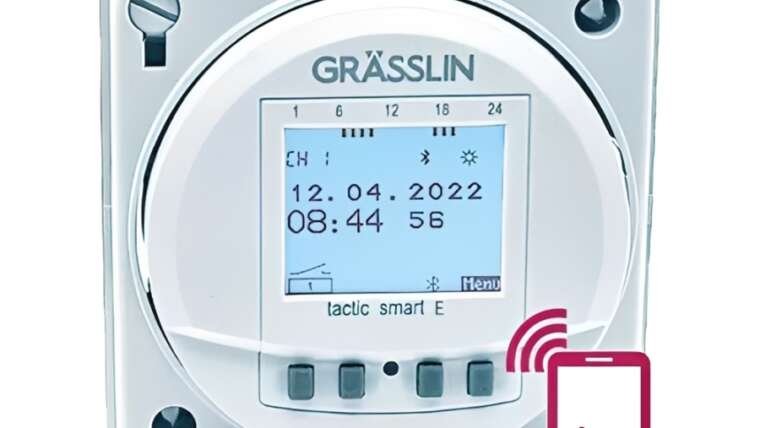
A Grasslin Digital Time Switch offers more than a simple daily on-and-off programme. It can organise routine electrical operation around weekdays, seasonal changes and particular events, giving buildings and equipment a more consistent schedule.
For facilities that need adaptable timed control, the Grasslin Digital Time Switch identified by part number 43.87.0003.1 provides a useful example. This smart E model operates from 110–230 V AC, controls one relay channel and supports Bluetooth programming through the compatible talento smart app. Its functions are especially relevant when a fixed daily timer would be too restrictive.
Start with the Schedule, Not the Switch
Before programming any time switch, map when the equipment genuinely needs to run. A school corridor, irrigation pump and retail display each follow a different pattern.
Next, decide whether the timer should be the only source of an operating command or part of a wider control arrangement. In more complex installations, occupancy sensors, thermostats or safety interlocks may need to override a simple time-based request.
Weekly and Annual Programmes for Changing Routines
Weekly schedules suit repeated patterns such as weekday opening, weekend closure or recurring cleaning periods. Annual programming adds flexibility where operating dates vary across the year, including planned shutdowns or seasonal facility use.
The tactic smart E also provides pulse and cycle functions for repeated timed events. However, these should not be confused with feedback control. A timer follows its programme; it does not know whether a room is occupied or a tank is full unless other equipment supplies that logic.
What Does Astronomical Timing Add?
Astronomical switching uses calculated sunrise and sunset rather than a fixed clock time. Because daylight changes throughout the year, this function can help match suitable outdoor operations to local light conditions without manually rewriting the programme each month.
A correct location setting and appropriate time configuration are important. Engineers should also decide whether a small offset from the calculated event is needed. For example, a walkway may require illumination shortly before dusk rather than after darkness has already arrived.
Why Clock Accuracy Still Matters
Manufacturer data for the Tactic Smart E states approximately ±0.3 seconds per day at 20°C and an eight-year power reserve.
Bluetooth setup helps with supported configuration changes, particularly when a device is installed in an accessible control enclosure. It should not be mistaken for an internet connection or a guarantee of remote access from anywhere.
Which Technical Details Shape Installation?
The following published characteristics help determine whether this single-channel device suits the job:
- Supply: 110–230 V AC, with 50–60 Hz operation.
- Output: One relay channel for controlled switching.
- Programmes: Weekly, annual, astronomical, pulse and cycle.
- Interface: Bluetooth control through the Talento smart app.
- Resistive load: 16 A at a power factor of 1.
- Inductive load: 10 A at a power factor of 0.6.
- LED load: Manufacturer-stated capacity of 400 W.
- Protection: IP20, requiring a suitable installation environment.
These are not interchangeable load figures. LED drivers can create inrush current, while motors often draw substantial starting current. The actual load, protective devices and installation method must be checked together.
Where Does Scheduled Switching Offer Practical Value?
In shared buildings, thoughtfully designed Lighting programmes can align lamps with occupancy patterns or daylight availability. Astronomical timing can be useful for external lights, provided the timer itself is housed appropriately, and the chosen circuit is correctly rated.
HVAC systems may use time windows to prepare spaces before occupation and reduce unnecessary running afterwards. Yet comfort, ventilation requirements and temperature feedback remain important. A timer can define a permitted operating period while other controls determine demand within that period.
Process Control applications may include recurring wash cycles, watering schedules or equipment availability windows. For pumps and motors, the switching stage must withstand real starting conditions; direct connection to a timer relay is not automatically suitable.
How Do You Prevent Common Scheduling Problems?
Most problems arise from mismatched assumptions rather than a lack of features. Before commissioning, review the entire operating sequence and any situations where the programme must be interrupted.
- Confirm the local time, date and daylight-saving arrangement.
- Check conflicting events and overlapping ON/OFF instructions.
- Test weekend and annual exceptions independently.
- Verify how the system behaves after a supply interruption.
- Label controlled circuits and record the approved programme.
- Confirm that necessary safety controls remain independent.
A sensible schedule can improve consistency, but automatic operation still needs supervision appropriate to the equipment. Occupants and maintenance staff should understand when machinery may start without manual intervention.
Integrating the Timer into a Control Panel
In a larger installation, Control Relays may distribute low-power commands or coordinate auxiliary circuits while appropriately rated contactors handle heavier loads.
Because the tactic smart E carries an IP20 rating, it should not be left exposed to water or harsh outdoor conditions. Consider enclosure protection, conductor routing, accessible isolation and thermal conditions before making the unit live.
Commissioning and Future Adjustments
Once installed, programme a short test cycle and observe the connected equipment switch as intended. Then review the full weekly pattern and any annual or astronomical events. Verify that a manual intervention, if provided by the system, does not defeat essential safety provisions.
Keep a copy of the schedule for future maintenance. When operating hours change, update the programme deliberately and retest exceptions instead of adding ad hoc events that might conflict.
Is This the Right Time Switch for Your Project?
The Grasslin tactic smart E is well suited to consideration when an installation needs one scheduled output, seasonal timing options and app-assisted configuration.
For other panel layouts, DIN Rail Time Switches may offer alternative installation formats and channel arrangements. A successful choice is one that makes everyday operation predictable, keeps maintenance straightforward and controls the intended load safely.