


For many small businesses, managing leads and customers has traditionally meant juggling spreadsheets, emails, notes, messaging apps, and multiple software tools. As businesses grow, this approach can quickly become difficult to manage. In 2026, more small businesses are turning to AI-powered CRM software to simplify these everyday sales and customer management tasks.
AI CRM tools are helping small teams organize customer information, follow up with leads, manage conversations, and keep sales activities moving without adding unnecessary complexity. Instead of relying on complicated enterprise systems, small businesses are looking for practical CRM solutions that are affordable, easy to use, and capable of supporting their daily workflows.
What Is an AI CRM?
An AI CRM combines traditional customer relationship management features with artificial intelligence. A conventional CRM helps businesses store customer records, track leads, manage sales pipelines, and organize interactions. An AI CRM adds intelligent assistance that can help businesses identify important information, automate repetitive activities, and determine useful next steps.
For a small business, this can mean spending less time on administrative work and more time communicating with prospects and customers.
AI CRM software can support activities such as lead organization, follow-up reminders, customer communication, appointment management, sales tracking, and simple automation. The goal is not necessarily to replace the people managing customer relationships, but to make their work more efficient.
Why AI CRM Is Becoming More Popular Among Small Businesses
1. Small Teams Need to Do More With Less
Small businesses often operate with limited employees and resources. Sales, marketing, customer service, and administrative responsibilities may be handled by the same few people.
An AI CRM can help reduce repetitive work by keeping customer information and sales activities organized in one place. This makes it easier for a small team to stay on top of opportunities without spending hours updating different systems.
2. Missed Follow-Ups Can Cost Sales
A new lead is valuable only when a business follows up consistently. However, when customer information is spread across spreadsheets, inboxes, and messaging platforms, follow-ups can easily be forgotten.
AI-powered CRM software can help businesses organize leads and create structured follow-up processes. With the right workflow, sales teams can see which prospects need attention and what action should happen next.
This can be especially useful for businesses that receive leads through multiple channels.
3. Businesses Want Simpler Software
Many traditional CRM platforms were designed with larger organizations in mind. They can offer extensive features, but small businesses may not need every advanced function.
In 2026, simplicity is becoming an important factor when businesses evaluate CRM software. Owners and small sales teams often want a system they can start using quickly without spending weeks learning complicated features.
An AI CRM designed around everyday small-business workflows can provide a more practical alternative.
4. Affordability Matters
Software costs can add up quickly for startups, consultants, agencies, and small businesses. Paying for several separate tools for CRM, marketing, appointments, and customer communication can become expensive.
Affordable CRM solutions allow smaller businesses to access essential sales and customer-management capabilities without taking on a large software budget.
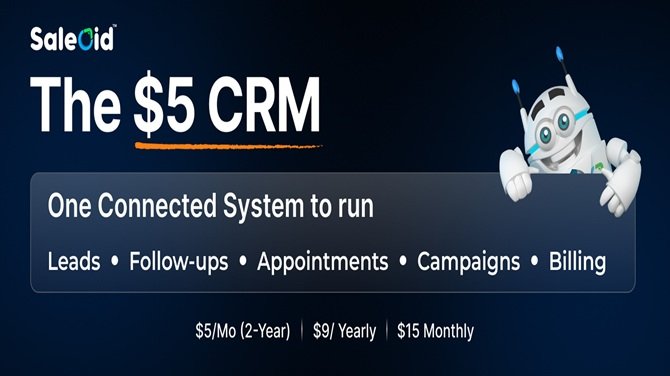
This is one reason products such as Saleoid are attracting attention. Saleoid positions itself as a $5 AI CRM built for small businesses, focusing on practical sales workflows rather than the complexity often associated with enterprise CRM platforms.
What Can an AI CRM Help Small Businesses Manage?
A useful AI CRM can bring several everyday activities together in one connected system.
These may include:
- Capturing and organizing leads
- Managing customer information
- Tracking sales opportunities
- Automating follow-ups
- Managing customer conversations
- Scheduling appointments
- Running simple campaigns
- Organizing sales activities
- Identifying important next steps
- Keeping customer interactions in one place
The biggest advantage is often the connection between these activities. Instead of managing each task separately, businesses can create a workflow where customer information moves naturally from one stage to another.
AI CRM for Different Types of Small Businesses
AI CRM software isn’t limited to traditional sales teams. Many types of small businesses can benefit from organized customer management.
Consultants can use CRM software to track prospects, schedule meetings, and manage client conversations.
Agencies can organize leads, follow up with prospects, and keep customer information accessible to their teams.
Startups can establish structured sales processes early instead of relying on spreadsheets as their customer base grows.
Solopreneurs can use automation to reduce the amount of manual administrative work involved in managing prospects and customers.
Small sales teams can use AI-assisted workflows to keep leads moving through the sales process and reduce missed opportunities.
What Should Small Businesses Look for in an AI CRM?
Choosing an AI CRM doesn’t have to mean selecting the platform with the longest feature list. Small businesses should focus on whether the software solves their actual problems.
Important factors include:
Ease of use: The CRM should be simple enough for employees to adopt without extensive training.
Essential sales tools: Lead management, customer records, follow-ups, and pipeline organization should be easy to access.
Automation: Repetitive tasks should be streamlined wherever possible.
Affordability: Pricing should make sense for a small business rather than requiring a large enterprise budget.
Scalability: The platform should be able to support the business as its customer base and sales activity increase.
Connected workflows: Businesses benefit when leads, conversations, appointments, and follow-ups can be managed within the same system.
The Future of CRM for Small Businesses
The growing interest in AI CRM doesn’t mean every small business needs a highly complex AI platform. In fact, the opposite may be true.
The most useful CRM tools are likely to be those that make technology feel simpler rather than adding another layer of complexity. AI can help turn customer information and sales activity into practical actions, while automation can reduce repetitive administrative tasks.
For small businesses, the value of AI CRM ultimately comes down to saving time, improving organization, and helping teams stay consistent with customers and prospects.
Final Thoughts
Small businesses are turning to AI CRM in 2026 because they need practical ways to manage growing customer relationships without increasing operational complexity. AI-powered CRM software can help organize leads, automate follow-ups, manage conversations, schedule appointments, and keep sales activities connected.
For businesses that want an affordable and straightforward approach, Saleoid offers a $5 AI CRM focused on the needs of small businesses. Its approach reflects a broader shift in CRM: giving smaller teams access to useful technology without requiring the cost or complexity traditionally associated with enterprise software.
As AI continues to become part of everyday business software, small businesses have an opportunity to use it not simply as a technology upgrade, but as a practical way to work smarter and manage customers more effectively.